



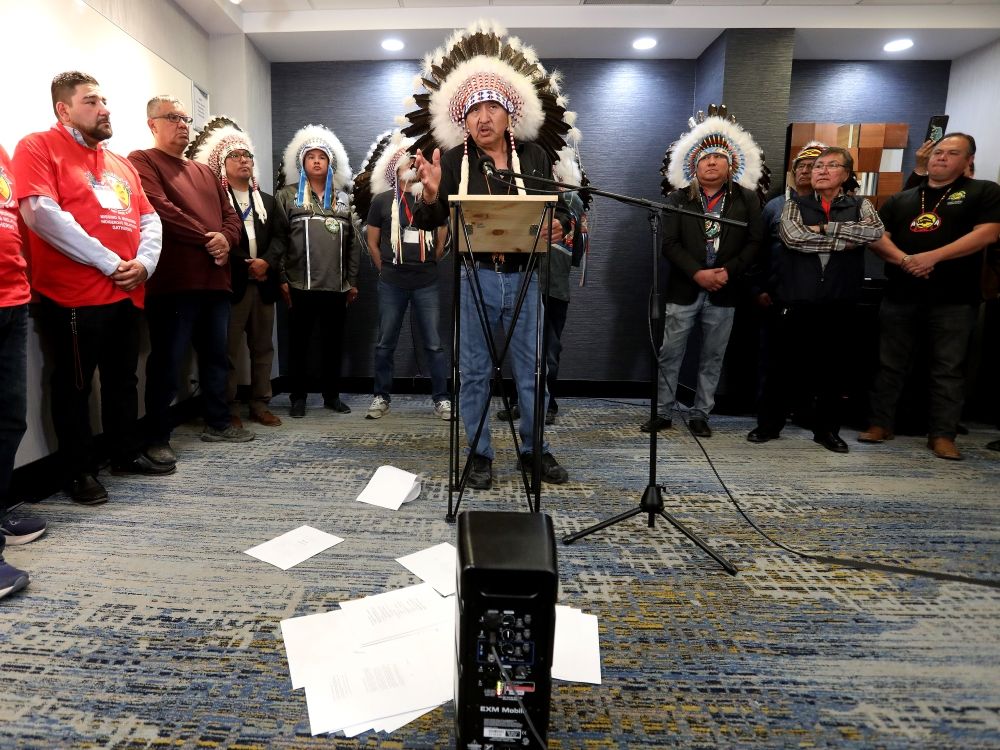
Various Indigenous leaders have complained vocally about Alberta Premier Danielle Smith’s roundabout way of engaging with the province’s separatist movement by making it easier for organized citizens to arrange for referendums.
But the moment they have me nodding along in understanding, they pull their own sovereigntist card: arguing that the numbered treaties situated in Alberta are a higher, purer form of authority; that secession talk violates treaty rights; and that treaty land is literally their property and thus untransferable.
We get statements like the one by Grand Chief Greg Desjarlais of Treaty 6, who
that Smith’s referendum-friendly amendments were a “direct violation of the Treaty relationship that exists between our Nations and the Crown,” adding, “Our Treaties are internationally binding, solemn covenants and cannot be broken by any province or political party…. These Lands were never ceded, nor surrendered.” What he meant by “internationally binding” wasn’t clear, and he certainly wasn’t correct about cessation. Treaty land is by definition ceded land — it was surrendered in exchange for benefits provided by the Crown.
Meanwhile, the Assembly of Manitoba Chiefs took greater liberties in
their view of the law, making the case that Alberta isn’t a “nation” at international law, but that First Nations are, per the United Nations Declaration on the Rights of Indigenous Peoples (UNDRIP). Provinces, says the assembly, are “administrative regions within the Canadian federation and do not possess the right to self-determination,” while First Nations have sovereignty and self-determination rights.
It’s a nearly malicious retelling of how Canada works: First Nations aren’t sovereign — they’re Crown subjects like anyone else; provinces have a large degree of self-determination power, which is detailed in the constitution. The fact that UNDRIP validates the existence of Indigenous groups around the world doesn’t make other levels of human organization illegitimate.
Similarly, the Federation of Sovereign Indigenous Nations released a
arguing that “Any process of separation that fails to honour the true spirit and intent of our treaties would violate both constitutional and international law.”
Their frustrations make sense. Constitutional protection and the stability of a long relationship with Ottawa and hammered-out expectations are worth a lot. Plus, it’s the federal government that provides funding and benefits while laying off on the thorny matters of financial disclosure. The current federal government has been generous in signing billion-dollar settlements,
one for $1.4 billion last year in Alberta.
But in voicing their arguments, they often run high on emotion. In truth, it’s incredibly hard to predict the fate of the numbered treaties and the federal responsibility for Indigenous matters in a secession scenario.
When Quebec was rushing for the exit, the Supreme Court in 1998 weighed in on the requirements for legitimate separation; the Indigenous issue was brushed upon only lightly, concluding it was “unnecessary to explore further the concerns of the aboriginal peoples in this Reference.”
Scholarship has since tried to brainstorm what secession looks like on the Indigenous front, but it’s all speculation without the real thing, or at least, a real court decision that does explore the issue further. Bradford Morse, a legal scholar and former land claims negotiator who went on to become the dean of law at Thompson Rivers University,
the what-ifs in a 1999 essay: it could be that Independent Quebec would inherit its treaties with the First Nations from the feds; it could be that Independent Quebec would have to re-negotiate them; or it could be something else. There were too many unknowns to be sure.
“Firstly, lawyers would have a field day debating the many procedural as well as substantive aspects that directly flow from secession generally, not to mention the added complexities that arise in the Aboriginal law context,” Morse concluded. “Secondly, dramatic and far-reaching arguments would be made, many of which cannot be dreamt of yet, given the uncertainties surrounding how the secession might occur and on what terms…. The last thing of which I am certain is that it will be a mess.”
Weighing in on Alberta, Dwight Newman, a constitutional law professor, Indigenous rights expert and Canada-Research-Chair-holder at the University of Saskatchewan, told me the treaties would raise “genuine issues” were the province to separate.
“It would seem plausible that there could be a state succession to a treaty…. People generally haven’t suggested that Quebec would be incapable of separating due to treaties,” he wrote in an email Wednesday.
“At a broad level, Alberta could likely take on the obligations associated with the treaties to ensure that they continue on. I do see it as appropriate that Indigenous peoples are part of the conversations.”
As for what involvement the federal government would have, Newman said that the duty to consult would be triggered “when there is a decision under contemplation that could affect Indigenous rights” — this could include early decisions and even negotiation stances. Obtaining actual consent from the First Nations for enabling separation would be ideal, he added, but he saw “little in law to say that it would be absolutely mandatory.”
The numbered treaties, however, haven’t been treated as international treaties. Newman noted that if they were, that would make everything a lot more straightforward, “as there are established rules on state succession to international treaties that have been applied in cases of secession.”
For me, it’s hard to take either side all that seriously. The most extreme parts of the Indigenous side have been arguing for ethno-sovereignty for years, embracing the freemen-on-the-land-like “land back” movement and urging for an expansion of unique treatment under Canadian law. They use UNDRIP, memetic news stories, and “reconciliation” as levers to pull for even more state benefits and permissions, and the current federal government almost never says no.
Their exaggerated understanding of Indigenous sovereignty — on display in their statements about separation — and their hold on Canadian land is voraciously lapped up by our own media, which often presents these views without counterpoints, giving them the appearance of legitimacy. Sure, they claim to love the Crown now, but just wait until it’s convenient to once again blame it for all their woes.
The Alberta separatists, too, put blind faith in the UN — in particular, a treaty that appears to guarantee port access for landlocked states (but in practice, does not). They, too, have outsized claims about their hold on these lands, drunk on nostalgia for a libertarian utopia that will never exist because the majority of the province doesn’t indeed want it. The provincial government doesn’t tell them to buzz off, and instead amends its laws to better accommodate their desires.
Though both are exercising their rights, they’re also antagonistic to the Canadian project. If only they used their voices to do something productive instead of trying to carve out bits of territory for their own.
National Post

