



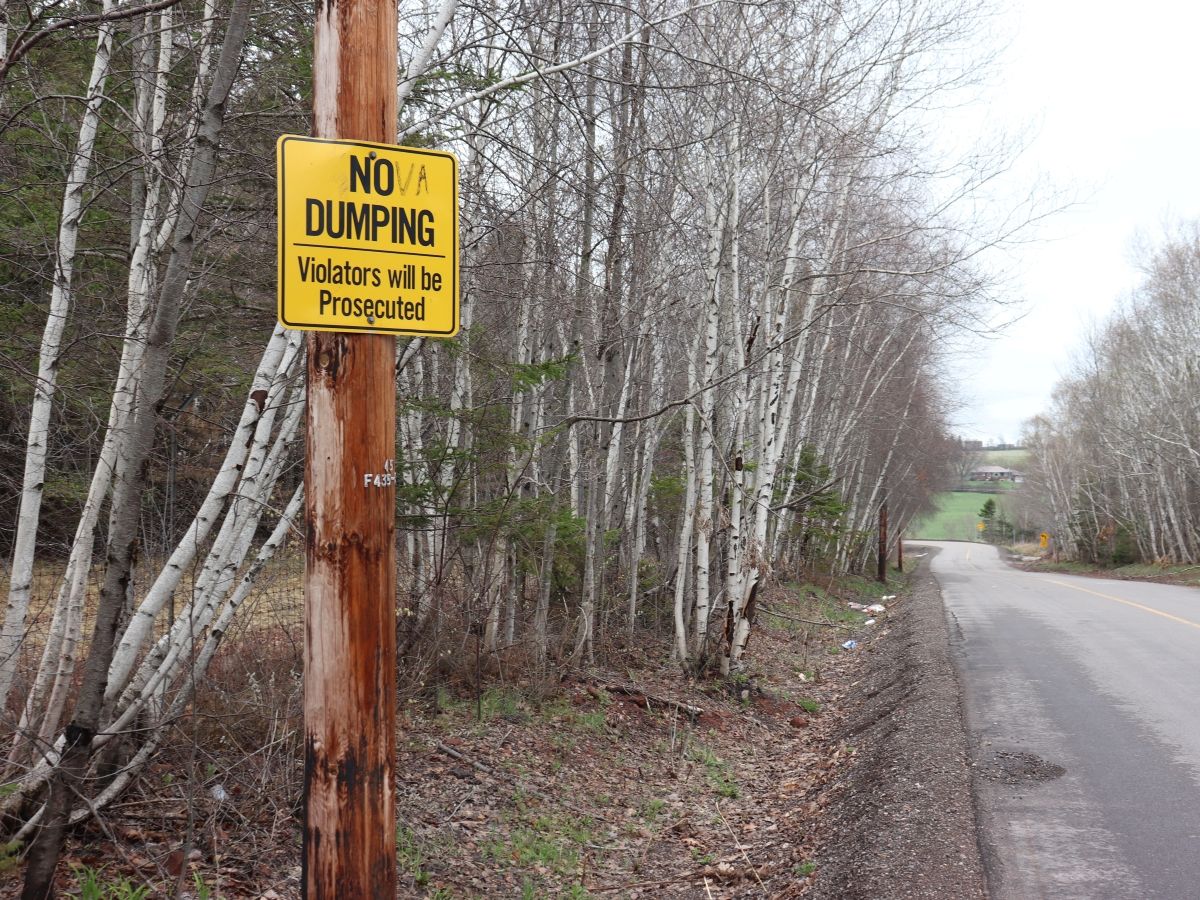
One of Alberta’s greatest Samaritans is a man who goes by the online alias “One Ditch at a Time.” He scours the countryside for illegally dumped garbage along roadsides and fencelines, documents it, names and shames whenever possible (and it’s often possible, based on how much mail gets tossed), and prepares the trash for pickup or takes it away himself.
But, as satisfying as his fight against dumping is, one can’t help but feel disappointed at just how steep this uphill battle is across Canada. This is a growing problem everywhere, and the authorities have little to say about it beyond the municipal level. Except, perhaps, in Alberta.
During a news conference last Tuesday with Premier Danielle Smith, a reporter asked whether the province was considering whether to crack down on illegal dumping — perhaps by assembling a team of officers to track down perpetrators and getting them to pay for the cleanup. Smith gave an encouraging reply: “We need to do something in the fall,” she said. Currently under consideration is a provincewide $10,000 fine and two years’ jail.
Alberta’s environmental protection law currently caps dumping fines at $250 for individuals and $1,000 for corporations.
Consultations, Smith added, were currently open. “Maybe that is too high a penalty, but, you know, I was a kid who grew up in the ’70s when we had a do-not-litter campaign, and I still, if I’m on a walk and see litter, will pick it up and put it in the garbage can.” She also said that she was open to running a new public awareness campaign against littering.
My personal feedback is that we need to go a lot further. The possibility of a $10,000 fine is not enough to deter dumpers — that’s plain enough from places where that’s already the ceiling. It was just in August that a woman caught a group of men in a work truck depositing wood chip waste onto her family’s land in Rocky View County, the region that encircles much of Calgary. There, municipal bylaws cap dumping fines at $10,000.
When a local journalist asked the county about what happened , a spokesperson said she couldn’t comment on individual cases. And there’s another problem that must be fixed under any provincial law on illegally dumping trash: anonymity. Allegations against individuals and companies need to be public. If I’m looking to hire a disposal company, or a landscaping company, or something else that can save time and money by dumping garbage where our food is grown, I should be able to properly inform my choice.
The public interest in stopping trash dumpers is immense. One of the great principles of the West is that there is an inherent dignity to green spaces that should be respected; another, of course, is private property. People who empty their garbage alongside what are usually rural roads are violating usually one, and often both. It harms wildlife; it pollutes waterways and groundwater if there’s enough of it; it can cost landowners thousands to clean up. The more normalized this is, the more backwards Canada will become. No amount of plastic-straw bans can make up for that.
The damage of letting litterbugs run wild is quantifiable, and the results are damning. In just Rocky View County, illegal dumping costs an annual $500,000 per year, and the problem is ramping up to such a degree that it’s expected to cost $1,000,000 in 2030. It’s a similar story across Canada. In 2023, dumping in Montreal nearly doubled from seven years prior (16,306 complaints to 28,441). In Vancouver, where the maximum fine is also $10,000 , there were about 22,000 reports in 2024 , similar to what it was in 2018 — not good enough, seeing how much of a reputation the area has for trash.
In Mississauga, where the maximum fine is a refreshing $100,000, there were 580 reports last year . Between 2015 and 2017, there were roughly 500 reports — which means the problem has roughly doubled in scale. And it’s not just municipalities — dumping in Markham’s Rouge National Urban Park hit record highs in 2024.
The trouble with dumping is that it’s so easy for it to go unpunished — that’s why those who do it target rural areas in particular. Farmers can’t monitor their land 100 per cent of the time, nor can locals patrol their range roads constantly, so this is what happens. The dumpers avoid paying drop-off fees, so they save a bit of cash in the process. They may even be saving money, if the cost of being caught once is worth less than however many trips they avoided taking to the dump.
Fines should be high enough to take a good bite into the cash flow of whoever is involved. They should be so high that dumping is not a viable business decision. They should be an onerous burden to individuals. They should be painful enough that, if the perpetrator is from abroad, they’ll write home and complain about how harshly Canada handles the wrongful disposal of trash. They should reflect this country’s actual abhorrence for treating nature and farmland like a dump.
We should be talking about minimum corporate fines in the thousands, capped in the six or seven figures. When oil companies leak gas into the environment, they can be fined into the hundreds of thousands , and that’s widely accepted as an appropriate punishment. We should think of rogue garbage more along those lines. As for individuals, they can often be fined into the tens of thousands for contravening environmental laws; dumping should be in that same category.
Alberta at present does not do this. There are three categories of fine under the province’s Environmental Protection and Enhancement Act . For highest-tier contraventions, the maximum is $1,000,000 for corporations and $100,000 for individuals. In the second-highest tier, the caps are $500,000 and $50,000 for corporations and individuals, respectively. In the third and final tier, which covers only garbage dumping, the corporate maximum is $1,000, and $250 for individuals.
A lot of creative tinkering could be done with this to make garbage dumping a formidable provincial offence. There’s an opportunity to make it a model for the country.
National Post