



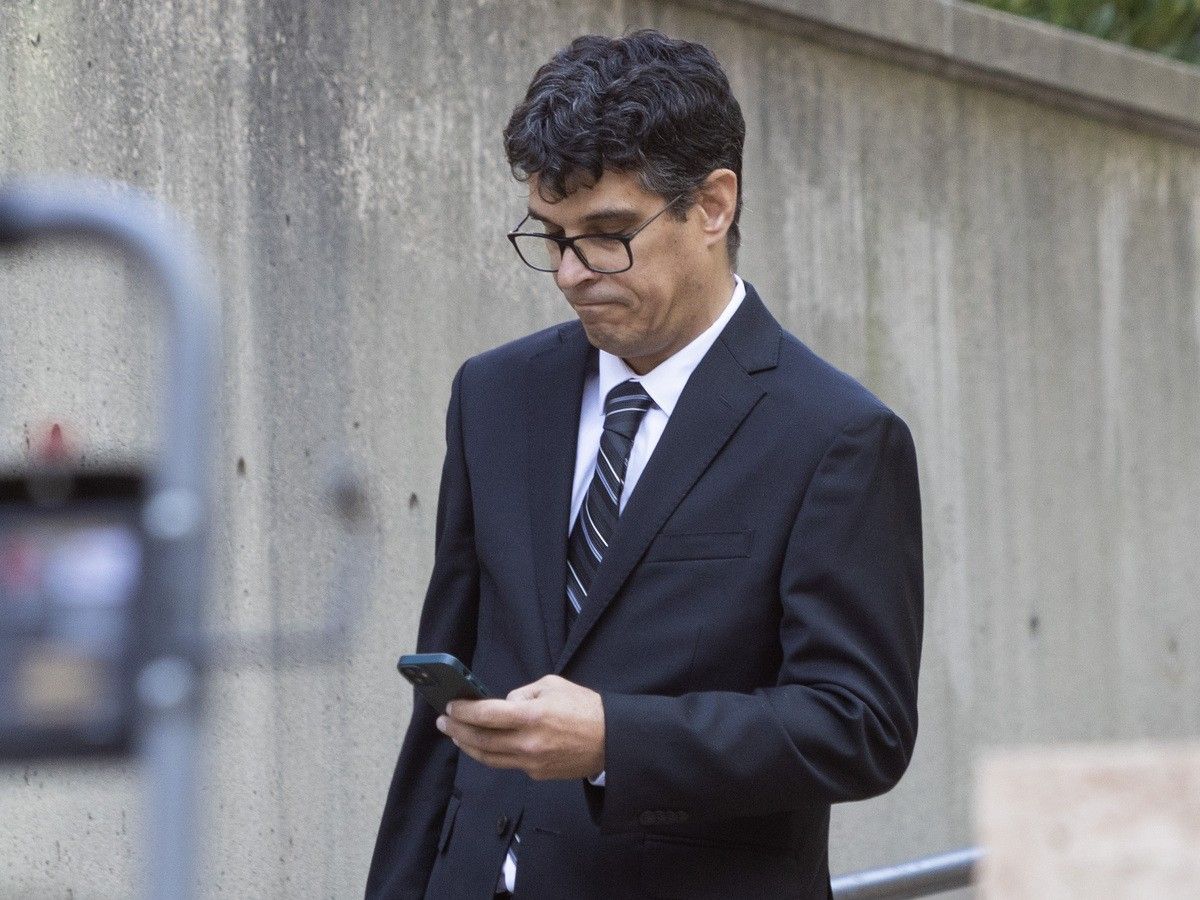
When Steven Galloway’s wife tried to tell the courtroom how the children of the household have been affected by their father’s (and stepfather’s) decade of living under unproven sexual assault allegations, her words turned into sobs.
Katie Wagner testified that, since they and the rest of the public learned of the allegations, Galloway hasn’t been able to attend events at the kids’ schools knowing that other parents had read all the stories about him. And of course, the kids know, too.
“There are newspaper reports that say something bad happened, and he was fired, and then that’s being qualitatively rewritten on platforms kids can see,” like their phones, she said.
Wagner was the first witness to take the stand Monday in the defamation trial that Galloway embarked upon to clear his name.
The once-renowned UBC professor and novelist went from being a star in his department to a pariah overnight when a former grad student in his faculty, married and senior to him in age, accused him of rape. He and the student, known to the public only as A.B., had an affair from 2011 to sometime in 2013. The relationship ended in 2013, and in July of that year — the same month Galloway met Wagner, whom he’d go on to marry — A.B. told UBC’s equity office that Galloway had raped her.
The allegations escaped containment in 2015. Galloway was suspended and later fired. At the same time, he became the subject of a media storm despite never being tried, and his career came to a halt.
A.B.’s rape claims were declared unsubstantiated by a former judge tasked with investigating the matter for UBC in 2016. Now, in 2026, she won’t be taking the stand in court to tell her side of the story or testify that her allegations are true due to mental health and suicide risk. Testifying could, in theory, keep her from losing the lawsuit, so the choice not to do so is a remarkable one.
The details of A.B.’s mental health struggles are under a publication ban, but Galloway’s are not. His wife told the court at length about the destruction their normal lives underwent after the allegations went public.
Galloway was in Ohio when he got the call that he had been accused of rape. Wagner, in Toronto at the time, testified that she took a hasty flight down and found the man in a psych hold — in a hospital gown, shaking, crying, confused, and afraid. He was looking at 72 hours in detention, but Wagner convinced the staff that she could supervise him.
The pair, still trying to figure out what was going on, experienced a final few days of relative normalcy in the United States. And then they returned to Vancouver. Wagner recounted their landline being bombarded with phone calls, their home being staked out by Global News. They retreated to Wagner’s parents’ home on Vancouver Island, where they “hunkered down” for a couple of weeks.
Wagner described Galloway as a shadow of what he once was. While he used to enjoy socializing with writers, such outings were now rare. Wagner could “only count on one hand the number of times (she) got him to go out.” There were times when he wouldn’t eat, wouldn’t sleep. He would shake, and throw up, and withdraw. Dreams about the online comments he’d read haunted him, making mornings particularly difficult. Fearing he’d commit suicide, Wagner made herself the custodian of his pills, and intervened when she found him tying rope.
Making misery worse was the cycle of hope for a restored reputation — and crushing disappointment when it didn’t happen. “He so badly wanted to clear his name,” Wagner told the court.
After the retired judge’s inquest into A.B.’s allegations resulted in a 2016 report that cleared Galloway of sexual assault, Wagner remembered another wave of disparaging comments online. There was a feeling, she said, that it was never going to end — “like Whac-a-Mole.”
The two saw another off-ramp to the chaos when a campaign calling for fair process on behalf of Galloway took off later in 2016, and author Margaret Atwood added her name to the related open letter.
“A lot of people signed it, big names like Margaret Atwood,” Wagner testified. “There was a hope that people would just stop and back off because they would have seen the light” — and that they should just be fair.
No such retreat was made. Instead, people online were calling Atwood a rape apologist.
In 2018, Galloway also won a labour arbitration award of $167,000 for “certain communications” by UBC. This, Wagner said, would have given him “a bit of hope.”
Wagner reported that Galloway was initially unable to work, but eventually found some small enjoyment from working a landscaping job, which got him outdoors. Wagner credits her family for helping them “stay afloat.”
Wagner returns to the stand Tuesday, and Galloway is set to testify next. How unfortunate that we won’t be able to hear out the other side.
National Post

