



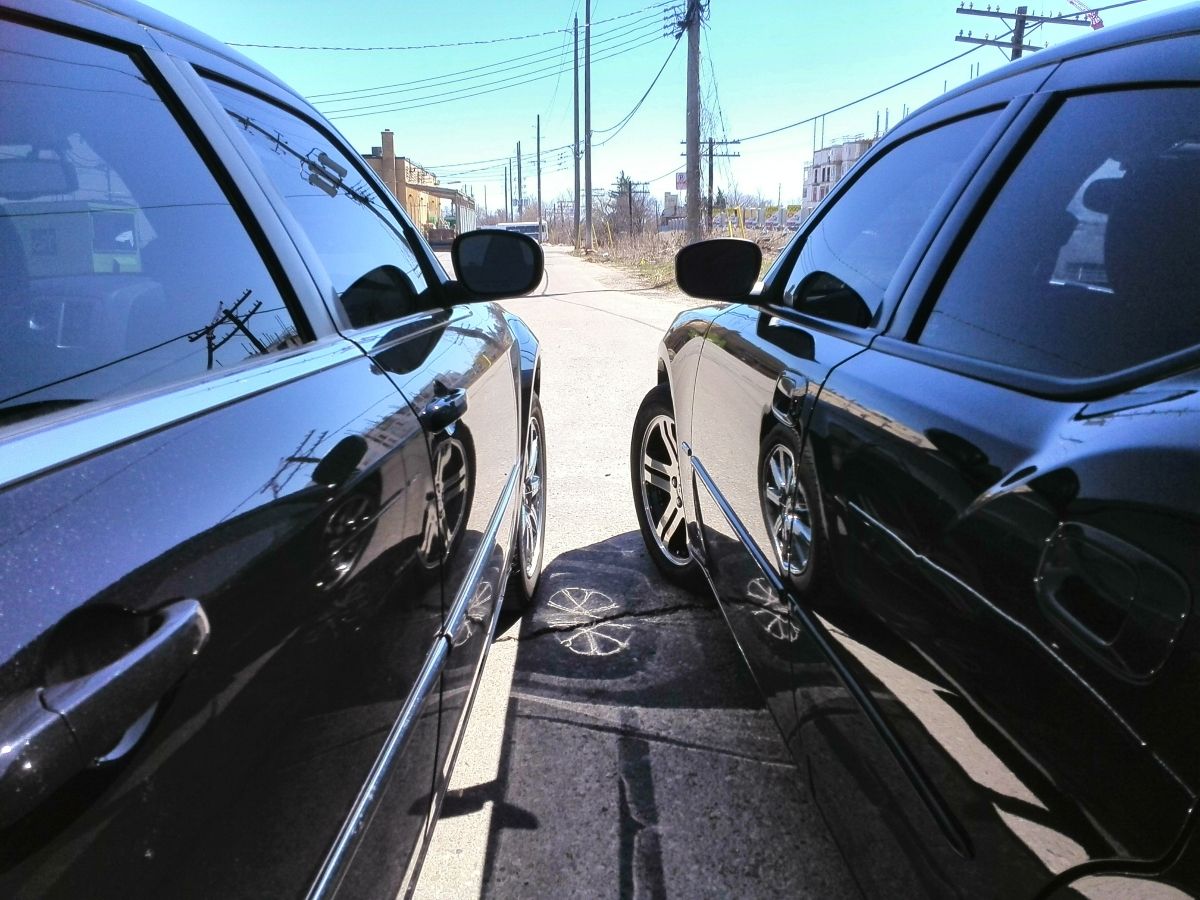
The fully tinted-out vehicle is one of the great villains of Canadian traffic. It’s more likely to drive aggressively, ripping through residential zones and weaving through high-density freeway traffic far above the speed limit. Even worse than its road etiquette is what’s inside: people, possibly wanted on warrants, along with their drugs and guns.
That’s why the opaque-windowed car is the perfect target for any province that wants to make substantive change in the fight against organized crime — without depending on the feds.
Window tint is a simple matter of traffic regulation, placing it squarely within provincial jurisdiction. And it’s regulated for good reason: completely darkened windows on the entire car reduce driver visibility and the tint can complicate extraction in an emergency. They also make the job of traffic enforcement much more dangerous for the officers on the front line. It’s a lot easier for the occupants of that tinted-out hellcat to ambush the sheriff who pulled them over if he can’t see inside on the approach.
Generally, the present rules on window tint across the provinces allow for some degree of tint in the back of a vehicle, and no tint at all in the front. But, generally, the consequences across Canada for violating these very straightforward rules are astoundingly low. In B.C., for example, the illegal tint fine is usually $109 , according to the RCMP. If the officer also makes an inspection order to ensure the tint is removed, and said order is not followed, there can be another fine of $598.
Alberta is much the same: earlier this week a tinted-out Ford Mustang whose driver had been speeding on a learner’s licence — go figure — was hit with a $105 fine for the state of the car’s windows. The minimum is $81 , and failure to remove the tint after being ordered to do so comes with a $243 fine. Ontario’s rates are similar: the fine is $85 , which comes to $110 after tacking on the victim surcharge.
It’s pretty clear why cars with all-black windows remain a common enough sight in city traffic. The fines amount to a low cost-of-doing-business charge. The benefits of heavy tint, concealing seedy business and protecting against targeted attacks from rivals, are easily worth that price.
Enforcement, meanwhile, is not happening to the degree it should be. The visible violation of a traffic rule in the form of tint does provide officers an easy justification for pulling over a probable criminal and potentially taking an illegal gun or two off the street — but at great risk. A proper, safety-conscious traffic stop of a fully tinted car is a bigger production than normal because of all the precautions that must be taken, which takes more effort and time. Judging by how frequently front window tint can be observed on the road, the juice doesn’t appear to be worth the squeeze for a lot of officers.
The good news? That calculation is easy to change. Traffic fines can be cranked up with the stroke of a pen at a moment’s notice — to $3,000, $5,000 or even, for subsequent violations, $10,000 and beyond. Seize the vehicles of those who insist on eating the massive fines.
Admittedly, this would be a pain to those who simply tint their front windows for the love of the game, but it’s not like they should have been doing that in the first place. Whatever protest they make in response to such a rule change would be worth the wrench it would throw into the criminal underworld.
Four- and five-figure fines would actually serve as a painful punishment to the people who make thousands off of moving cocaine. And with more traffic stops of a city’s sketchiest vehicles will come more criminal charges. It’s common enough that the driver is caught intoxicated or with open alcohol ; or that some vehicle occupant is in the midst of violating bail conditions , wanted on a warrant , or that the car contains illegal firearms , cash , substances or stolen goods.
One traffic stop in Ottawa in 2024 actually yielded a whopping 21 charges after an officer stopped a car for tinted front windows. He noticed an improperly stored vape pen in the front and judged this to be a Cannabis Control Act contravention; the ensuing search yielded pills, cash, white powder, a scale, a handgun, 9-millimetre ammunition. The driver, it turned out, had a history of violently robbing banks and had been previously caught robbing a Rideau Centre jewelry store. Alas, a judge ended up throwing the charges out in 2025 by declaring the search illegal, but one wonders how an appeal would have gone. In any event, the search got a handgun off the street and added to the paper trail of a notorious Ottawa criminal.
Provinces can’t amend the Criminal Code — that’s entirely up to the feds — but they can create the conditions for better enforcement by tackling what’s well within their jurisdiction instead of wasting time lobbying Ottawa for changes to criminal laws. Audit the suspicious restaurants that are obviously buying stolen meat and cheese from thieves; name and shame the trucking companies whose fleets are found to be moving drugs; come down hard on problem properties that sow the surrounding blocks with disorder. And of course, hunt down the opaque-windowed menace responsible for cutting off many a law-abiding driver. The people will love you for it.
It’s clear from their decade in office that the Liberals prefer writing ineffective reverse-onus bail provisions that don’t make a practical difference in court and engineering new ways for judges to ignore “mandatory” minimum sentences. Take it as an opportunity. There’s more pride in being the premier who roots out organized crime than being one who helplessly points to Ottawa with each brazen robbery or extortion.
National Post