



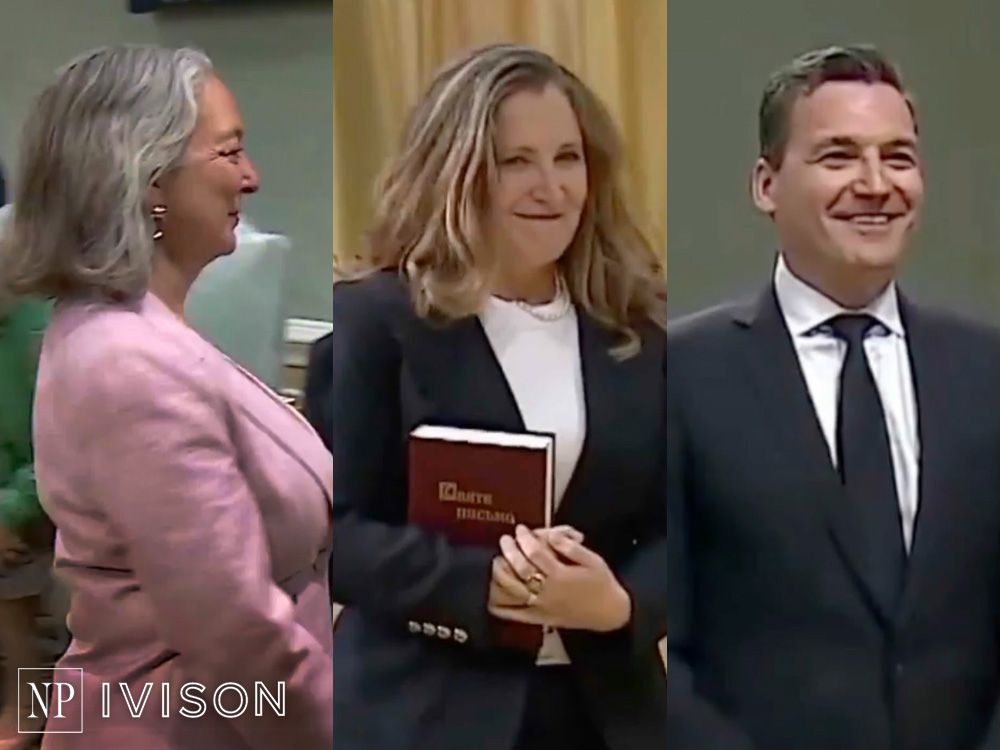
In this week’s show, John Ivison is joined by regular guests Eugene Lang and Ian Brodie to take a deep dive into Mark Carney’s post-election cabinet shuffle.
Brodie, a former chief of staff to prime minister Stephen Harper, said one concern he has is the predominance of “downtown Toronto, urban progressives” in the new cabinet.
“It’s an almost obsessively Toronto-focused cabinet,” he said, noting that excluding the one Liberal elected in Calgary (Corey Hogan) was a “missed opportunity”.
Brodie said that new natural resources minister Tim Hodgson is an improvement on his predecessor (Jonathan Wilkinson).
“But the problem is not that the Natural Resources department has been standing in the way of natural resource development in this country; the problem has been the environmental regulations that come out of the Environment Ministry. The Environment Ministry is huge now and much larger than it was 10 years ago. It has many more levers over the Canadian economy and the people in the Environment Department seem to be quite prepared to use all of them. The fact is that we have basically, to be blunt, the kind of a standard issue, downtown Toronto, social justice activist, kind of do-gooder, NGO type person as minister (Julie Dabrusin).
“There is a long history of ‘we have to keep oil and gas in the ground and keep Alberta and Saskatchewan from growing if we’re going to save the planet’. If that’s the approach of the government, then we’re in for a very difficult couple of years.”
Lang, a former chief of staff to two Liberal defence ministers, said his first impression is that there are far too many Trudeau-era ministers in this cabinet.
“I count 11 out of 28 – about 40 per cent of this cabinet are former Trudeau-era ministers. There is no reason for that. Mr. Carney owes none of these people anything. And he had an opportunity here to really show change in this cabinet, and he chose not to,” he said. “It’s more than about optics. It’s about competence. The last Trudeau government’s great failing was its relative lack of competence in governing. I don’t know how you improve the competence in your governing when 40 per cent of your ministers are from a government that was less than competent.”
Brodie said that, while the cabinet does look like a rearrangement of the chairs of people Carney inherited, there is “deep experience” on the front bench with ministers like Dominic LeBlanc on the Canada-U.S. trade and security file.
Lang took aim at the appointment of 10 secretaries of state, who will report to ministers on specific files (for example, Ruby Sahota has the responsibility to combat crime, reporting to justice minister, Sean Fraser).
“There seems to be this sort of narrative going around that secretaries of state are people that you can get focused on a specific issue within a portfolio and deliver results. That’s nonsense in my experience. I once worked for a secretary of state a long time ago. One of the biggest challenges a secretary of state has in the Canadian government is getting senior officials in their department to return their calls. There is a real competition here that goes on between secretaries of state and ministers and their offices. Secretaries of state have no legal authorities. They usually have no program authorities. I can’t think of a secretary of state in the long history of our secretaries of state that has meaningfully advanced an important file in government. I’ve never seen it,” he said.
Carney has said he is bringing back a more traditional cabinet-style government.
Lang said that every prime minister in recent history has said this – and none have.
“I think the last time we had a functioning cabinet government in the old sense was probably under (Jean) Chrétien 30 years ago. (Carney) says he wants to run a team. He says he’s going to empower ministers. Well, we’ll see,” he said.
Lang said that reorganizing ministries and creating new agencies is going to require “a lot of legislative bandwidth.”
“(The Liberals) made an election platform commitment to create a new organization called the Defence Procurement Agency. That sounds innocuous. It’s not. That’s a massive, complex machinery of government change, involving three or four departments. And it’ll be interesting to see if they even have the stomach to try and carry that out in a minority government context. Machinery of government changes, in my view, rarely yield the claimed benefits. They tend to be very painful things to execute. They tend to take years, if not decades. So, one wonders whether we’re stuck with the basic structure we have, whether we like it or not, because of the pain and the effort that’s needed to make major changes,” he said.
Brodie talked about the need to reform the bureaucratic side of government
“The next step ordinarily would be a reorganization in the Privy Council Office, the central agency closest to the prime minister that sends out the instructions to the rest of government and checks to make sure whether anybody’s paying attention to those instructions, he said, noting that reform would include the deputy minister cohort.
“In my view, it’s not so much that the deputy minister group is weak. I know there are some very good people there. (But) it’s just way too big. There are a bunch of fake deputy ministers floating around – people with high falutin titles and pay scales, all the accoutrements of the deputy minister group, all the status in Ottawa that comes with the title ‘deputy minister’, like being the viceroy of some central Europeans satrapy during the Holy Roman Empire.
“It’s a big deal when you go to the Rideau Club as a deputy minister, unless you’re the deputy minister of something that doesn’t really exist and your staff is four or five people stuck away in some obscure office building. And Ottawa is full of them. Frankly, the Privy Council Office itself is full of them. If I were advising on transition or on the machine of government, I would say the next step is to just get rid of that and streamline your senior civil service team in order to focus authority on a handful of people who can make things work for you.
“Mr. Carney knows all these people. They all know him. He’s as well placed as any new prime minister is to make changes in this group and I expect there’ll be big changes. But if he doesn’t make them between now and the end of parliament, you’re wasting the summer opportunity for new deputies, new ministers, and a streamlined team to get things moving for the fall session of parliament. He cannot waste the summer with ministers not knowing exactly what they’re supposed to do or with deputy ministers worried about whether they’re going to be shuffled in August or September.”
Lang agreed, saying the same principle applies to assistant deputy ministers (the next rung down in the public service).
“You could blow out 40 per cent of the assistant deputy ministers in this town and no Canadian would notice. The Privy Council Office, the prime minister’s department, has 1,400 officials working in it. Now when Ian was in the Prime Minister’s Office, there were 700 people working there. When I was in government, before that, there were 400 people working there. You could cut that organization in half tomorrow and nobody would notice,” he said.

