


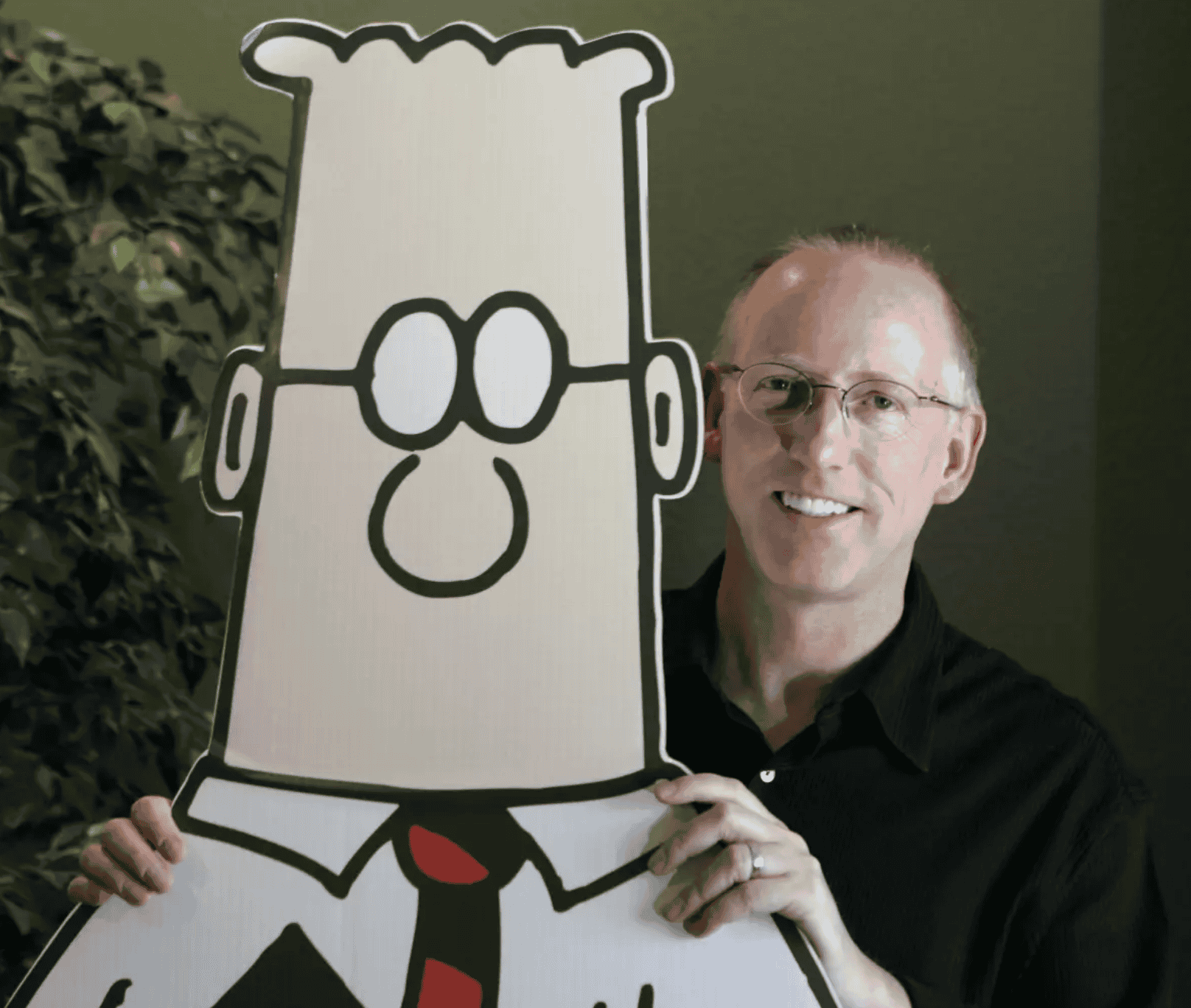

Scott Adams passed away on Tuesday at age 68. The popular cartoonist who became a political pundit (of sorts) revealed last May that he had been diagnosed with metastatic prostate cancer. The prognosis wasn’t good, and he only had a few months to live.
“I have the same cancer that Joe Biden has,” he said on his daily podcast, Real Coffee with Scott Adams. “I also have prostate cancer that has also spread to my bones, but I’ve had it longer than he’s had it — well longer than he’s admitted having it. I expect to be checking out from this domain sometime this summer.”
As fate would have it, he walked among us even longer than expected. It gave him more time to draw cartoons, speak on his podcast, and meet new friends and admirers.
Adams was born in Windham, New York on June 8, 1957. He loved comics at an early age, including Charles M. Schulz’s Peanuts. He was a talented artist who won a drawing contest at age 11. While he initially worked in banking, computers and economics, he woke up at 4 am every morning before heading to his job at Pacific Bell in hopes of building a new artistic career.
It was this ambition and drive that led to the launch of Dilbert on April 16, 1989. His comic strip focused on the aforementioned Dilbert, an engineer in a white-collar office environment who regularly suffered from micromanagement and macro-frustration. It was a massive success, appearing in 2,000 newspapers in 65 countries and 25 different languages in 2013. Adams won two National Cartoonists Society awards in 1997 (Best Newspaper Comic Strip and the prestigious Reuben Award), and an Orwell Award in 1998.
The Dilbert franchise was wide and varied. Adams wrote many books, including The Dilbert Principle and The Joy of Work. There was plenty of merchandise, from toys to coffee mugs. A video game, Dilbert’s Desktop Games, was released in 1997. There was a short-lived animated series, Dilbert, that ran on UPN for two seasons and won an Emmy for outstanding main title design in 1999.
If Adams’s career had solely revolved around Dilbert’s cartoon world, it would have been fulfilling in its own right. Yet, his life took an unexpected turn when he became a free speech advocate, pundit and vocal supporter of Donald Trump.
There were early signs of Adams exhibiting an independent political streak. “No reasonable person doubts that the Holocaust happened,” he blogged on Oct. 8, 2006, “but wouldn’t you like to know how the exact number was calculated, just for context?” That post could have easily sunk his career, but it was deleted and mostly went under the radar.
There was also his April 20, 2011 blog post that called Trump a “magnificent bastard” and endorsed him for President. He appreciated Trump’s decision to side with the birthers against then-President Barack Obama and believed the billionaire businessman “knows that no level of clownery in a field of clowns will single him out as the one clown that doesn’t really mean it.” Adams wrote additional blog posts about Trump’s “persuasive skills” when he finally ran for the presidency and suggested “none of his campaign success so far is an accident.”
Adams’s political leanings were all over the map. He described his social views as “libertarian, minus the crazy stuff” in 2008. He endorsed Mitt Romney in 2012, and supported Trump in 2016 as a “master persuader.” He even described himself as “left of Bernie [Sanders], but with a preference for plans that can work” in 2017.
His most controversial moment occurred during an analysis of a Feb. 2023 Rasmussen Reports poll. It included this question, “Do you agree or disagree with this statement: ‘It’s OK to be white.’” The poll found that only 53 percent of Black respondents agreed with this phrase. “If nearly half of all Blacks are not OK with white people – according to this poll, not according to me, according to this poll,” Adams said on his podcast, “that’s a hate group…And I don’t want to have anything to do with them. And I would say, based on the current way things are going, the best advice I would give to white people is to get the hell away from Black people. Just get the fuck away. Wherever you have to go, just get away. ‘Cause there’s no fixing this.”
When this clip went viral, Adams was widely denounced as a racist. Hundreds of newspapers dropped Dilbert. His distributor, Andrews McMeel Syndication, severed ties and Portfolio wouldn’t publish his forthcoming book. Although he tried to explain that this was a misinterpreted example of hyperbole and disavowed racism, it was too late.
Incredibly, Adams survived a controversy that would have destroyed the reputations of most people. How did he achieve this? By being honest, forthright and impactful in his views and values. He also proved that the noise and nonsense of his (mostly) left-leaning critics was just that.
Real Coffee became a popular feature on YouTube, Twitter/X, Periscope and Rumble, and he offered paid subscriptions on Locals. He invited prominent guests like Greg Gutfeld, Stephen Hsu, Bjørn Lomborg and Dave Rubin. He self-published Dilbert and several books. He appeared on radio, podcast and TV shows. He remained on friendly terms with Trump, visiting him in the White House and received help from the President for his medical condition, as confirmed by Health Secretary Robert F. Kennedy, Jr.
Adams became a political pundit who straddled conservatism and libertarianism, albeit in a rather unconventional manner. Real Coffee switched to the Scott Adams School when his health got worse. He converted to Christianity in his final days, in spite of not being a believer, out of respect for his Christian friends and the “risk-reward calculation.”
“I tried to be useful,” Adams wrote on X to @PersuasionSays on Jan. 6. It’s fair to say that this fascinating individual succeeded more than he could have ever imagined. Rest in peace.
Michael Taube, a long-time newspaper columnist and political commentator, was a speechwriter for former Canadian prime minister Stephen Harper.

