


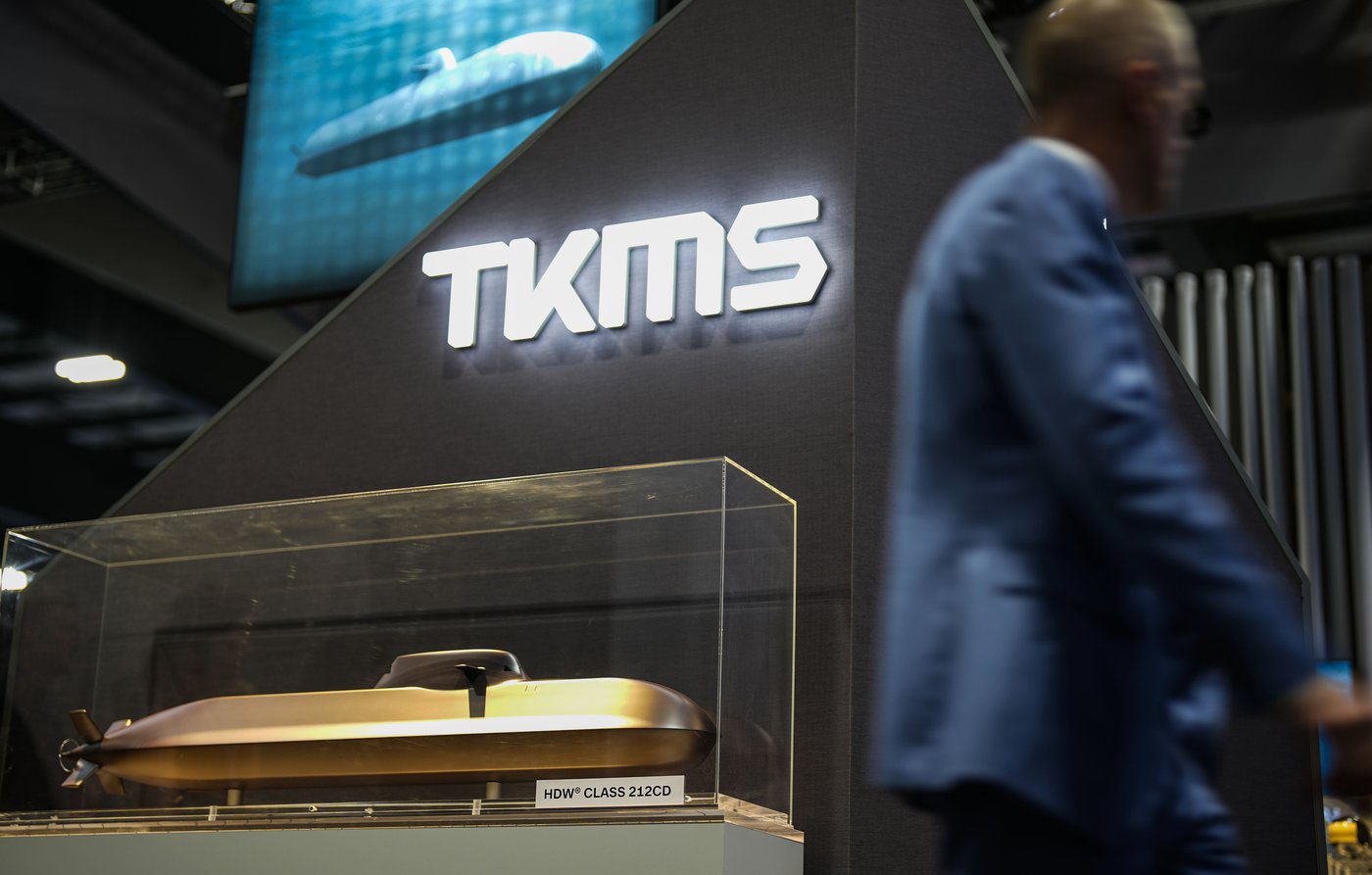
OTTAWA — Prime Minister Mark Carney’s Liberal government is set to name Germany’s ThyssenKrupp Marine Systems as the preferred bidder to build the navy’s next fleet of submarines, according to multiple media reports.
That means Canada will now enter into months of closed-door negotiations with the winner.
TKMS had been competing with South Korean defence firm Hanwha Ocean for the lucrative contract.
Here’s a quick look at what is behind this major military purchase.
What is the Canadian government buying?
Canada intends to buy the 212CD submarine, joining a German-Norwegian partnership. The vessels are made by TKMS, a German company that has supplied the vast majority of NATO’s conventional submarine fleet.
These submarines are similar in size to the current Victoria class; the 212CD measures about 74 metres long and 13 metres high. They’re designed for a crew complement of about 28 sailors, though they have extra room for more crew.
While the 212CD is a new design that has yet to roll off assembly lines, it will be produced by an experienced exporter of submarines.
Its hull is shaped like a diamond in cross-section, something the manufacturer says will increase its stealth profile and make it harder to detect by sonar.
A key selling point for these subs has been that the German and Norwegian navies will be using the same boats, and can share crew, supplies and expertise.
Norway also has offered up its own design schematics for Canada to copy when it builds submarine facilities.
Why does Canada need to replace the existing submarines?
Canada’s four Victoria-class submarines are set to retire from service by 2035.
The federal government bought those submarines, built between the late 1980s and early 1990s, second-hand from the United Kingdom. By 2035, the oldest of the fleet, HMCS Chicoutimi, will be 52 years old.
Military experts say submarines are an effective deterrent due to their stealth and can block foreign vessels from entering Canadian waters.
The subs Canada is buying — and the ones it’s replacing — are conventional diesel-electric submarines, not nuclear-powered subs.
Canada has looked into acquiring nuclear submarines a few times in the past. Ottawa has always ended up dropping the idea because of the significantly higher costs and other challenges associated with owning complex, nuclear-powered vessels.
The new subs are more like hybrid cars and will rely on lithium-ion battery systems and hydrogen fuel cells. They use new technology called air-independent propulsion to generate power underwater.
This feature can significantly extend the duration of missions by extending the time a sub can go without surfacing to vent exhaust — a manoeuvre which can give up a submarine’s position.
When will Canada get its new subs?
TKMS has said it can deliver four subs by 2036, with a sub delivered in each of 2032, 2033, 2035 and 2036.
That had to be negotiated with Germany and Norway, which are also waiting to get their hands on 212CD subs for their own navies.
The estimates of future economic benefits provided by the firms and their delivery schedules are data points Canada can use down the road to work out whether the deal lived up to the promises.
Hanwha promised the fastest delivery schedule — four subs by 2035, then a submarine each year afterward, meaning Canada would get its full fleet by 2043.
It has said this would help Ottawa retire the Victoria class early and save the government about $1 billion on maintenance and support costs.
Why aren’t the subs being built in Canada?
It wasn’t entirely out of the question. TKMS, for example, had suggested Canada could manufacture some domestically. That would have to happen in the latter part of the contract, though, due to logistics and delivery timelines.
But Canadian shipyards have not built submarines since the First World War. Experts say tooling up industry to build them would come with a hefty price tag. Canada is also ordering too few submarines to make domestic production economically viable over time. Building them domestically also would likely throw off delivery timelines.
While the navy has said it wants to purchase submarines off-the-shelf from another country, it has meanwhile expressed a desire for domestic shipbuilders to build a made-in-Canada replacement for the Kingston class ships.
Which other Canadian firms will be involved?
Hanwha signed more than 80 industrial and government partnerships, most of which took the form of memorandums of understanding — handshake agreements to collaborate.
The Hanwha agreements that have received the most attention are proposed partnerships to offer a lifeline to tariff-hit industries — Algoma Steel in northern Ontario and auto-parts makers in southern Ontario.
Hanwha also reached agreements with other Canadian firms, including PCL Construction, BlackBerry, L3Harris and Ontario Shipyards. Babcock Canada, which serviced the Victoria-class subs, has an agreement for in-service support for the KSS-III.
Hanwha also has agreements with satellite technology firms MDA Space and Telesat.
TKMS, meanwhile, signed more than 18 partnerships with Canadian companies — far fewer than Hanwha.
TKMS has said it is focused on the quality of the partnerships — and even pointed out it refused many such offers that would not be good fits. It also said several key partnerships that formed part of its confidential bid have not yet been made public.
Some of its public partnerships include deals with EllisDon, Marmen and Seaspan. General Dynamics Mission Systems-Canada would support TKMS’s plans for a research and development centre focused on underwater surveillance technology.
Some Canadian companies partnered with both bidders.
They include: Quebec-based CAE, which provides simulation and training equipment; Mississauga-based Magellan Aerospace; Ottawa’s Gastops, which is part of the F-35 supply chain; and the Toronto-based AI firm Cohere.
Both submarine makers struck agreements with Canadian firms involved in lithium production for batteries, and both announced Indigenous partnerships as well.
This report by The Canadian Press was first published July 6, 2026.
Canadian Press Staff, The Canadian Press

