




First Reading is a Canadian politics newsletter curated by the National Post’s own Tristin Hopper. To get an early version sent directly to your inbox, sign up here.
TOP STORY
In Canada, you can shoot, stab and bludgeon an intruder who comes into your home with hostile intentions, and the legal system will almost always determine that you didn’t do anything wrong.
But the problem, according to self-defence advocates, is that this determination often only comes at the tail end of a ruinous and years-long legal battle.
“Self-defence in Canada; yes, it most certainly exists, but it exists as a defence at trial, as opposed to a discretionary act that the police have in determining whether or not to press charges in the first place,” Toronto-based criminal defence lawyer Jordana Goldlist explained in a recent episode of her podcast, Who Judges the Judge?
In other words, it’s very rare that a Canadian jury will convict a homeowner who has killed or injured a home invader. But that acquittal may only come after an odyssey of arrest, bail denial and six-figure legal bills.
This week, a 44-year-old man in Lindsay, Ont., Jeremy McDonald, was charged with aggravated assault against an alleged home intruder who was wanted by police at the time. The charge sheet against McDonald accused him of turning a knife on the man.
“My client was doing what anyone would do if they were in his situation of a home invasion,” McDonald’s lawyer said in a statement to the press.
The case has become a cause célèbre among Canadian conservative politicians, with everyone from Conservative Leader Pierre Poilievre to Ontario Premier Doug Ford denouncing the charge as overreach.
“You should be able to protect your family when someone’s going in there to harm your family and your kids, you should use all resources you possibly can to protect your family, and maybe these criminals will think twice before breaking into someone’s home,” Ford told a recent press conference.
‘It’s pretty straightforward’: Danielle Smith objects after Ontario man charged with assaulting home intruder https://t.co/agF8SdB0qU pic.twitter.com/uZ347Bfnbs
— National Post (@nationalpost) August 22, 2025
But the experience of McDonald is not atypical.
In 2023, Milton, Ont., man Ali Mian was arrested and charged with second-degree murder after using his legal firearm to shoot and kill a home invader.
The charges were dropped five months later after Crown prosecutors determined there was no reasonable chance of conviction, but in the interim Mian had been forced to surrender his passport and firearms license and live with his grandmother as a condition of his bail release.
“It’s taken quite the toll on him. It’s been a very difficult time,” Mian’s lawyer told CBC upon the charges being dropped.
In 2019, Cameron Gardiner shot and killed two home invaders with their own gun. He had been tied up by two masked burglars who had kicked in the front door, and was able to free himself only after his 19-year-old son was able to surprise the invaders and intervene.
Charged with second-degree murder, Gardiner would spend two years bound by bail conditions until the charges were dropped.
“It’s good to be free. I’m happy to be alive. It’s overwhelming, ’cause I thought I was going to spend the rest of my life in jail,” he told Postmedia at the time.

In 2017, Nova Scotia man Brad Evans was surprised by two masked home invaders who forced him to lie on the floor at gunpoint. Evans managed to fight back, seize the weapon, and fire at the fleeing invaders, injuring one. He was hit with three gun charges, including “reckless use of a firearm,” before prosecutors ultimately dropped them a year and a half later.“
“I’m glad someone over there at the Crown finally had some common sense, but it should have happened way sooner,” Evans told The Chronicle-Herald at the time, expressing gratitude that he hadn’t taken a plea deal of merely pleading guilty to a charge of “pointing a firearm.”
“I’m fighting for my life and you have the audacity to charge me for pointing a weapon at these people — their own weapon?” he said.
In 2016, Newfoundland man Gilbert Budgell was charged with second-degree murder after shooting and killing a masked home invader. The charges wouldn’t be dropped until 17 months later, with prosecutors declaring they wouldn’t be able to prove guilt beyond a reasonable doubt.
Even in cases where charges proceed to trial, it is very rare for a jury to convict if the accused was facing an unsolicited violent threat in their home.
One of the more obvious examples of this phenomenon occurred in 1991, when Quebec man François Guerin opened fire on two robbers who were running away from his wife’s convenience store, killing one (he lived in an apartment over the store).
The charge was only criminal negligence causing death, but the jury threw it out anyway.
Written Canadian law states that a violent act is not a crime if a person does it for “the purpose of defending or protecting themselves,” and the act is “reasonable in the circumstances.”
In term of what constitutes a “reasonable” act of violence, the Criminal Code includes a long list of potential caveats, including whether the accused had “other means available” to respond to a violent threat, whether they knew the person threatening them, and even the “size, age, gender and physical capabilities” of both parties.
Meanwhile, there are strict curbs on what can actually be used for self-defence in Canada. Carrying any kind of self-defence weapon in public is illegal. As for Canadian firearms law, one of the ways it differs most sharply from U.S. law is that it has no provision for gun ownership as a means of self-defence.
Guns in Canada can be owned for hunting and target practice, but aside from a handful of unique exceptions, they can’t be possessed as an explicit means of personal protection. A homeowner can still use their firearm to shoot a home invader, but in the same way as a kitchen knife or a lamp; an incidental self-defence weapon that just happened to be at hand.
Another thing muddying the legal waters is that self-defence is frequently claimed by legitimate murderers. If police attend a scene where someone has just been killed to settle a drug debt, chances are good the killer will claim they did it to protect themselves.
“Acting in self-defence is one of the most common defences or justifications pleaded in court against a criminal charge, particularly charges of a violent nature,” reads a write-up by the Toronto law firm Hicks Adams.
Quebec man Jacques Cinous, for instance, went all the way to the Supreme Court in 2001 with the claim that he had only shot a criminal accomplice in the back of the head at a Montreal gas station because he believed the accomplice had been readying to kill him. The Supreme Court didn’t buy it, stating in a ruling that Canadian self-defence law didn’t allow “preemptive killings within a criminal organization.”
All of this means that there is a lot of wiggle room on whether police or prosecutors will decide to pursue charges in cases where they attend a scene with a dead body on the ground, and a homeowner tells them it was an intruder.
In 2012, Mississauga homeowner Mike Vrga faced no charges after tackling an armed home invader and killing the man with his own gun. In 2021, no charges were laid against a Red Deer man who shot a home invader who had begun attacking him with a baseball bat.
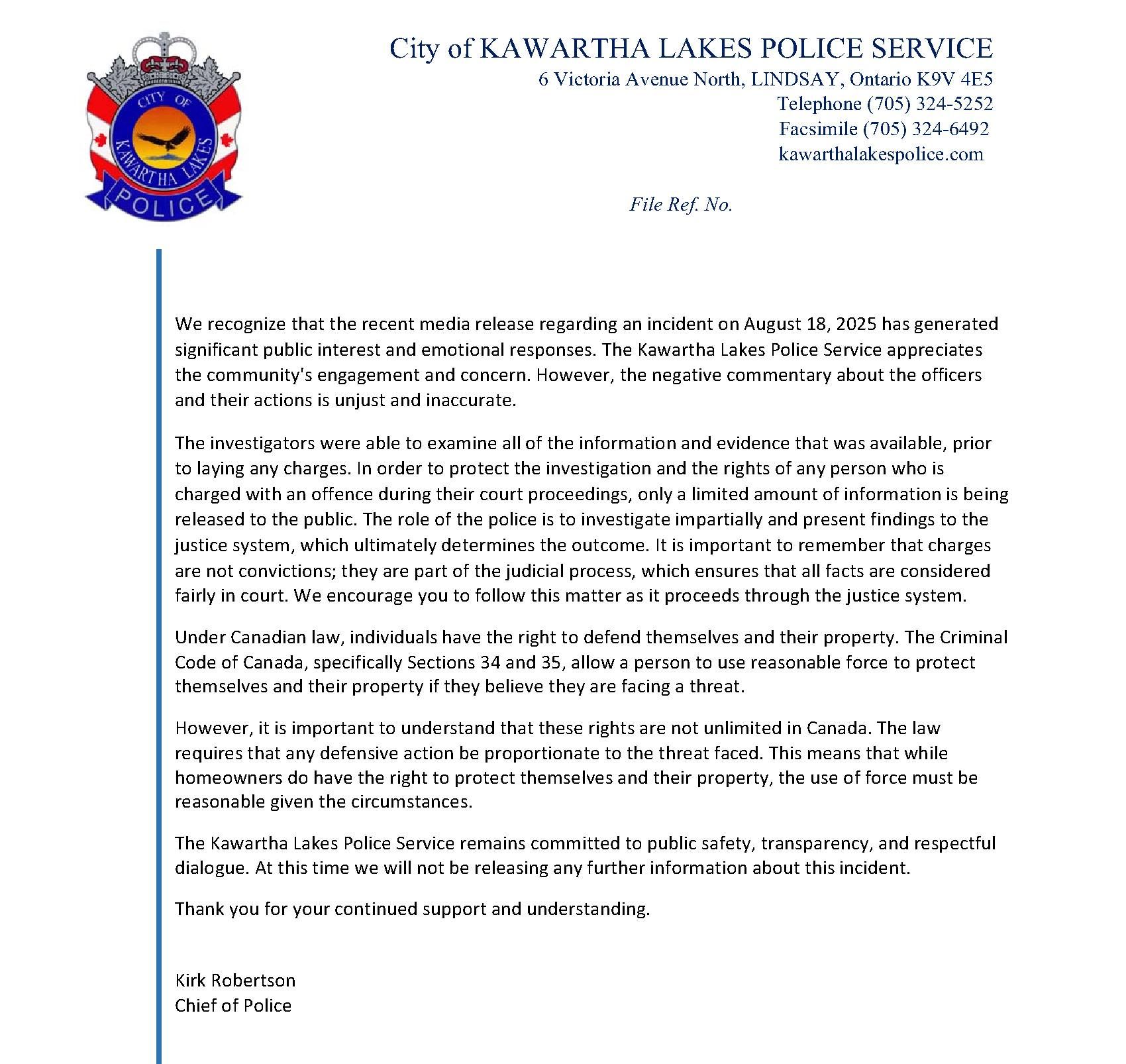
The Kawartha Lakes Police Service is providing very few details of why officers believe McDonald deserves an assault charge, responding to public criticism by saying that “the law requires that any defensive action be proportionate to the threat faced” and urging critics to “follow this matter as it proceeds through the justice system.”
IN OTHER NEWS
Prime Minister Mark Carney’s signature campaign pitch during the 2025 election was the hockey term “elbows up,” a reference to how he pledged to take an aggressive approach to U.S. tariffs. But after a tenure defined largely by
concessions to the United States
, Carney said this week that the “elbows up” era is over, and dropped almost all Canadian counter-tariffs. Carney told reporters that while throwing elbows is fine, “there’s also a time in the game when you want the puck, you want to stick-handle, you want to pass, you want to put the puck in the net.” U.S. President Donald Trump, meanwhile, continues to have nothing but good things to say about Carney; a rare occurrence for any centre-left world leader. “I like Carney a lot; I think he’s a good person,” Trump told an Oval Office press scrum on Friday.
Get all of these insights and more into your inbox by signing up for the First Reading newsletter.