



First Reading is a Canadian politics newsletter curated by the National Post’s own Tristin Hopper. To get an early version sent directly to your inbox, sign up here.
TOP STORY
Once again, a potential Canadian massacre appears to have been halted within seconds of disaster by the quick actions of police.
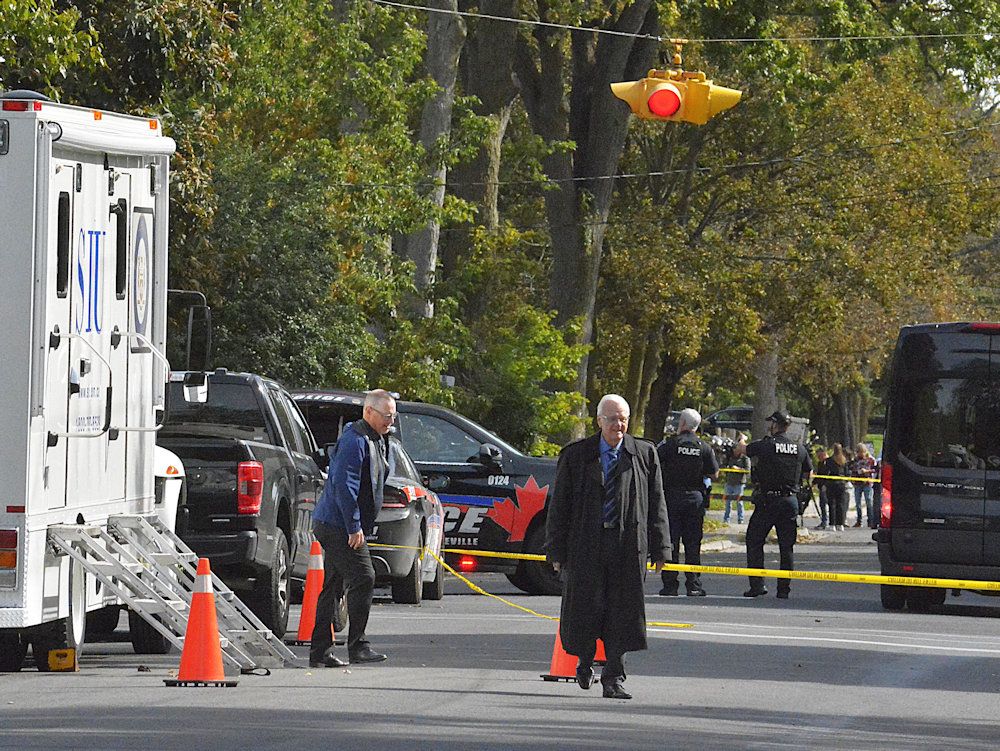
On Sunday night, congregants at a Yom Kippur service at a Belleville, Ont., synagogue dropped for cover at the sound of gunfire outside the building.
Multiple witness accounts described one large boom, likely from a shotgun, followed quickly by pops, possibly from a pistol.
The next day, investigators revealed that a gunman had opened fire on a Belleville Police Service officer with the apparent intention of then turning his gun on the approximately 25 congregants massed in the Sons of Jacob synagogue.
Instead, the wounded officer, Const. Jeff Smith, was able to return fire and hold back the attacker. In conjunction with a second officer who scrambled to the scene, Smith was able to subdue the shooter, who was hit multiple times.
Jeff Smith is a real hero.
A Belleville Police officer who put himself in harm’s way protecting our community.
Please pray for Jeff, his family and his fellow officers.
Our community is behind you, Jeff. Stay strong. Keep fighting. Come home to your family. pic.twitter.com/7tBeWH0C4T
— Ryan Williams 🇨🇦 | The Competition Guy (@Ryan_r_Williams) September 21, 2026
“It’s believed that the individual came in a truck and he had a shotgun and he discharged his firearm at a police officer,” Kristy Denette, a spokesperson for Ontario’s Special Investigations Unit, told reporters.
Denette added that it was “common sense” to suggest that the shooter had targeted the officer as a prelude to attacking the synagogue.
Police identified the suspected gunman as 29-year-old Sean Ward of nearby Quinte West.
The response to the Sons of Jacob incident is reminiscent of a 2017 ISIS-inspired terror attack in Edmonton. There again, an assailant initiated an attempt at a civilian massacre, only to have the effort thwarted by a frontline police officer.
Abdulahi Sharif, a Somalian national who had claimed asylum in Canada just five years prior, began his attack by driving a Chevrolet Malibu into Const. Michael Chernyk, 48, an Edmonton Police officer performing traffic control for an Edmonton Eskimos game at Commonwealth Stadium.
After striking Chernyk with the car, Sharif then stabbed the officer at least three times in the head with a kitchen knife in an attempt to steal his service pistol.
Instead, the badly wounded Chernyk not only protected his firearm, but was able to overpower Sharif and get control of the knife.
Chernyk would testify later that he was a single father of two children, and had been “trying to survive for my kids.”
Had the struggle gone differently, Sharif would have found himself armed with a 15-shot Glock 22 and facing streets packed with football crowds.
In 2014, a quick police response was also credited in limiting the carnage caused by an Islamist terrorist attack on Parliament Hill.
The shooter murdered Nathan Cirillo, a sentry stationed at Ottawa’s Tomb of the Unknown Soldier, before gaining access to the Centre Block of Parliament armed with a lever-action rifle.
As MPs and political staffers barricaded themselves in nearby meeting rooms, RCMP officers engaged the attacker in a shootout.
A subsequent investigation determined that the gunman was ultimately killed by bullets from two responders: Sergeant-at-Arms Kevin Vickers, and the RCMP’s Curtis Barrett, who was reported to have “perforated” the attacker with shots as he was distracted by a lunging attack from Vickers.
The Belleville, Ont., attack also just happened to occur nearly 20 years to the day after the Dawson College shooting, another textbook case of a massacre in progress being halted by a quick police response.
On Sept. 13, 2006, a heavily armed gunman opened fire on students at the Montreal college in an apparent attempt to stage a copycat version of the 1999 Columbine Massacre.
Two Montreal police officers who happened to be on scene for an unrelated call were able to return fire within seconds, trapping the shooter in an atrium.
After a shootout, responding officer Denis Côté was able to hit the gunman with two well-aimed shots that avoided three student hostages the gunman had taken as human shields. The wounded gunman then took his own life.
The shooting’s one fatality was Anastasia De Sousa, 18, who was hit in the attack’s first seconds.
In Belleville on Sunday, Smith, a 13-year veteran of the force, had been positioned outside the synagogue for the precise purpose of heading off a potential violent attack on a Jewish site.
“He is a longstanding and highly respected member of our emergency response unit,” Belleville Police Service’s Deputy Chief Sheri Meeks said on Monday. She described Smith’s condition in hospital as serious, but stable.
Dedicated police protection has become commonplace at synagogues across Canada, particularly during Jewish holidays, as Jewish sites have faced a wave of threats and violent incidents in the wake of the Oct. 7, 2023 terrorist attacks in Israel.
Earlier this month, for instance, Toronto police announced a strategy of positioning uniformed and non-uniformed officers at “strategic locations” in Jewish neighbourhoods for Yom Kippur.
IN OTHER NEWS
Canada has a bit of a problem with misleading referendum questions. Most notoriously, the Quebec government of 1995 was prepared to unilaterally declare independence if they could get a majority of voters to agree to this:
Do you agree that Québec should become sovereign, after having formally offered Canada a new economic and political partnership under the bill respecting the future of Québec and the agreement signed on June 12, 1995?
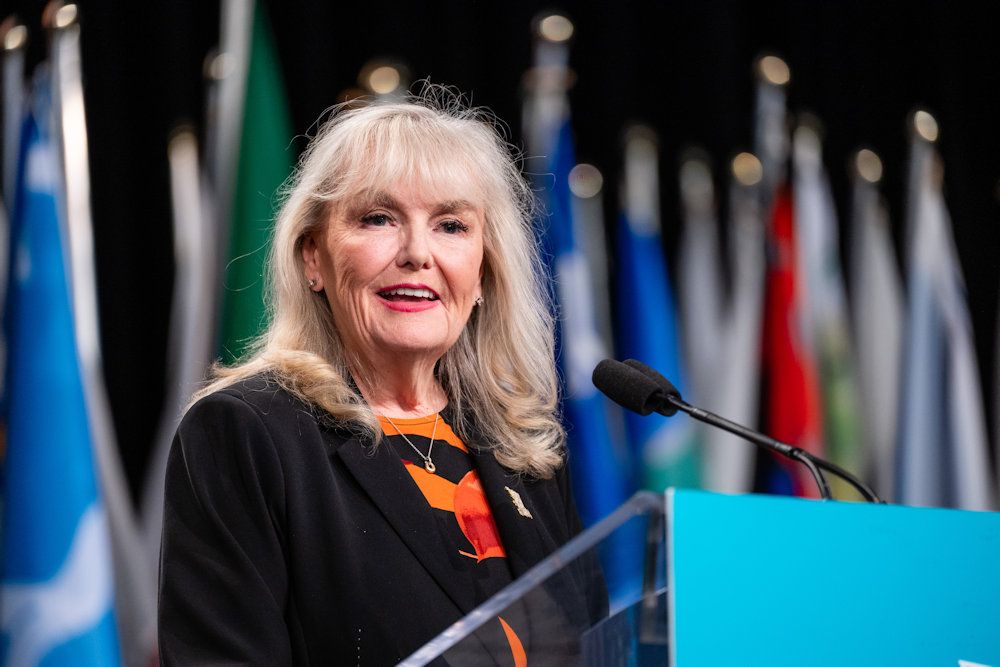
Something similar may now be happening in Alberta. Although Alberta separatists have always favoured a referendum with a simple question of “yes” or “no” on seceding from Confederation, Premier Danielle Smith compromised with a double-barrelled ballot question that will instead ask Albertans if they want to stay in Canada, or if they want another, second, referendum on secession. Specifically …
Should Alberta remain a province of Canada, or should the Government of Alberta commence the legal process required under the Canadian Constitution to hold a binding provincial referendum on whether or not Alberta should separate from Canada?
According to an Angus Reid Institute survey, one fifth of Albertans find the question difficult to understand, with just 34 per cent saying the question is “very clear.” One fifth isn’t a lot, but with separatist sentiment occasionally breaching 30 per cent in polls, it’s enough to swing a result.

First Reading is a Canadian politics newsletter curated by the National Post’s own Tristin Hopper. To get an early version sent directly to your inbox, sign up here.

