



First Reading is a Canadian politics newsletter curated by the National Post’s own Tristin Hopper. To get an early version sent directly to your inbox, sign up here.
TOP STORY
Prime Minister Mark Carney won the election in April thanks in part due to his promise to take a hard line with the United States. Carney declared during the campaign that Canada’s highly integrated “old relationship” with the U.S. was over. Polls showed at the time that among Liberal voters, their top motivation in voting for Carney was their idea that he would be an effective counterweight against U.S. President Donald Trump. One Ipsos poll from April 13 found that voters saw Conservative Leader Pierre Poilievre as likely to “roll over and accept whatever Trump wants,” while trusting Carney to be “a tough negotiator who would get the best deal for Canada.”
So it’s a little weird that Carney’s premiership has largely been marked by deference to Washington. Two months in, the Carney government has not materially opposed the U.S. agenda in any meaningful sense.
Below, a cursory record of how Carney’s “elbows up” strategy against U.S. President Donald Trump has actually played out.
Immediately rescinding legislation because of a Trump social media post
It’s certainly not unprecedented for Canada to acquiesce to a demand from the United States. The 2020 re-negotiation of NAFTA, for one, was marked by a series of Canadian concessions on everywhere from dairy quotas to
.
But Carney has overseen the first time in history that a Canadian government has seemingly promised to rescind House of Commons legislation just because the U.S. president complained about it in a social media post.
That would be the Digital Services Tax Act, which
last June following a “yea” House of Commons vote of 175 to 144. But it
for the Carney government to reverse all of that as a sop to Washington.
The spur was a Truth Social post by Trump, in which he said he was immediately suspending all Canadian trade negotiations because of the tax, which he called an “attack on our Country.”
Within two days, the Carney government unilaterally pledged to do what Trump wanted: Collection of the tax would stop immediately, and the Digital Services Tax Act would be repealed as soon as possible.
Here’s how White House Press Secretary Karoline Leavitt summed up the move in a recent press conference: “It’s very simple. Prime Minister Carney and Canada caved to President Trump and the United States of America.”
Carney’s flattery of Trump is unprecedented
Until recently, the most conspicuous example of a prime minister kissing up to the American leader was usually cited as the time in 1985 when Brian Mulroney
publicly sang When Irish Eyes Are Smiling
to then U.S. president Ronald Reagan. Justin Trudeau and Barack Obama were also known to praise one another, with Trudeau calling his U.S. counterpart “a man of both tremendous heart and tremendous intellect.”
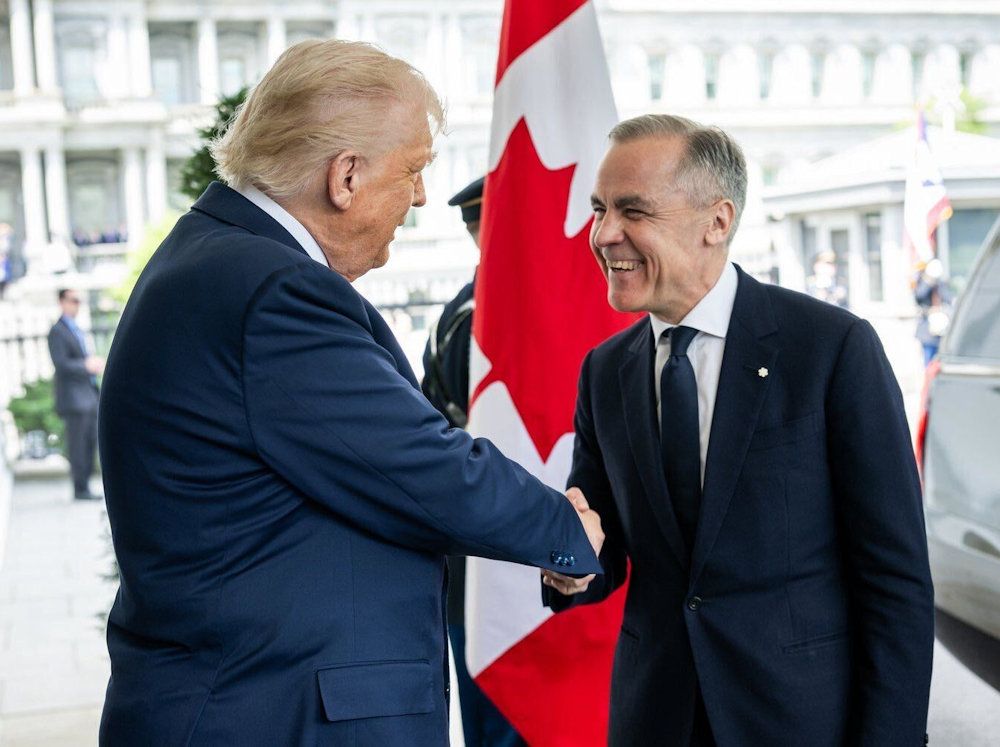
But Carney takes the tactic to a whole new level. In the two times he’s personally met with Trump, he’s made a point of delivering an extended paean to the U.S. leader in front of news cameras. The most recent example came at the G7 summit in Alberta, where Carney wished Trump a happy birthday before declaring that the Canadian-hosted summit was “nothing without U.S. leadership, and your personal leadership.” In a May meeting at the White House, Carney called Trump a “transformational president” who was “securing the world.”
First bill tabled by Liberals was a package of U.S.-demanded border security measures
The first major piece of legislation tabled by the re-elected Liberal government was Bill C-2, the Strong Borders Act. The bill codified a package of border security measures
as part of an ultimately unsuccessful attempt to stave off a trade war.
This includes a promised crackdown on fentanyl trafficking, as well as tighter controls on immigration, particularly in the realm of fraudulent asylum claims.
There are good reasons for Canada to pass a border security bill, but the Liberals have been quite open about the fact that their newfound interest in border security has been a direct reaction to Trump.
In a House of Commons defence of Bill C-2, Liberal MP Kevin Lamoureux
, “members will recall that the criticism being levelled by the President of the United States toward Canada was about the issue of fentanyl, of our borders not being secure.”
The Americans are actually pretty satisfied with Canada’s turn on defence spending
Probably the most conspicuous anti-American policy turn taken by the Carney government has been its attempts to substitute Canada’s close relationship with the U.S. in favour of a close relationship with the European Union. This has been most notable in the realm of defence, with Carney pledging vast increases to Canadian military spending while
striking a new European military alliance
that will include Canadian participation in the ReArm Europe program.
Federal literature has made clear that
to “diversify Canada’s defence partnerships beyond the United States,” but the tack is pretty much in line with what the United States has been begging Canada to do.
U.S. politicians of both major parties have long bemoaned Canada’s lacklustre contributions to the likes of both NATO and NORAD, with senior members of the Trump White House often citing low defence spending as
against Canada.
In fact, NATO’s recent decision to raise their military spending benchmark to five per cent of GDP (a move that Canada swiftly agreed to),
was hailed by Trump as a major victory for U.S. foreign policy
.
Carney swiftly dropped most of the Canadian counter-tariffs
During the federal election, Carney was quite forceful in outlining the need for “countermeasures” against U.S. tariffs. After Trump hit the Canadian auto sector with a round of tariffs in early April, Carney immediately retaliated with what he described as “purpose and force.”
“Canada has responded to the U.S. imposition of tariffs on Canadian goods by
introducing a suite of countermeasures
designed to compel the U.S. to remove the tariffs as soon as possible,” read a statement from the prime minister’s office at the time.
But almost as soon as the election was over, Carney unilaterally zeroed almost all of the counter-tariffs. Oxford Economics reported in May that any retaliatory Canadian trade measures were now “
,” even while key elements of the original U.S. tariffs remained.
IN OTHER NEWS

By resigning his seat in order to give Conservative Leader Pierre Poilievre a path back into the House of Commons, Conservative MP Damien Kurek received much praise for the fact that he did so despite the fact that he was only a months away from qualifying for his gold-plated Parliamentary pension. But Kurek appears to have landed on his feet;
by the lobbying and public relations firm Upstream Strategy Group.
Get all of these insights and more into your inbox by signing up for the First Reading newsletter.