



First Reading is a Canadian politics newsletter curated by the National Post’s own Tristin Hopper. To get an early version sent directly to your inbox, sign up here.
TOP STORY
When Gregor Robertson first became Vancouver mayor in 2008, he promised affordable housing, fewer drug overdoses, lower crime and a total end to homelessness by 2015.
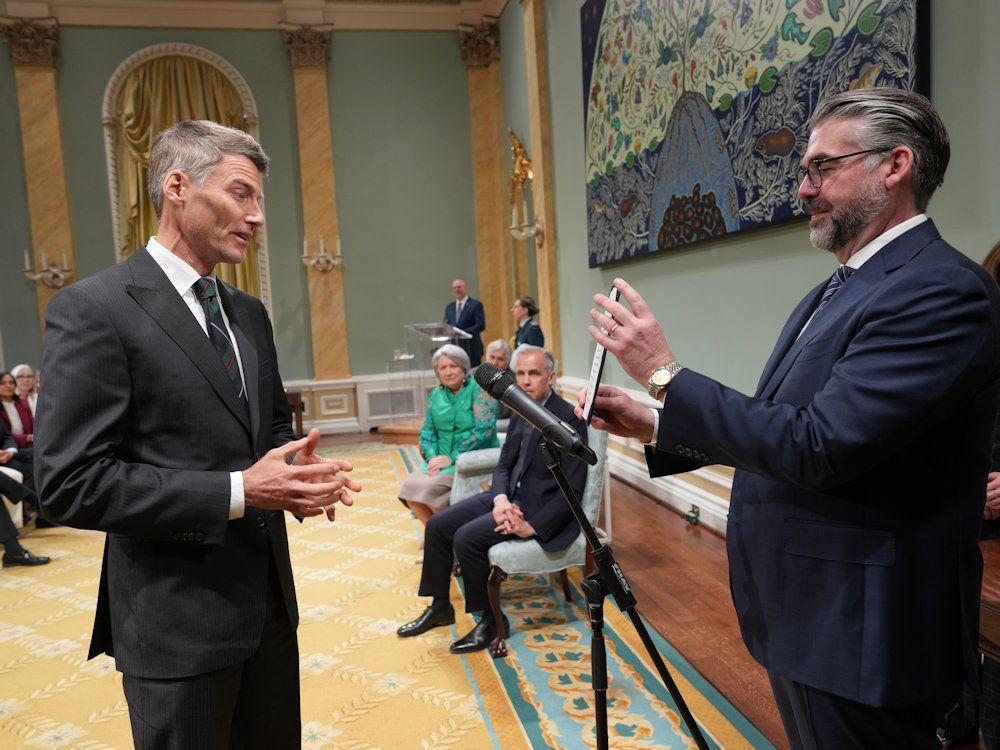
All of those problems would become catastrophically worse under his watch. But given that Robertson was just appointed federal housing minister on Tuesday, it’s notable that his most iconic failure was on the issue of housing affordability.
On Robertson’s first day as mayor, the average detached Vancouver home cost the inflation adjusted equivalent of $942,000.
It was the most unaffordable jurisdiction in Canada, but Robertson took the helm of a city in which it was still technically feasible for average Vancouverites to own property.
According to RBC estimates from the time
, the average Vancouver household could still feasibly purchase a townhouse, although it would consume 50 per cent of their income in mortgage costs.
When Robertson left the mayor’s office in 2018, the average cost of a detached house in Vancouver had doubled.
Adjusting for inflation, the benchmark house price on Robertson’s last day was $1.8 million. Across Robertson’s decade-long tenure, the average Vancouver house had surged in price by an average of $84,000 per year, or $230 every 24 hours.
Rents and condo prices had similarly attained record highs, to the point where the City of Vancouver was no longer just the most unaffordable jurisdiction in Canada; it was now one of the most unaffordable cities on earth.
According to a ranking at the time by the California-based Center for Demographics and Policy, Vancouver was now
in terms of world cities where home ownership was most out of reach for locals.
Shelter costs had become so divorced from local incomes that the mortgage costs of owning just an average home in Vancouver
87.8 per cent of the typical household income. “It’s increasingly hard to dismiss concerns that housing unaffordability is at crisis levels in Vancouver,” reported RBC at the time.
Robertson had entered office
that would “inspire the world.”
His inaugural speech in December 2008 pledged that in addition to his “audacious” plan to end homelessness, he would “spur the creation of new affordable housing” using everything from zoning reform to tax incentives to “unlock” vacant stock.
“If ever there was a city that can set and reach and exceed courageous goals, it is Vancouver,” said Robertson.
Robertson’s last months, by contrast, were marked by a series of interviews in which he maintained that Vancouver’s cratered unaffordability wasn’t his fault.
“I wouldn’t have dreamed the crisis would get this intense,” he told the U.K.’s The Guardian in 2018, putting the blame on everything from “national governments underinvesting in housing” to “provincial governments not doing enough.”
“The city doesn’t control offshore investment, doesn’t control the real estate industry, doesn’t control what developers can do … we really did have limited tools,” Robertson said
with CBC’s Justin McElroy.
He added, “we recognize this has been a big challenge, but it’s a globally significant perfect storm.”
When defending his record on housing, Robertson usually pointed to subsidized housing programs that had been approved under his tenure. “We are investing $61 million into affordable housing this year — the highest in our history,” he wrote in a 2015 op-ed in The Georgia Straight.
All the while, his administration lagged on addressing many of the prime drivers of the crisis, ranging from zoning constraints to the city’s
. The Vancouver Sun would note in 2018 that it wasn’t until Robertson’s
final council meeting as mayor
that the City of Vancouver would
greenlight a basic zoning reform
allowing duplexes to be built in neighbourhoods zoned for single family residential.
“He always knew population growth that was coming — yet everybody acted like this was a surprise,” Vancouver developer Bob Rennie, a onetime supporter of Robertson,
.
Perhaps most notably, Robertson had long resisted any notion that Vancouver home prices were being bid up by foreign buyers who were effectively treating the city’s real estate as a financial commodity.
In 2015, urban planning researcher Andy Yan released a groundbreaking case study which analyzed six months’ worth of Vancouver home sales and found that
were signing their purchase papers with non-Anglicized Chinese names.
At the time, Robertson was one of several public figures to accuse Yan’s research of being divisive.
“This can’t be about race, it can’t be about dividing people … it needs to get to the core issue about addressing affordability and making sure it’s fair,” the mayor
.
As a Global News profile would note, only three years later Robertson would
be blaming other levels of government
for failing to appropriately curb “offshore investment.”
On Tuesday, a reporter told Prime Minister Mark Carney that his new housing minister had overseen one of the most explosive increases in home prices in the country’s history, and asked whether this was a signal that “you don’t think housing prices should go down.”
Replied Carney, Robertson “brings the type of experience that we need to tackle some aspects of this problem.”
IN OTHER NEWS
Prime Minister Mark Carney obviously had his first post-election cabinet sworn in on Tuesday. Despite signals that his government would be taking a hard tack away from the prior Liberal government, almost all of the key posts are occupied by Trudeau government veterans (albeit in different positions).
This includes …
Sean Fraser, Minister of Justice.
As immigration minister under Trudeau, Fraser oversaw a massive unchecked increase in migration to Canada that peaked at more than a million newcomers per year in 2022 and 2023. In the Trudeau government’s last months, they notably admitted error on the immigration file and sought to reverse many of the increases (albeit under a different immigration minister).
Chrystia Freeland, Minister of Transport.
As finance minister, Freeland championed the wildly unpopular capital gains hike, and oversaw
one of the largest and fastest expansions
of the federal debt in Canadian history. In her last weeks as minister of finance, Freeland would orchestrate an
extremely complicated and contradictory holiday GST break
that economist Mike Moffatt would describe as “probably the worst tax policy in a decade.”
Mélanie Joly, Minister of Industry.
Joly was Trudeau’s last foreign affairs minister, a tenure marked by her frequent mismanagement of Canada’s response to the Israel-Hamas War. This included multiple instances in which she deviated from Canada’s official line on the conflict, such as a statement in which
“negotiations at a negotiating table” between Israel and Hamas, a group that Canada (and all its peer countries) regard as a terrorist group.
François-Philippe Champagne, Minister of Finance.
As industry minister under Trudeau, Champagne coordinated several multi-billion dollar subsidy packages in order to entice foreign EV-makers to build factories in Ontario and Quebec. Despite claims that the subsidies would pay for themselves within five years, the Parliamentary Budget Officer said
the reality was closer to 20 years
… and that was before many of the subsidy recipients
started running into financial problems
.
Steven Guilbeault, Minister of Canadian Identity and Culture.
Guilbeault was probably
the single most controversial Trudeau cabinet minister
when he served as Minister of Environment. Not only was he the face of the carbon tax, but he championed a ban on gas-powered cars by 2035, was widely criticized for 2024 comments in which he seemed to pledge to stop building new roads, and has been blamed for forestry mismanagement preceding the partial wildfire destruction of Jasper, Alta.

Get all of these insights and more into your inbox by signing up for the First Reading newsletter here.

