


First Reading is a Canadian politics newsletter curated by the National Post’s own Tristin Hopper. To get an early version sent directly to your inbox, sign up here.
TOP STORY
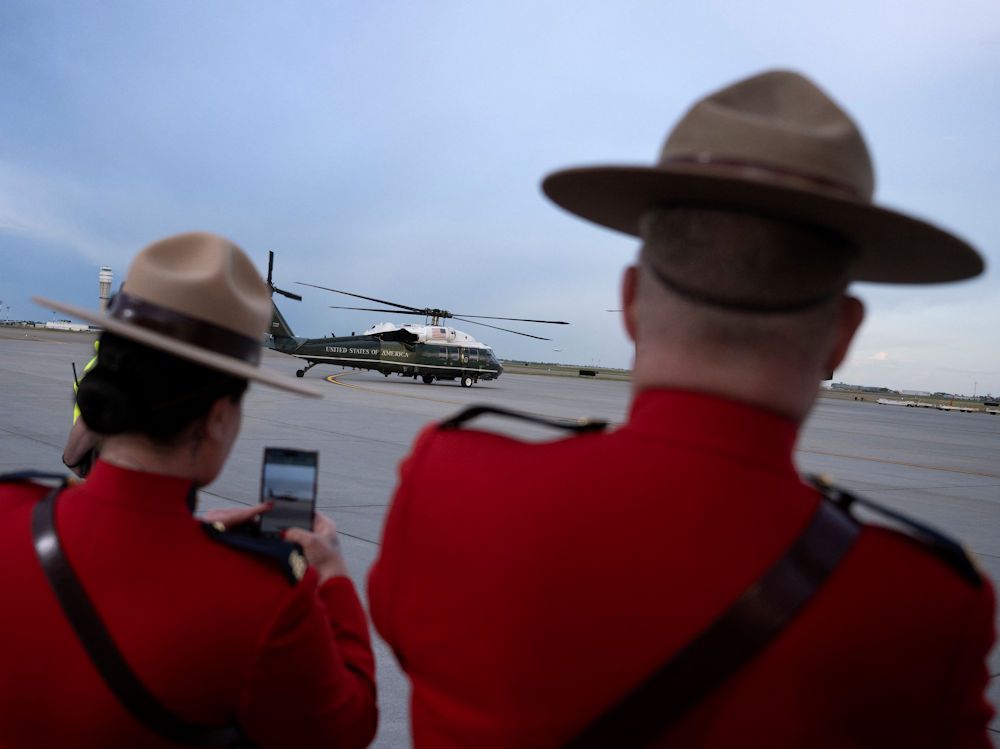
A perennial criticism of the G7 — whose latest iteration is gathered right now in Alberta — Is that nothing ever happens.
The world’s most powerful leaders gather at a luxury resort, group photos are taken, vague statements are issued, but the only consistent outcome is that politicians get to spend a weekend playing statesman for voters back home.
Progressive groups such as the Bono-founded ONE Campaign have derided prior G7 summits for yielding only “pointless platitudes.” The right-wing National Review has derided it as a mere “festival of diplomacy.”
Even some of its attendees have called it out as an impotent annual endeavour. Former U.K. prime minister Gordon Brown has called it the “G-Zero.” French President Emmanuel Macron has called it an “informal club.”
And if you go back to the earliest days of the G7 summit, this all started right around the time Canada was first invited.
The whole idea of a “Group of Seven” comes from France. In 1975, then French president Valéry Giscard d’Estaing proposed a coming together of the world’s dominant economic powers to try and get a handle on a global economy beset by inflation, energy crises and other “
.”
The meeting would end up being called Rambouillet, due to its being held at the Château de Rambouillet outside Paris. And this first meeting would include six members: France, the U.K., West Germany, the United States, Japan and Italy.
And the French were very clear at the time that Canada couldn’t come. This was to be a serious meeting of financial heavyweights. Inviting second-tier nations to the table would serve only to dilute its effectiveness.
“Only the big boys,” was how Canadian columnist Bogdan Kipling summed up the French position at the time. In telling then Canadian prime minister Pierre Trudeau
, then U.S. president Gerald Ford said that France was concerned that “a further expansion of the original group would reduce the informality and flexibility of the occasion.”
The Canada of 1975 easily ranked among the world’s wealthiest nations, but not quite at the level of the six countries who showed up to Rambouillet. Although Canadian GDP was approaching that of Italy, it was about half that of France’s, one third of Japan’s and one tenth that of the United States. In addition, Canada’s population was a fraction of the other members.
The interim five decades have seen Canada fall further from any claim to be in a club comprising the world’s top seven economies, with China and India pulling well ahead of Canada. Canada’s GDP is now less than eight per cent of the United States’.
The Rambouillet summit was only ever intended to be a one-off, but only seven months later U.S. President Gerald Ford would orchestrate the convening of a second meeting in Puerto Rico that would be quickly dubbed Rambouillet II.
The moniker was a derisive one, with critics accusing Ford of merely attempting to commandeer “the glamour and harmonious spirit” of the Rambouillet summit in advance of the 1976 election.
“In my opinion, it’s a boondoggle,” Michael Evans, director of Chase Econometrics, would tell United Press International. That same story would quote another economist saying that while Rambouillet II couldn’t hurt, it did indeed look like an “election year gimmick.”
Ford had only been in office for two years, and the unique circumstances of his ascension made him particularly vulnerable to charges of illegitimacy.
Ford remains the only U.S. president to obtain the office without contesting a U.S. presidential election. He was appointed vice president in 1973 upon the resignation of vice president Spiro Agnew over a fraud scandal, only to be sworn in as president a few months later upon the resignation of Richard Nixon over the Watergate scandal.
“The ready agreement of other chiefs of state to attend Rambouillet II doubtless stemmed from political considerations of their own,” wrote The New York Times in a profile of the summit, noting that both the German and French leaders were also heading into contentious fall elections.
And it was amid these charges of American political cynicism that Canada first found itself at what would end up being called the G7.
Canada’s economy still lagged behind the other original Rambouillet attendees, but the spot was assured for the singular reason that Ford wanted Canada there.
Trudeau spoke English, he’d been in office for nine years and Canada’s economic interests were basically the same as the U.S., at least as compared to a table mostly filled with Europeans. “They felt that I could at least understand the point of view of the Americans, even though I didn’t always share it,” was how Trudeau described it in his 1993 Memoirs.
Perhaps tellingly, Trudeau’s memoirs made no mention of any particular policy that ever resulted from one of the many subsequent G7 summits he would come to attend.
Rather, the whole point was that he was allowed to go at all.
In designating Canada as a G7 country, Trudeau would personally thank Ford for having arranged “one of the greatest achievements of Canadian foreign policy.”
IN OTHER NEWS
Much of the command structure of the Iranian military, as well as its various nuclear facilities, were destroyed Thursday night in a series of strikes by Israel. The Carney government swiftly pooh-pooh’ed the operation, with foreign affairs minister Anita Anand
“de-escalation must be the priority.”
This stance is a little odd given that Iran has been particularly hostile to Canadian interests of late.
It was only a few months ago that the RCMP announced an alleged plot by Iranian agents to assassinate Irwin Cotler, a former Liberal minister of justice. Canadians were also
in the crash of Ukraine International Airlines Flight 752, a 2020 flight downed by Iranian surface-to-air missiles. In fact, many of the Iranian figures killed Thursday night are technically terrorists under Canadian law, as Canada considers the Islamic Revolutionary Guard Corps a
.
Get all of these insights and more into your inbox by signing up for the First Reading newsletter.

