


First Reading is a Canadian politics newsletter curated by the National Post’s own Tristin Hopper. To get an early version sent directly to your inbox, sign up here.
TOP STORY
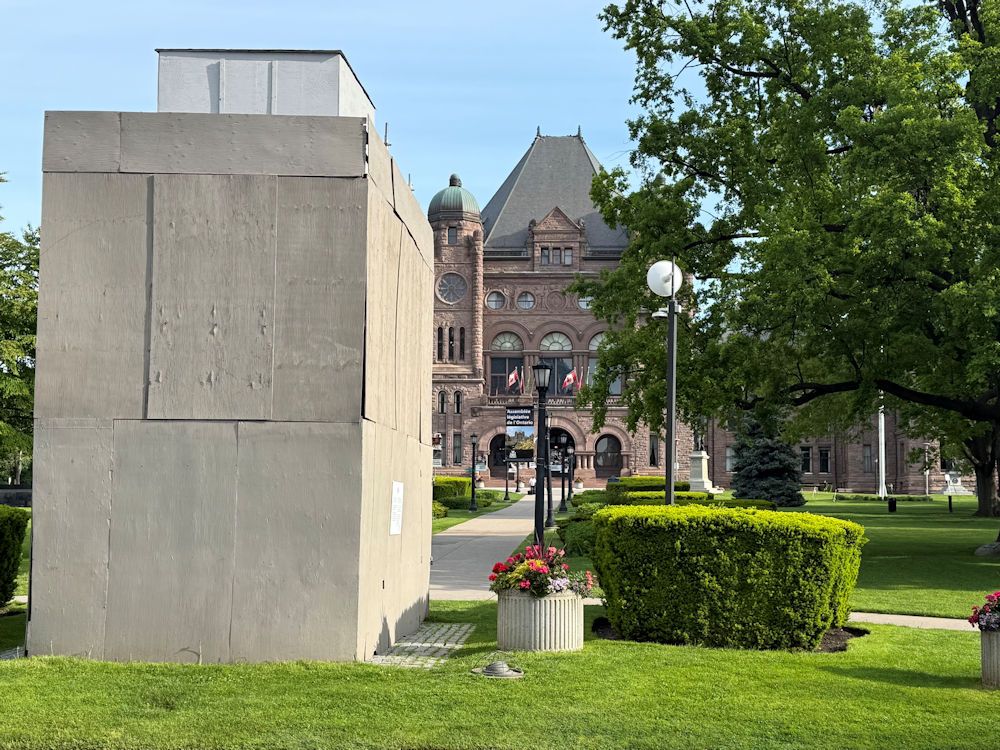
In one of the first major reversals of Canada’s nationwide purge of historic figures and names, Ontario announced Tuesday it will dismantle a wooden box enshrouding their official statue of Sir John A. Macdonald, Canada’s first prime minister.
Since 2020, an 1893 statue of Macdonald outside the Ontario Legislative Assembly has been covered by an impromptu plywood box ostensibly to protect the structure from vandalism or even outright mob destruction.
On Tuesday, Ontario’s Board of Internal Economy, which controls the grounds around the legislative assembly, announced that the structure would be removed and Macdonald would be restored to public view.
Ontario Speaker Donna Skelly
on Tuesday that she could say with “guaranteed” certainty that the boards would be removed by the summer.
Over the past five years, Canada has experienced a wave of name changes and statue removals unlike anything seen since the First World War, when anti-German sentiment fuelled a purge of Germanic names and symbols.
The trend began in earnest in 2020 as Canadian cities were hit by “defund the police” protests inspired by the death of George Floyd in Minneapolis.
It then became supercharged in the summer of 2021, following a B.C. First Nation’s announcement that
turned up in a radar survey of the former Kamloops Indian Residential school were the unmarked graves of children.
A running Wikipedia list catalogues
that have been destroyed by mobs or removed by civic order since 2020.
Seven of those are of Sir John A. Macdonald, included an 1895 memorial in Montreal that was destroyed in 2020 by a defund the police protest. A Macdonald memorial in Hamilton, Ont. was destroyed under similar circumstances the next year, albeit by demonstrators fresh from a Hamilton Indigenous unity rally.
The period has also been marked by dozens of renamings of streets, schools and civic buildings.
In 2023, for instance, Ottawa’s Sir John A. Macdonald Parkway was renamed to Kichi Zībī Mīkan, an Algonquin word roughly meaning “river path.”
Toronto renamed its iconic Yonge-Dundas Square to Sankofa Square in 2024, citing namesake Henry Dundas’s association to slavery. Although Dundas was an abolitionist and a key figure in an 18th century British push to abolish the slave trade, activists criticized him for
.
Ryerson University renamed itself as Toronto Metropolitan University in 2022, over connections to the Indian Residential School system.
Although Egerton Ryerson was long dead before the establishment of the first Indian residential school, he
of Indigenous children being taught “industry and sobriety” at boarding schools located far from their home communities.
Indian residential schools have also largely characterized the push to remove symbols of Sir John A. Macdonald. Although Macdonald was the singular figure who stitched together Canada’s current form, his record on Indigenous affairs was
controversial even in his own time
.
The renaming trend has slowed to a trickle of late, particularly amidst a wave off flag-waving patriotism sparked by U.S. President Donald Trump’s trade war against Canada, and repeated annexation threats. An ongoing Toronto District School Board
remains one of the only such programs underway at a governmental level.
But the announced unboxing of Ontario Legislative Assembly’s Macdonald statue represents one of the first times that a government will be reversing a sanction imposed against a Canadian historical symbol over the past five years.
It occurs amid a recent debate in Wilmot, Ont., to similarly restore a Macdonald statue that was placed into storage after being splashed with red paint in 2020. Beginning last year, the community
on a possible re-installation of the statue, which depicts Macdonald holding two chairs, a symbol of his bringing together of rival camps in the negotiations that created Canada.
IN OTHER NEWS
Tuesday’s
, read by King Charles III, is actually one of the few ways to divine what the Carney government intends to do, since they’ve dispensed with the usual indicators such as a budget or specific mandate letters.
It may also be notable for what it
didn’t
contain:
- Woke stuff. As noted by National Post’s John Ivison, the speech is entirely free of the culture war beats that defined so much of the Trudeau era. As recently as 2021, the Speech from the Throne was laden with lines like “fighting systemic racism, sexism, discrimination, misconduct and abuse, including in our core institutions will remain a priority.”
- Any mention whatsoever of oil and gas. Or pipelines, for that matter. All it does is repeat a Liberal campaign pledge to make Canada the “world’s leading energy superpower in both clean and conventional energy.”

It was only six months ago that the Liberal Party was polling at historic lows due in large part to the refusal of then prime minister Justin Trudeau to resign. As was frequently noted at the time, the Liberals could have easily swapped out their unpopular leader much earlier if only they’d bothered to sign on to the Reform Act, a piece of legislation that gives the caucus enhanced powers to trigger a leadership review. With the start of a new Parliament, the Liberals had a fresh opportunity to subscribe to the terms of the Reform Act and avoid any future debacles with leaders who refuse to leave.
A source told National Post that
a “large majority” Liberal MPs voted against holding Prime Minister Mark Carney to the terms of the Reform Act.

Get all of these insights and more into your inbox by signing up for the First Reading newsletter.

