



First Reading is a Canadian politics newsletter curated by the National Post’s own Tristin Hopper. To get an early version sent directly to your inbox, sign up here.
TOP STORY
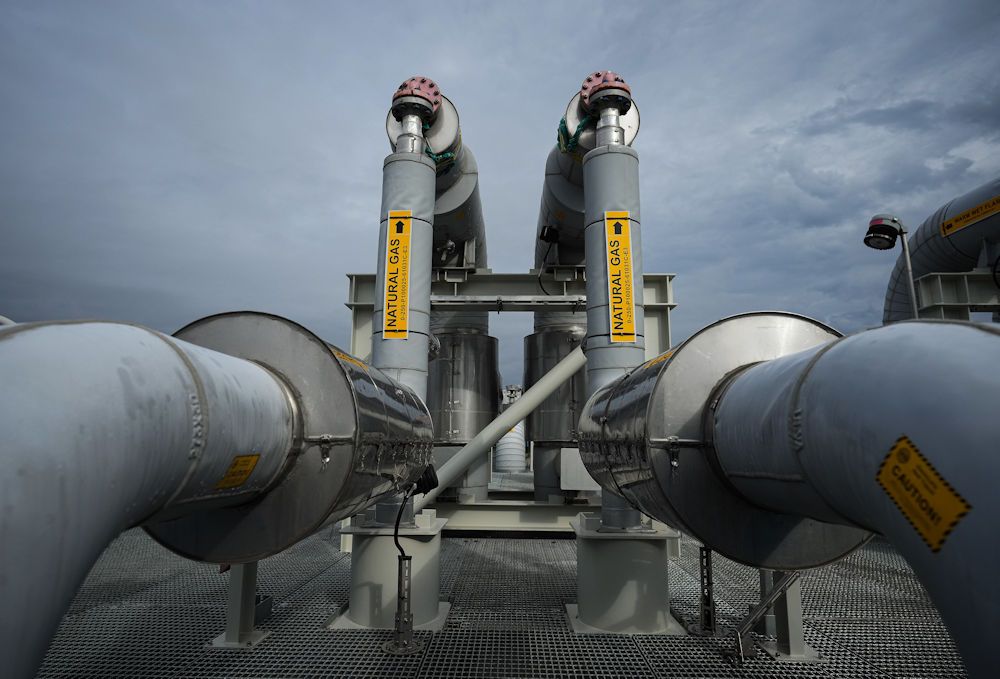
A new report says that if Canada really wanted to save the climate, the most effective thing it could do would be to sell as much natural gas to Asia as humanly possible.
The 46-page study, published on Thursday by the right-leaning Fraser Institute, is premised on the notion that Canadian natural gas exports could singlehandedly reduce Asian dependence on coal.
If Canada could double its LNG production, write the authors, it would divert enough coal from Asian power plants to stop 630 million tonnes of greenhouse gases per year from entering the Earth’s atmosphere.
For context, that nearly represents Canada’s entire carbon footprint. According to the most recent figures from Environment and Climate Change Canada, the country was responsible for 694 million tonnes of carbon emissions in 2023.
“Instead of focusing on reducing domestic GHG emissions in Canada by implementing various policies that hinder economic growth, governments must shift their focus toward global GHG reductions and help the country cut emissions worldwide,” the report says.
The Fraser Institute’s calculation is based on the simple fact that natural gas is an easy substitute for coal, and can produce the same amount of energy with far lower emissions.
The U.S. Energy Information Administration maintains a ranking of fossil fuels by the quantity of emissions they produce for every one million BTUs (British Thermal Units) — roughly the amount of power needed to heat a standard house for several days.
Generating one million BTUs by burning coal will produce between 93 and 103 kilograms of carbon dioxide. Doing the same with natural gas will produce just 53 kilograms.
Canada currently produces about 17.9 billion cubic feet per day of natural gas. Most of this is consumed domestically, while 39 per cent is exported, mostly to the United States via pipeline.
The Fraser Institute calculated that if Canada could double production and “send the surplus … to Asia,” it could potentially supplant more than 200 million tonnes of coal every year.
Although there’s no guarantee that increased Canadian natural gas production would immediately divert coal from Asian furnaces, the continent has recently been burning record quantities of the fuel due in part to supply disruptions of natural gas prompted by Russia’s full-scale invasion of Ukraine.
At the precise moment that many advanced economies are close to phasing out coal entirely, world coal consumption reached an all-time high of 8.77 billion tonnes in 2024. This was driven almost entirely by Asia, with Chinese power plants alone representing a third of global coal consumption.
In December, a report commissioned by the Asia Natural Gas and Energy Association concluded if world natural gas prices weren’t kept low by high North American production, the result would be continued heavy coal use everywhere from Malaysia to Thailand to Vietnam.
“Without certainty of an affordable supply, their fallback position, quite understandably, is to stick with a fuel they are familiar with and which they know is likely to be inexpensive and plentiful: coal,” it read.
The Fraser Institute is not the first to claim that Canada’s best service to the world climate would be to feverishly produce natural gas. Under Conservative Leader Pierre Poilievre, one of the party’s singular pledges on the issue of climate change was to dismantle domestic decarbonization programs in favour of selling more natural gas abroad.
“The best way to reduce emissions is to bring home clean production here,” Poilievre said at a press conference just before the start of the 2025 campaign.
Under the last 10 years of Liberal governance, Canada’s climate strategy has focused almost entirely on bringing down Canada’s domestic carbon emissions, with little accounting on how Canadian actions are otherwise affecting global emissions.
This includes scenarios in which Canada is arguably undercounting its overall contribution to climate change. As one example, Canada remains a major exporter of coal to Asia, but the emissions created by the coal are not counted towards Canada’s overall carbon footprint.
The decarbonization strategy proposed by the Fraser Institute is obviously the more profitable one for Canada.
The Conference Board of Canada has previously reported that for every 4 billion cubic feet of LNG being produced daily by Canada, GDP grows by $7.4 billion per year and the country adds 65,000 jobs. So, a doubling of Canada’s current production could conceivably add more than $30 billion to annual GDP and nearly a quarter million jobs.
And this would be as an alternative to decarbonization efforts that, by any metric, have generally served to reduce growth, GDP and employment.
Prior to the consumer carbon tax being zeroed in March, the Government of Canada’s own internal forecasts showed that it would slash $25 billion from Canadian GDP by 2030 — the equivalent of deleting one per cent of the national economy.
IN OTHER NEWS

By standing for byelection in Battle River—Crowfoot, the single most Conservative riding in Canada, Conservative Leader Pierre Poilievre was likely angling for an extremely drama-free campaign. But Alberta separatists have promised to make the process hell — or at least difficult — given that Poilievre is very much a federalist. “You could almost run a straw bale in our riding under the Conservative flag and that would get elected… but there might be an apathy there if (Poilievre) can’t shake the label of being a parachute candidate from Ottawa,” Rick Strankman, a former Wildrose MLA for the area, told National Post.

Get all of these insights and more into your inbox by signing up for the First Reading newsletter here.

