



First Reading is a Canadian politics newsletter curated by the National Post’s own Tristin Hopper. To get an early version sent directly to your inbox, sign up here.
TOP STORY
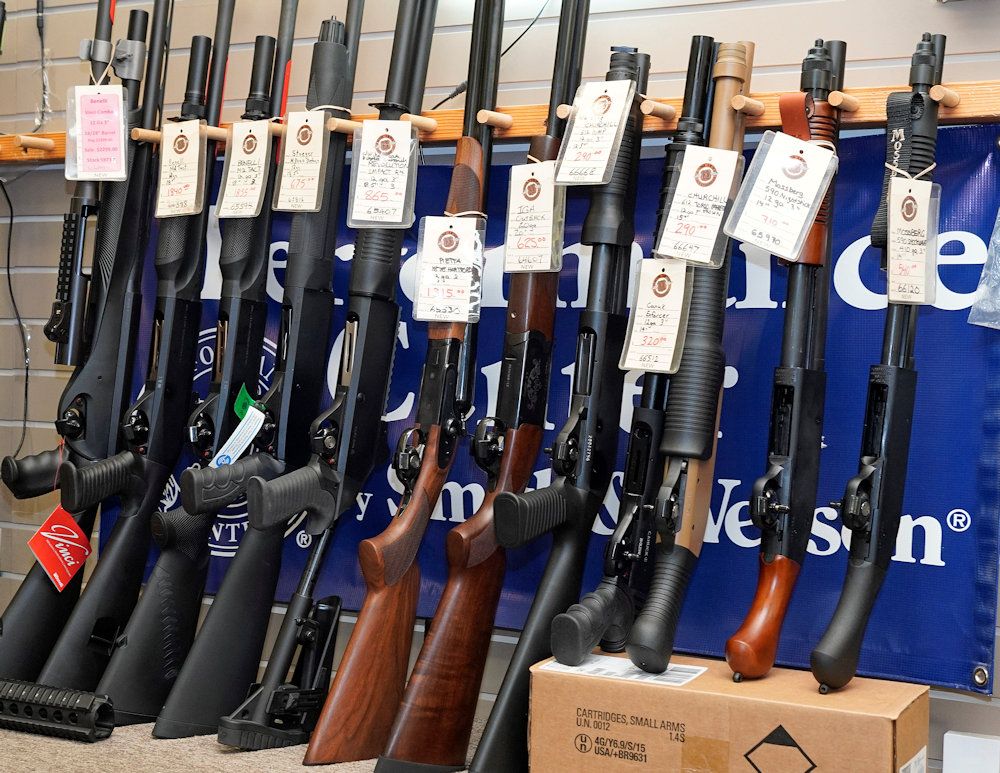
The Liberal government’s plan to “buy back” thousands of once-legal Canadian firearms is not only severely behind schedule and over-budget, but a newly released internal report shows that Ottawa is doubtful of the plan ever actually working as announced.
In May 2020, former prime minister Justin Trudeau’s government
banning more than 1,500 different types of Canadian firearms given the new designation of “assault-style.”
In an instant, an
guns that used to be legal for hunting or target shooting were now classified as prohibited, meaning the owners faced criminal charges if they so much as removed them from storage.
At the time, the government estimated that it would cost
to purchase all the newly prohibited firearms as part of a “buy-back” scheme that would come to be called the Assault-Style Firearms Compensation Program.
Five years later, the Liberals have sunk more than double that amount into the program, with a
having been turned over to the government to date.
The program is so behind schedule that private owners of prohibited firearms can’t even turn over their banned guns if they wanted to, as the buy-back currently only applies to businesses. “The program is not yet available for individuals,” reads a warning on the official webpage of the Assault-Style Firearms Compensation Program.
And even when gun owners do become eligible for the buyback, the government’s own internal reports are warning that they may not bother.
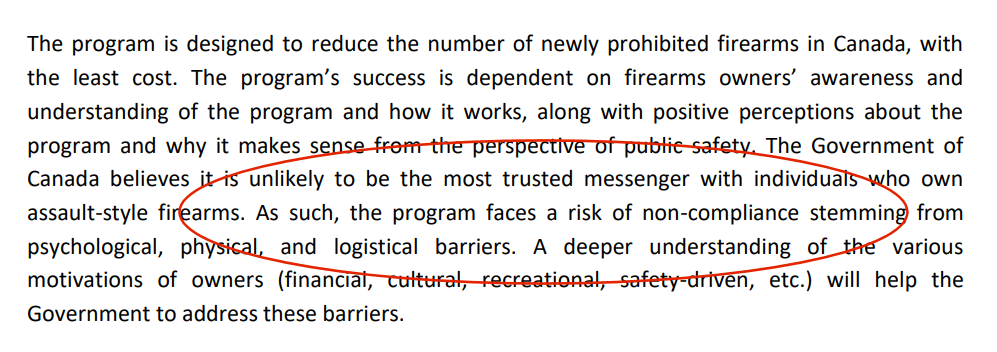
A recently published internal report for the Privy Council Office warned that the Government of Canada “is unlikely to be the most trusted messenger” when it comes to Canadian gun-owners.
It added, “the program faces a risk of non-compliance.”
The report,
entitled Understanding Firearms Owners
, is a $100,000 survey commissioned from the polling firm EKOS Research Associates in order to “support the development of Government communications” encouraging gun-owners to participate in the buy-back program. Delivered to the government in January, it was just made available online.
The buy-back program is voluntary, as anybody in possession of one of the banned firearms could simply opt to keep it in storage indefinitely. As such, the report notes that the whole program hinges on convincing gun owners to have “positive perceptions about the program and why it makes sense from the perspective of public safety.”
As far back as 2021, the Parliamentary Budget Officer calculated that $200 million was a wild underestimate for the scale of the buy-back program being suggested. A report estimated that it would end up costing
$756 million just for compensation fees
, in addition to the bureaucratic expenses of administering the program.
A fiscal analysis released earlier this month by the publication Calibre Magazine found that federal funds earmarked for the buy-back program would blow past the $500 million mark this year. Given the small quantity of prohibited firearms that have actually been captured by the program, Calibre Magazine calculated that the cost thus far works out to about $24,000 per gun.
According to a departmental plan
released last week by Public Safety Canada
, the government is planning to spend $459.8 million on the Assault-Style Firearms Compensation Program over the next fiscal year.

For the current fiscal year, this makes the gun buyback program one of the Liberal government’s largest single expenditures on public safety.
For comparison, a
to combat fentanyl trafficking announced earlier this year came to $200 million. In December, when the Trudeau government caved to U.S. demands to strengthen border security, the result was $355.4 million in new spending for the Canada Border Services Agency.
The ballooning expense of the buyback program is occurring in tandem with growing evidence that a recent rise in Canadian gun crime is due almost entirely to illegal guns smuggled in from the United States.
The Toronto Police Service now estimates that
of the crime guns it is encountering are U.S. firearms that never had any connection to the Canadian legal firearm market.
Illegal U.S. guns were also the primary weapons used in the mass-shooting that directly preceded the May 2020 “assault style” ban. Although the ban was issued as a direct response to an April 2020 Nova Scotia mass shooting that saw 22 people murdered, a probe would determine that the firearms employed were all illegal at the time of the massacre, and three had been smuggled in from the United States.
IN OTHER NEWS
The federal government appears to be staffing up an unofficial “stop Alberta from separating” department.
That comes via a Freedom of Information and Privacy Act filed by True North, which returned
heavily blacked-out correspondence
seeming to show that the Department of Justice is rounding up a team of constitutional experts to counter any future Alberta sovereignty claims.
In other Alberta separatism news, Alberta Premier Danielle Smith
that
it’s up to Prime Minister Mark Carney to tamp down the record-high separatist sentiments in the province.
This wasn’t an appeal for Carney to bring the hammer down on “Free Alberta” types. Rather, Smith was claiming that the sentiment will go away if Ottawa can just slacken the leash on its latticework of oil and gas restrictions. “I’m telling him what the pathway is to have (separatism sentiments) subside, and I guess it’ll be up to him to choose whether or not he takes that pathway,” she said.
Get all of these insights and more into your inbox by signing up for the First Reading newsletter.

