First Reading is a Canadian politics newsletter curated by the National Post’s own Tristin Hopper. To get an early version sent directly to your inbox, sign up here.
TOP STORY
When the Carney government dropped its first list of “nation-building projects” on Thursday, critics quickly noticed that the document lacked any mention of an oil pipeline.
With Ottawa actively hunting for resource projects to boost GDP, an oil pipeline was always one of the most obvious ways to do that. Canada sits atop one of the world’s largest petroleum reserves, and a relative lack of export infrastructure has long limited production and depressed prices.
The idea has also become rather popular, particularly as a way to spite the United States, which currently exercises near-total control over Canadian oil exports. A June poll by Nanos Research found that 73 per cent of Canadians favoured a new pipeline to move oil to the Atlantic Coast.
In a statement, Conservative Leader Pierre Poilievre said that the “major projects” list didn’t mean that any of the five projects were anywhere closer to approval, merely that they were now under consideration by a major projects office that “isn’t even staffed up yet.”
Later, in a social media post, Poilievre mocked Carney’s comments that he understood the “frustrations” of Albertans pushing for independence. “You know what would heal those frustrations, sir? Approving an oil pipeline,” he wrote.
Prime Minister Mark Carney has said multiple times that he was willing to break with his party’s prior track record of opposing new export pipelines. This was why, after Carney’s April election win, both the oil sector and figures such as Alberta Premier Danielle Smith briefly entertained the notion that Canadian oil might soon have new means to get to market.
But with oil pipelines seemingly once again on the Liberal back burner, here’s a cursory summary of the times that Carney or his ministers hinted that this time might be different.
“We as a nation need to build some new pipelines for conventional energy”
Before Carney had even become prime minister, his campaign for the Liberal leadership included pledges that a Carney government would be championing some kind of new fossil fuel infrastructure.
In one of his first sit-down interviews since declaring his entry into federal politics, Carney said he supported “the concept” of a pipeline to move oil from Alberta to the Atlantic Coast. “We as a nation need to build some new pipelines for conventional energy,”
“You need to look forward in the future … that may mean you need pipelines that go East-West.”
In the final days of the premiership of Justin Trudeau, his industry minister told reporters that an oil pipeline could very well be a new national imperative. “Times have changed,”
said in February, before adding that Canada may “need pipelines that go East-West.”
The comments had been spurred by threats of ruinous U.S. tariffs against Canadian goods, with U.S. President Donald Trump just beginning to lean into his rhetoric about annexing Canada as a 51st state. Champagne is no longer industry minister, but he was picked for the Carney cabinet and is currently serving as minister of national revenue.
“It’s about getting pipelines built, across this country, so we that can displace imports of foreign oil.”
In March, just before calling the 2025 federal election, Carney flew to Edmonton for a memorably tense meeting with Alberta Premier Danielle Smith, followed by a scrum with reporters. Postmedia’s David Staples asked Carney if he would be repealing legislation that the oil sector had identified as a barrier to new infrastructure, such as the 2019 Impact Assessment Act.
Carney didn’t address the core of the question, but he
that Canada needed oil pipelines, if only to ensure that consumption of imported oil in the country’s eastern regions was supplanted by Canadian supply. “It’s about getting pipelines built across this country so that we can displace imports of foreign oil,” he said.
“We have to choose a few projects, a few big projects, not necessarily pipelines, but maybe pipelines. We’ll see.”
Carney soon started adding caveats to his “new pipeline” promises. The above quote, delivered in French, was one of the first instances of Carney dialling back the notion that he would be leading a pro-pipeline government. The comment was
without “consensus of all the provinces and the Indigenous people” — a threshold far higher than anything previously entertained for a Canadian infrastructure project.
“Will I support building a pipeline? Yes.”
Just two weeks after the election, Carney was asked about his support for oil pipelines during an interview with CTV. Carney replied that he not only supported them, but that he had said so “multiple times.”
“First off, I’ve said repeatedly: yes,” he told host Vassy Kapelos on May 13. Carney said he couldn’t unilaterally approve any pipeline, and that “consensus” would be needed. But he added “I’m a prime minister who can help create that consensus.”
“We need infrastructure that gets our energy to tidewater and to trusted allies — diversifying beyond the U.S.”
soon after the election by Carney’s newly minted natural resources minister, Tim Hodgson. The address was notable for its overt support of the energy sector and its call to increase Canadian fossil fuel production.
“Energy is power. Energy is Canada’s power. It gives us an opportunity to build the strongest economy in the G7, guide the world in the right direction, and be strong when we show up at a negotiation table,” Hodgson said on May 23.
Hodgson never specified whether he was talking about oil or natural gas production, but he certainly endorsed getting one or both of those things to the coast via pipeline.
A new oil pipeline would be “highly, highly likely”
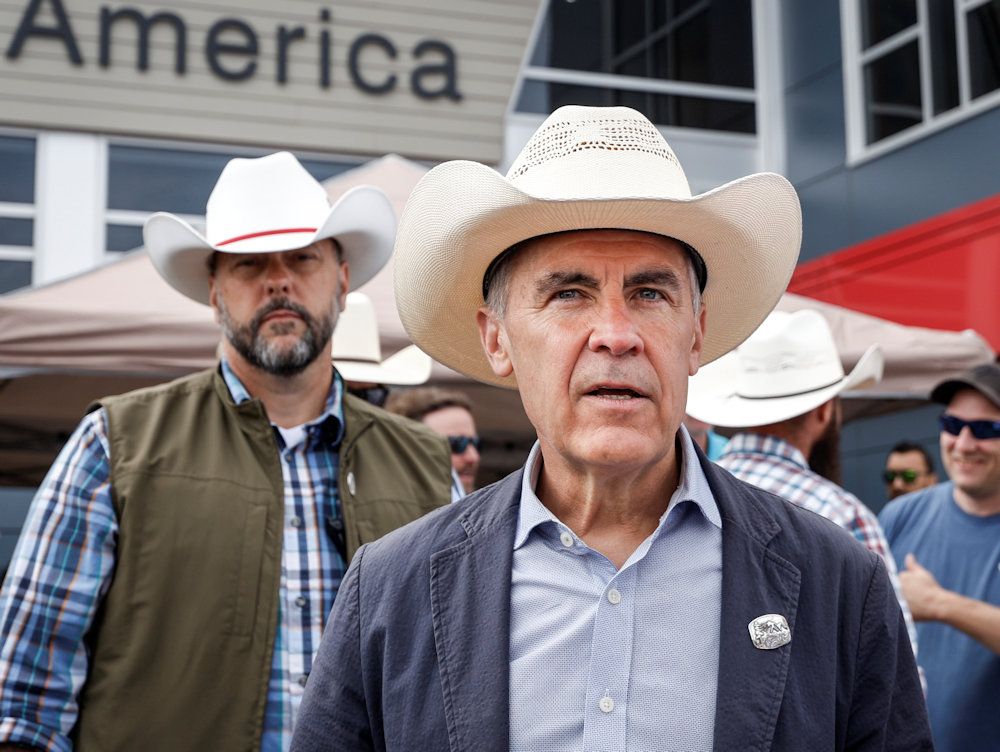
This comment was delivered by Carney just two months ago during a visit to the Calgary Stampede, after his government had already passed Bill C-5, a piece of legislation that gave him control to exempt potential resource projects from much of the usual red tape that had delayed their approval.
“I would think, given the scale of the economic opportunity, the resources we have, the expertise we have, that it is highly, highly likely that we will have an oil pipeline that is a proposal for one of these projects of national interest,”
“It’s highly, highly likely that that will be the case. And the only reason why I don’t say it definitively is this is not a top-down approach from the federal government saying, ‘We want this, we want that,’” he said.
IN OTHER NEWS
{“mime_type”:”image/png”,”url”:”https://smartcdn.gprod.postmedia.digital/nationalpost/wp-content/uploads/2025/09/Screenshot-2025-09-11-173112.png”,”caption”:” Here are those five u201cmajor projects,u201d by the way. Two mines, a marine terminal, a nuclear plant and an expansion of Canadau2019s one LNG port. In a statement on Thursday, Carney said it was u201cno accidentu201d that all five projects meet his governmentu2019s preferred low-carbon goals.”,”width”:”1324″,”height”:”663″,”shortcode”:”Here are those five u201cmajor projects,u201d by the way. Two mines, a marine terminal, a nuclear plant and an expansion of Canadau2019s one LNG port. In a statement on Thursday, Carney said it was u201cno accidentu201d that all five projects meet his governmentu2019s preferred low-carbon goals.“,”type”:”image”,”channels”:[“desktop”,”tablet”,”phone”]}
Former prime minister Justin Trudeau has found a new job, which is actually very similar to his old job. One of the first controversies Trudeau ever faced as a federal politician was the large speaking fees he had commanded in private life as the son of Pierre Trudeau, largely from charities and non-profits. One of the highest being a single $20,000 gig for the Canadian Mental Health Association. After nine years as Canadian prime minister, his fee has gone up a bit. He now costs