



First Reading is a Canadian politics newsletter curated by the National Post’s own Tristin Hopper. To get an early version sent directly to your inbox, sign up here.
TOP STORY
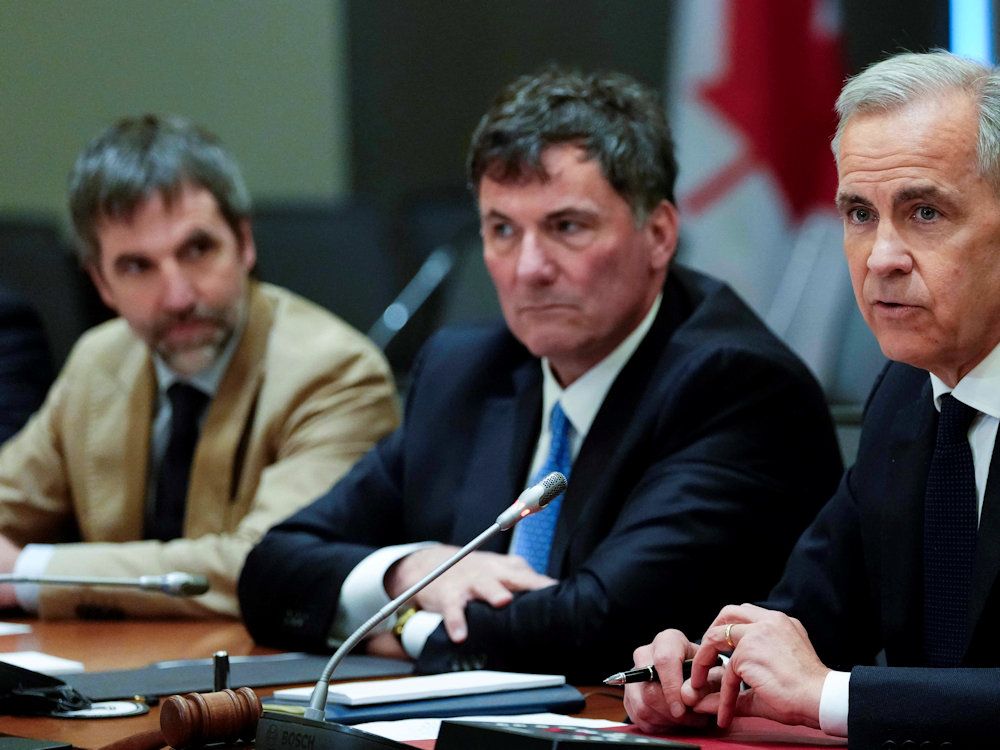
Although Steven Guilbeault no longer occupies his controversial position as minister of environment, his new cabinet post ensures that he will now have command of one of Canada’s most sweeping Trudeau-era internet controls.
Guilbeault will be supervising the implementation of the Online Streaming Act, a 2023 law that enables the feds to impose content controls over much of the Canadian internet.
Tuesday’s cabinet shuffle retained Guilbeault in his pre-election post as minister of Canadian Identity and Culture. The position gives him oversight over the CBC, Parks Canada, the Department of Canadian Heritage and the Canadian Radio-television and Telecommunications Commission, among others.
“Thank you for your confidence, Prime Minister Mark Carney. I look forward to getting to work building a stronger country, based on the values of Canadians,” said Guilbeault in a Tuesday social media post.
At the time of Parliament’s dissolution, federal agencies had only just begun the process of applying the terms of the Online Streaming Act, but it had not yet yielded any noticeable changes to how Canadians were able to consume content from sites like Netflix or Disney+.
The Online Streaming Act effectively requires internet companies to follow the same rules on “Canadian content” as traditional TV and radio broadcasters.
Ever since the 1970s, Canadian broadcasters have been required to stick to minimum quotas of so-called “Canadian content.” Commercial radio stations, for instance, risk losing their licence unless they can prove to the CRTC that at least 35 per cent of the music they play is Canadian.
What’s still up in the air is how such controls will be applied to the internet, and who will be subject to them.
In 2023, the CRTC required any streaming service or social media company with more than $10 million in Canadian revenue to register with them. Just this week, the CRTC began hearings to determine how Canadian content would be defined under the terms of the Online Streaming Act.
While the act was still before Parliament, regulators hinted that it would likely take the form of streamers being forced to rejig their content algorithms in order to artificially highlight Canadian media, while artificially hiding other media. In 2022, CRTC chairman Ian Scott told a Senate committee that the Online Streaming Act could empower him to tell the likes of Netflix: “I want you to manipulate it (the algorithm) to produce particular outcomes.”
The Act also requires streaming services to pay five per cent of their revenues to government-administered media funds.
Within hours of Guilbeault’s reappointment, one of those funds, the Canada Media Fund, publicly welcomed him into the post.
“Experienced leaders like Minister Guilbeault will be key in the coming years as our sector weathers growing pressures and rapid transformation,” read a statement by Valerie Creighton, the fund’s president and CEO.
In January, the Centre for Canadian Innovation and Competitiveness estimated that the likely result of the five per cent mandate would be for streaming services to hike the costs of their Canadian subscriptions.
“With the five per cent revenue contribution requirement, the average Canadian family will pay an extra $40 per year, or almost an extra month of streaming subscriptions, into various media funds,” the group wrote in January.
This is Guilbeault’s second run in the position. He was also minister of Canadian Heritage from 2019 to 2021, during which time he tabled the legislation that would eventually become the Online Streaming Act.
The language of the Online Streaming Act also goes beyond mere Canadian content by hinting that streamers may also be subject to “inclusive” mandates on their content.
The Online Streaming Act specifically requires broadcasters to produce content that reflects “Black or other racialized communities,” as well as Canadians of “diverse … sexual orientations, gender identities and expressions.”
As one CRTC fact sheet puts it, the Online Streaming Act empowers them to “ensure online streaming services support Canadian and Indigenous content.”
All the while, the rules for what is and what is not Canadian are famously complex. The mere presence of a non-Canadian crew or non-Canadian financing can often mean that an otherwise Canadian product is denied official recognition by Ottawa.
One of the most notable exceptions is that much of the catalogue of Canadian singer-songwriter Bryan Adams does not qualify as CanCon because Adams works with non-Canadian co-writers. Just last week, while appearing at Toronto’s Departure Festival, Adams renewed his criticism of the CanCon regime.
“It’s an archaic system; we don’t really need it in Canada,” he said. “People listen to music, they don’t consider nationality.”
Guilbeault remains relatively popular in Quebec, where his Montreal riding of Laurier–Sainte-Marie is now one of the safest Liberal seats in the country.
However, his turn as environment minister made him a bête noire throughout Western Canada for his championing of everything from carbon pricing to a total ban on sales of new gas-powered vehicles by 2035.
On Wednesday, Guilbeault weighed in on environmental policy one more time, saying that Canada shouldn’t build any new pipelines until all of its existing pipelines are being used at full capacity.
“Before we start talking about building an entirely new pipeline, maybe we should maximize the use of existing infrastructure,” said Guilbeault, before claiming that the Trans Mountain Expansion pipeline is only operating at 40 per cent capacity — a figure that turned out to be wrong (it’s actually at about 70 per cent capacity).
IN OTHER NEWS
One thing missed in much of the news coverage of the new cabinet is who didn’t get in:
- Karina Gould, the former Liberal House leader who ran against Mark Carney in the Liberal leadership race. Immediately after Carney was sworn in as prime minister, Gould was prominently at his side during a factory visit. No such joint appearances have happened after she was snubbed from Carney’s pre-election cabinet, and now his post-election cabinet.
- The last member of Justin Trudeau’s wedding party. There was a period of time when no less than three members of Trudeau’s wedding party were high-level government figures: Gerald Butts was principal secretary to the prime minister, while Marc Miller and Seamus O’Regan were cabinet ministers. Butts resigned amid the 2019 SNC-Lavalin scandal, O’Regan didn’t run for re-election and Miller was just snubbed for cabinet. However, the cabinet still retains Trudeau’s former babysitter, Dominic LeBlanc.
- Nate Erskine-Smith, the Toronto-area MP who was appointed as housing minister in Trudeau’s final cabinet — and then retained in the post in Carney’s pre-election cabinet. Unusually, Erskine-Smith actually complained about not getting to be a cabinet minister anymore, writing on social media that he felt “disrespected.”
To read about about the rest of the Liberals’ “cabinet losers,” click here.
Also, the cabinet awkwardly contains two Liberals who announced they were leaving politics to spend more time with their families, only to immediately return when Liberal polling numbers became more favourable. That would be Anita Anand, the new foreign affairs minister, and Sean Fraser, the new justice minister. Fraser, in particular, made a big deal out of how much politics had taken him away from his family and how happy he was to be rid of it.
Get all of these insights and more into your inbox by signing up for the First Reading newsletter here.