




First Reading is a Canadian politics newsletter curated by the National Post’s own Tristin Hopper. To get an early version sent directly to your inbox, sign up here.
TOP STORY
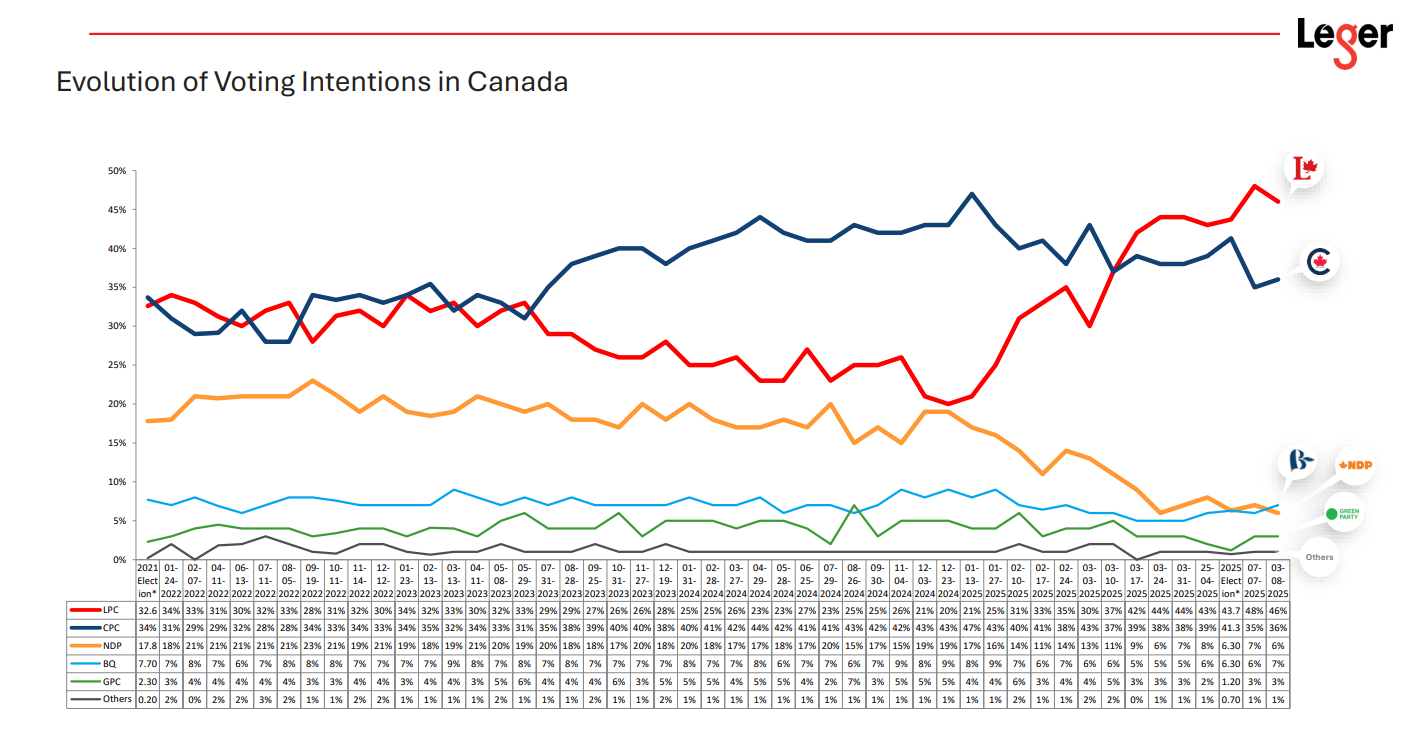
Mark Carney’s first 100 days as prime minister are over, and according to the electorate he’s doing a fine job. An Abacus Data poll
found that the approval ratings for both Carney and his government are in comfortably positive territory. A
showed much the same trend: 56 per cent of respondents approved of Carney, and would readily grant his Liberals a majority if given the chance.
What’s less clear is precisely what voters think Carney is doing well. That same Abacus Data survey found that just 36 per cent of Canadians think the country is headed in the right direction.
Not only has Carney made little to no material progress on any of his core campaign promises, but many of Canada’s economic fundamentals have been getting worse.
Below, a cursory summary of how — in just the last few months — Canada has been experiencing some very noticeable dives.
Large quantities of money are fleeing the country
One of Carney’s last actions in the private sector before entering politics
his company, Brookfield Asset Management, moving their head office from Toronto to New York. The move was seen as a bid to shield Brookfield from a wave of protectionist economic measures promised by the incoming administration of U.S. President Donald Trump.
Plenty of other investors — both Canadian and non-Canadian — have been taking a similar tack. Statistics Canada’s
on securities transactions show that Canada is in the midst of full-blown capital flight. In just the first four months of 2025, $84 billion in capital left the country. That’s the equivalent of $30 million leaving the country every single hour.
Record quantities of Canadian wealth are being collected as tax
Raw Canadian tax rates have actually gone down since Carney took power. He ended the consumer carbon tax and pushed through a promised “
” in the first session of Parliament.
So it’s all the more notable that the percentage of GDP being collected as tax is hitting 20-year highs.
According to
tallied up by economist Richard Dias, the feds are now collecting enough tax to equal 15.2 per cent of Canadian GDP, with an additional 16.4 per cent of GDP being consumed by provincial and local taxes.
The Canadian “tax take” is now higher than at any point since the early 2000s, when Canada was still paying down the sovereign debt crisis of the mid-1990s. And given that this is all happening while taxes are ostensibly going
down,
it’s a sign that the tax base is being hollowed out, as Canada is requiring an ever-increasing share of national wealth to run the government.
Canada’s Employment Rate continues to fall, now sitting at a 26-year low. Public Sector Employment is at a 30-year high.
The Federal Tax take as a percentage of GDP is at a 20-year high, and our tax base is being hollowed out.
This is not going to end well. pic.twitter.com/kfRJLgsmCN
— Richard Dias (@RichardDias_CFA) August 8, 2025
The gap between U.S. and Canadian per capita GDP has never been wider
When economists talk about a nation’s productivity or living standards, they’re usually talking about per-capita GDP. The higher an individuals’ average share of overall GDP, the richer they’re likely to be.
Canadian per-capita GDP has been falling since 2014. Although raw Canadian GDP has grown during that period, it hasn’t kept pace with the rising population. As such, each passing year is yielding a Canada in which the average worker is contributing less to GDP than the year before — a situation that’s inevitably going to be felt in terms of lower wages and diminished buying power.
And probably the starkest measure of falling Canadian productivity is that it hasn’t been happening in the U.S. The U.S. and Canada spent much of the latter half of the 20th century with comparable rates of per-capita GDP, but over the last 10 years, U.S. per capita GDP has continued to trend upwards while Canada has remained stagnant.
The first quarter of 2025 thus yielded
between U.S. and Canadian productivity. The average American is now 18 per cent more productive than they were in 2015. The average Canadian managed just two per cent.
🚨 Breaking: Q1 2025 GDP per capita numbers are in.
🇺🇸 U.S.: Still climbing, up again in Q1.
🇨🇦 Canada: Flat for years.GDP per capita measures our living standards, productivity, and ability to compete.
The gap is now the widest on record and growing every quarter. pic.twitter.com/eGS4qB8hkY
— Ryan Williams (@Ryan_r_Williams) August 13, 2025
Insolvencies are hitting levels not seen since the Great Recession
Canada has a Superintendent of Bankruptcies that keeps regular stats on just how many Canadians are going under each month. And according to data compiled by the site Better Dwelling, consumer insolvencies
in June. That’s higher than any point since 2010, when the last cohort of victims from the 2008 Great Recession were finally throwing in the towel.
More concerning is that the most severe type of insolvency — bankruptcy — is growing at an outsized rate. This is where we should mention that Canadian household debt is one of the highest in the developed world, with total consumer debt in Canada hitting a historic high of $2.5 trillion in February,
according to a report by the financial analyst firm TransUnion
.
The share of workers collecting a government paycheque is at generational highs
It’s been widely reported that youth unemployment is hitting highs
. But Canada’s overall employment rate is also getting steadily worse. The share of Canadians 15 years or older who have a job is now down to just 60.9 per cent. When omitting the temporary job losses caused by COVID lockdowns, that’s the
lowest sustained employment rate
Canada has seen since the 1990s.
With job losses occurring way faster in the private sector than in the public sector, the share of government jobs in the Canadian economy has
now hit a high of 21.7 per cent
. In other words, there is now a civil servant for every four Canadians employed in the private sector.
There are now more bureaucrats in the job market than at any point since the early 1990s, just before a sovereign debt crisis compelled a rapid reduction in the size of the Canadian government.
The Canadian trade deficit is plummeting to new lows
There’s nothing inherently wrong with a trade deficit. The term merely refers to whether a country imports more than it exports, and need not have any connection with GDP or national wealth. The United States, notably, has spent decades with both a trade deficit and the world’s largest economy.
However, given the share of the Canadian economy devoted to export industries, it’s of some concern that the Canadian trade deficit is hitting lows never seen before. According to recent Statistics Canada figures, April and June both posted the largest Canadian trade deficits on record, at $7.6 billion and $5.9 billion, respectively.
This would be fine if the deficits were being driven by increased Canadian imports, but they’re happening
mostly because of collapsing Canadian exports
.
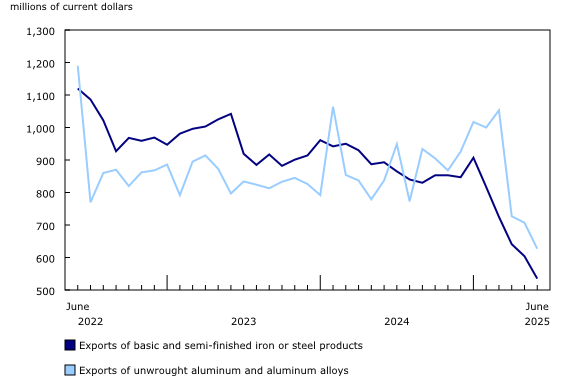
This is being driven largely by U.S. tariffs on Canadian goods. Exports of steel and aluminum alone
have plunged by more than a third
as compared to this time last year.
Multiple signs point to housing affordability getting worse
The Carney government has already backed off on some of the more sweeping housing pledges it made during the 2025 election. While the Liberal campaign had promised to restore affordability with the “most ambitious housing plan since the Second World War,” this was quickly checked by official assurances that housing prices wouldn’t actually be going down.
And for the foreseeable future, Canadian real estate is set to remain some of the most unaffordable on earth.
Housing construction is poised to fall dramatically in the coming years, exacerbating the housing shortage at the core of the Canadian affordability crisis. In Ontario, for instance, housing starts
a 25 per cent drop as compared to last year.
Even if the Carney government can stick to its pledge to
maintain lower rates of immigration
, it’s a simple numbers game that the Canadian population is set to continue growing at a faster rate than the number of new homes available to house everyone.
Get all of these insights and more into your inbox by signing up for the First Reading newsletter.

