



First Reading is a Canadian politics newsletter curated by the National Post’s own Tristin Hopper. To get an early version sent directly to your inbox, sign up here.
TOP STORY
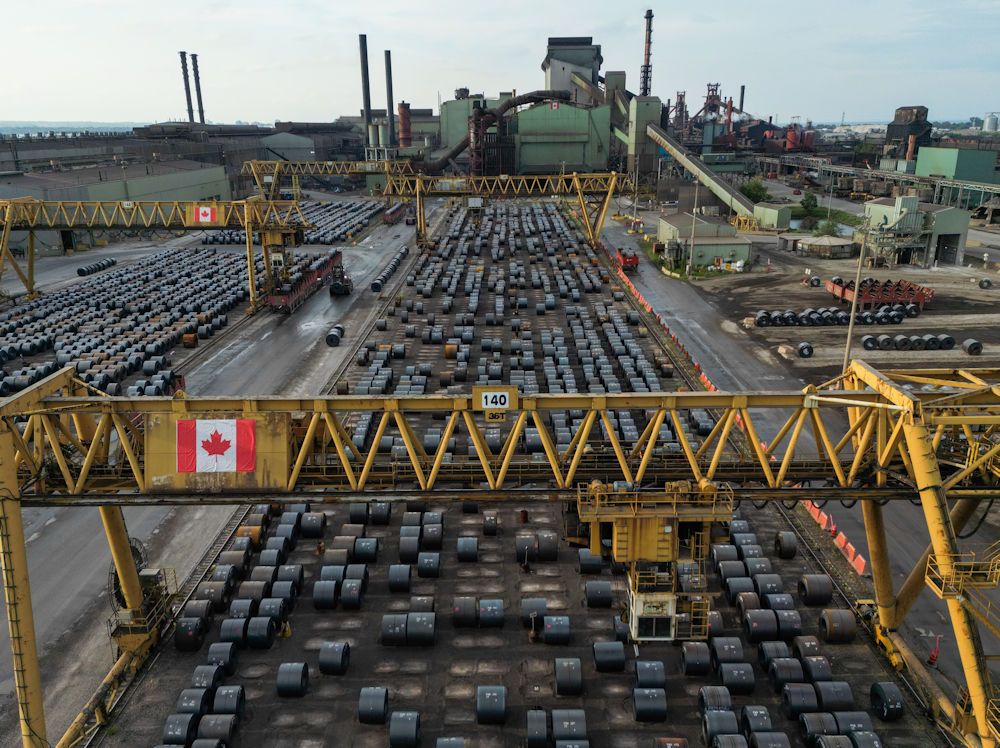
A new European Union plan to exempt its heavy industry from carbon taxes could have ramifications for Canada, given that heavy industry is one of the only corners of the Canadian economy where carbon taxes will continue to apply.
According to reporting in the Financial Times, the European Commission is
that would exempt industrial sectors such as concrete and steelmakers from having to pay carbon taxes on exported products.
The idea is to avoid kneecapping European exporters competing with the likes of China and India, whose own heavy industry face no such taxes.
As the EU’s climate commissioner Wopke Hoekstra told the Financial Times, carbon pricing could not come “at the expense of our own companies (as they) face unfair competition on the global market.”
Such an exemption would effectively be the inverse of what Canada has been doing on carbon pricing.
Unlike much of Europe, Canadians are no longer required to pay a consumer carbon tax. The first action of Prime Minister Mark Carney upon his March 14 swearing-in was to cease collection of federally mandated “retail” carbon taxes on motor fuels and heating oil.
However, the Carney government has stayed the course on
a latticework of industrial carbon taxes
targeting “big polluters” in sectors such as steel, concrete and oil and gas.
Although industrial carbon taxes haven’t generated nearly the same amount of public ire as retail carbon pricing, Canadian exporters have argued that it puts them at a disadvantage in a world market filled with competitors who aren’t subject to carbon levies.
In March, the group Canadian Exporters & Manufacturers
calling for the federal government to ensure that its industrial carbon taxes were not serving to “inadvertently weaken Canada’s manufacturing base or drive investment and production to jurisdictions with less stringent environmental standards.”
Around the same time, a letter signed by most of the major players in the Canadian oil and gas industry similarly
of the industrial carbon tax, calling it a hindrance to Canada’s “only form of economic hard power.”
Ironically, the EU’s proposed carbon tax exemptions for heavy industry come at the exact same time that the European Commission is
to reduce the trading bloc’s carbon footprint by up to 90 per cent by 2040. Nevertheless, the EU has promised its member states will be allowed “flexibilities” in reaching that goal.
The proposed EU exemption for heavy industry follows closely on another major EU concession on carbon pricing passed just last month.
Starting next year, the EU is set to implement a carbon border adjustment mechanism (CBMA) that would place tariffs on imports coming from non-carbon priced jurisdictions. The idea being “to encourage greater climate ambition in non-EU countries.”
But in June, the EU announced that
would be exempt from the CBAM. Any firm importing less than 50 tonnes per year of foreign product wouldn’t have to worry.
The EU exemptions would seem to undermine one of the Liberal government’s signature defences of carbon pricing as being necessary to maintain competitiveness with foreign markets.
Just last summer, Canada’s ambassador to France, Stéphane Dion,
entitled “carbon pricing as an asset for Canadian exports to Europe.”
“Carbon pricing is an export tool, and abolishing it in Canada would not only be an ecological mistake, but also contrary to the economic interests of Canadians,” said Dion.
In June, Liberal MP Kevin Lamoureux
that the industrial carbon tax had to be maintained to preserve Canadian access to the “global market.”
“The new prime minister and the new government have made a decision to get rid of the consumer carbon tax, but we still understand the importance of having the industrial carbon pricing system,” said Lamoureux. “Let us be very clear on that, because we understand the global market and the critical role that has to play in it.”
IN OTHER NEWS
The Liberal government is sticking with its plan not to table a budget until at least the fall, so the eggheads at the C.D. Howe Institute took the liberty of doing it for them. They tallied up the government’s various new spending promises, estimated what tax revenue is going to look like for the foreseeable future, and
concluded that Ottawa is on track to rack up $300 billion in new debt over the next four years
, an average of about $75 billion per year (or, about $5 in new debt per Canadian, per day). And that’s under the most optimistic scenario. More likely is that it hits $350 billion.
This is way higher than any of the non-COVID spending charted under Prime Minister Justin Trudeau.
Recall that it was only a few months ago that Trudeau was pressured into resigning in part due to shock that his government had
allowed the deficit to swell to $62 billion
. According to the C.D. Howe Institute, Canada is on a “troubling path.” “Adding $300 billion in federal debt while doing nothing to raise investment and productivity will make Canada more vulnerable, not less,” read the analysis.

Even though one of the only definitive acts of the 45th parliament thus far has been to pass a bill entrenching supply management,
the bill wouldn’t actually do much to protect the system from a U.S. government determined to destroy it.
That’s according to multiple trade experts quoted
, who identified several ways Canadian negotiators could run around it should the administration of U.S. President Donald Trump decide to play hardball on Canadian import controls of U.S. dairy.
Get all of these insights and more into your inbox by signing up for the First Reading newsletter.

