


ST. MARY’S — The first load of rotting, reeking fish sauce was trucked away from an abandoned factory in St. Mary’s, N.L., on Tuesday, marking the beginning of the end of a decades-long fight.
Steve Ryan, the town’s mayor, teared up several times as he told reporters he could finally feel hope after a protracted struggle to get the dilapidated plant cleaned up. But he was smiling widely as the truck pulled away, loaded with fetid sludge drained from barrels of fermenting fish and salt.
“We’re here, we have it dealt with hopefully now, and hopefully there are better days to come here at this site,” he said.
The stench from the Atlantic Seafood Sauce Company building has been wafting over parts of St. Mary’s, N.L., since it was left behind by its owner more than 20 years ago. When the wind is just right, the thick odour of rotten fish drifts into the nearby school and prevents at least one resident from hanging her laundry out to dry, Ryan said.
He and his colleagues on the town’s volunteer council have been begging the federal and provincial governments to help clean up the plant for decades. This summer, with the Newfoundland and Labrador government footing the bill, that work finally began.
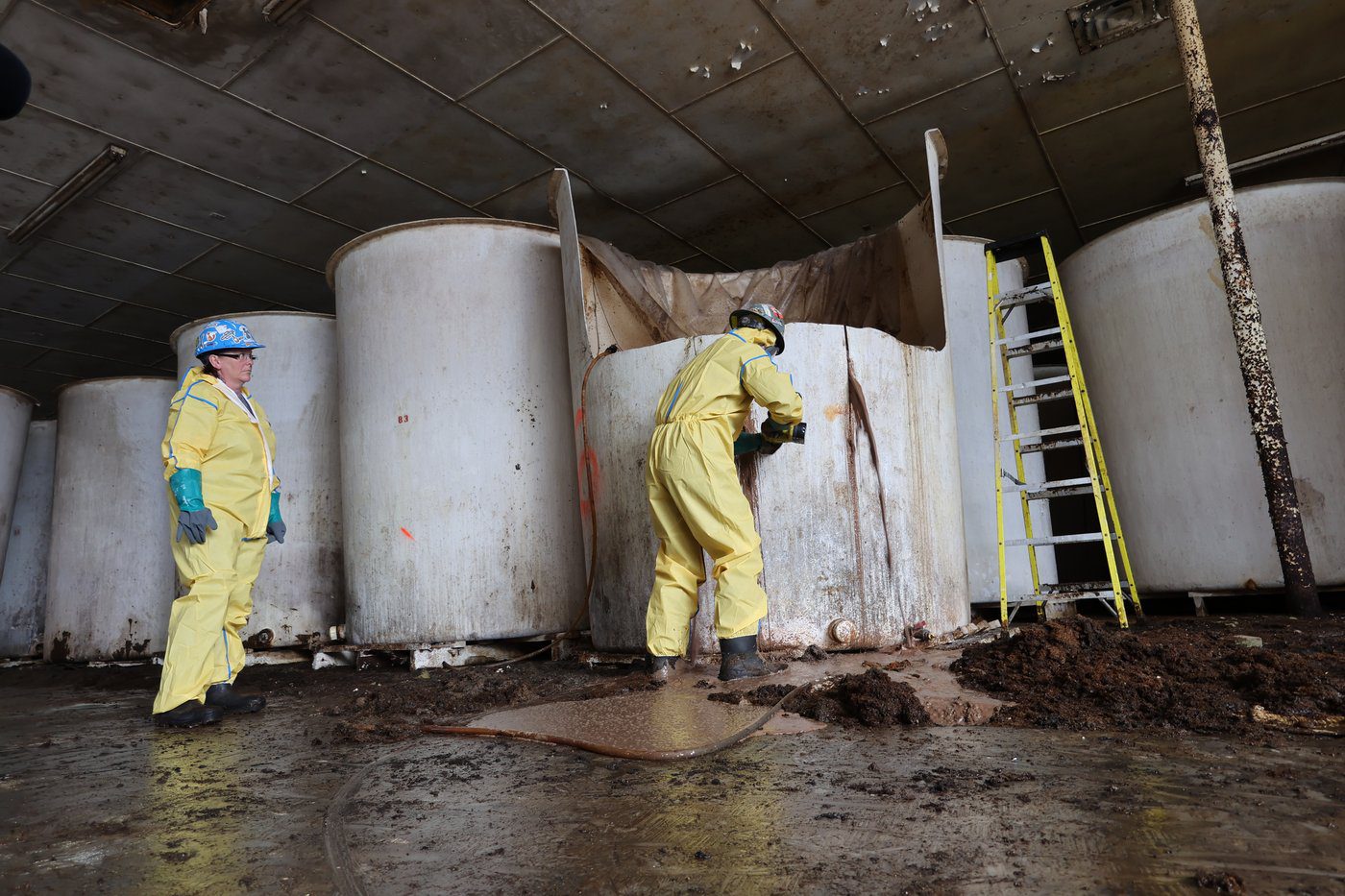
Over the next few months, workers will drain the 110 towering vats of left-behind fluids and mix it with peat moss, which will absorb all the liquids. Trucks with giant hoses attached will then suck up the material and transport it to a pit in nearby Sunnyside, N.L., which was dug over three weeks and lined with high-density polyethylene used in landfills, said Glenn Sharp, owner of Sharp Management, the company overseeing the task.
“This is a unique job,” Sharp told reporters Tuesday. “This is a special waste, designated as a unique special waste. This does not fall under any of the standard classifications.”
In a demonstration for members of the press, workers inside the plant sliced open a vat, releasing the greyish brown muck onto the floor.
The smell inside the plant was immediately worse.
“It almost makes a feeling in the back of your throat from the smell,” Sharp said.
“We expect the smell to get considerably worse as we open (the vats),” he added. “We have to go through this to get it out and get it gone.”
There are about one million litres of material — some liquid, some mixed with solid and some fully congealed — that must be removed from the plant, he said. He figured it would take between four to six truckloads a day over the next few months to get the job done.
St. Mary’s is a picturesque community with about 300 residents on the shore of St. Mary’s Bay, a narrow ocean inlet on the southern coast of Newfoundland’s Avalon Peninsula. The Atlantic Seafood Sauce factory opened in 1990, promising much-needed jobs. But the owner ran into regulatory trouble and abandoned the operation roughly a decade later.
Ryan, 55, briefly worked for the company after he graduated high school, collecting fish — mostly capelin, a type of smelt — that would ultimately be turned into sauce.
When he got involved with the St. Mary’s town council about 30 years ago, the plant was still a positive for the town and the building was in perfect shape, he said.
Ryan said he kept up the fight to have it cleaned up in part because he’s worked with town councillors who told him they didn’t think he’d succeed.
“But it happened,” he said, smiling. “There’s still a big process ahead, but I think the right crew are involved to get this done.”
This report by The Canadian Press was first published July 28, 2026.
Sarah Smellie, The Canadian Press

