


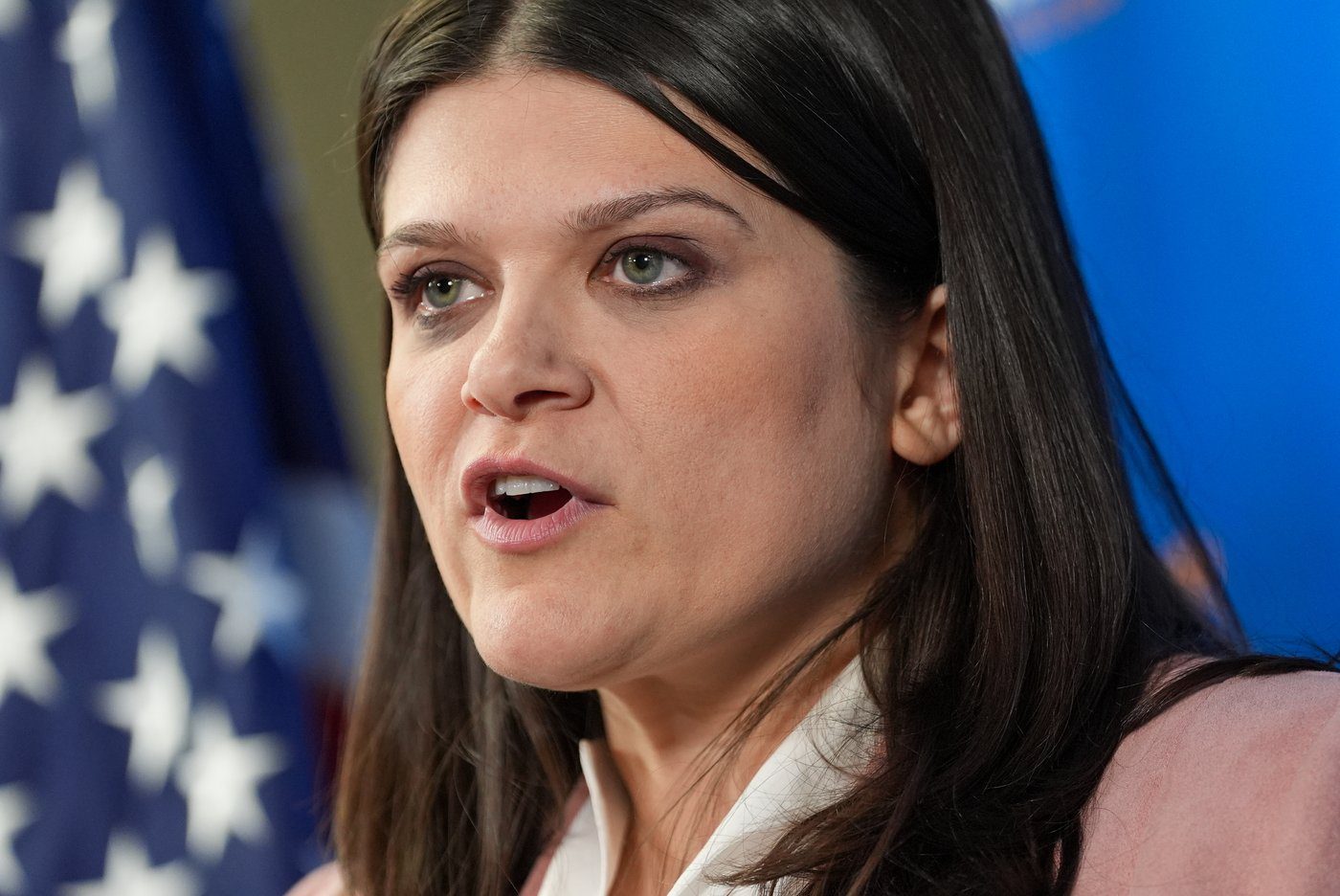
DETROIT (AP) — Abdul El-Sayed sat quietly alongside his wife and Black political leaders in a packed Detroit church Sunday morning, clapping as the congregation sang and the pastor preached. Then he stood before the room and asked for their votes.
Less than 10 miles away, U.S. Rep. Haley Stevens was making her own appeal at another Black church, where one of the city’s most prominent pastors made the case for her.
There were fewer than 48 hours left in Michigan’s fiercely contested Democratic Senate primary. And after more than a year spent preaching starkly different visions for their party — with tens of millions of dollars poured into the race and national attention focused on it — both candidates had come to some of the same places looking for the votes to win it.
First, Black churches. Later, union halls. Then rallies surrounded by their core supporters.
Stevens, who has been through several competitive Democratic primaries, has a name for the frenzy of the closing days: “the last word phenomenon.”
“Everyone’s trying to get in their last points,” Stevens said.
Where the candidates chose to make those final points reflected the simple contest underneath all the money and ideological warfare: which one can assemble enough of Michigan’s Democratic coalition to win Tuesday.
The primary has become one of the clearest tests yet of where Democratic voters want their party to go. El-Sayed, a progressive backed by Sen. Bernie Sanders and other leaders on the party’s left, has run against much of the Democratic establishment. Stevens, a four-term congresswoman backed by Senate Democratic leader Chuck Schumer and many of Michigan’s top Democrats, has made electability and experience central to her case.
The stakes extend well beyond the primary. The nominee will need to bring a fractured Democratic coalition back together to defeat Republican Mike Rogers in November and hold an open seat that is critical to the party’s hopes of taking control of the Senate next year.
Both hopefuls focused on the Detroit area, where Democratic primaries are often decided
Democratic primaries in Michigan have long run through Detroit, where support from the city’s Black voters is often crucial.
El-Sayed’s pitch to those voters Sunday — during stops at three churches — centered on a vision of economic opportunity and equal treatment.
“I believe in the kind of America where no matter where you grow up, the color of your skin, how you pray, you deserve equal rights in this country,” El-Sayed told the congregation at Kingdom Covenant Church.
“You deserve to go to a good school, you deserve to get healthcare, you deserve to graduate and get a good job,” he added.
El-Sayed was joined by Democratic Reps. Summer Lee of Pennsylvania and Ayanna Pressley of Massachusetts, as well as Yusef Jackson, the son of the late Rev. Jesse Jackson who is president of Rainbow PUSH Coalition.
Pastor David A. Johnson II said welcoming a political candidate was not something he typically did, but “this particular season, it’s time for us to do something different.”
For Robin Robertson, a 59-year-old Detroit resident, El-Sayed’s visit came just in time. Robertson said she had gone back and forth over whom to support, waiting until the campaign’s final days to decide.
She ultimately settled on El-Sayed, saying Stevens “had a good run.”
“His agenda seems to match more for me the things that we need right now,” Robertson said. “And then, he’s here in my little church. That was confirmation that I’m going to vote for him.”
Stevens, meanwhile, emphasized her longstanding connections to Detroit-area churches.
At a church in Pontiac on Sunday afternoon, Stevens stayed after the service to speak individually with congregants, greeting many like familiar faces.
“I come here year-round. This isn’t just a campaign thing,” Stevens said. “Our churches are places of community refuge, community connection.”
Stevens and her allies have also made a direct appeal to Black voters through advertisements highlighting her ties to former President Barack Obama and her work as chief of staff for his administration’s auto rescue effort from 2009 to 2011.
Her campaign acknowledges that a strong showing among Detroit voters will likely be necessary for her to win Tuesday.
Reggie Williams, a longtime constituent who was supporting Stevens at an Oakland County event Sunday evening, said he continues to back her because she “has always been there for the people.”
“She is out and about in the community, always has boots on the ground,” Williams said.
Stevens, El-Sayed will focus on different parts of Michigan on final day of campaigning
After spending much of Sunday pursuing some of the same Democratic constituencies, El-Sayed and Stevens will take different paths across Michigan for the final full day of the primary.
El-Sayed plans to remain in Detroit, joining canvass launches and trying to turn enthusiasm in the state’s largest city into votes.
“This has been the heart of my public service,” El-Sayed said about his decision to end the campaign in Detroit. “We wanted to come back here and demonstrate what this movement is and what it could mean.”
Stevens will head west, making stops across West Michigan as she tries to maximize support in a region with Democratic strongholds in cities such as Grand Rapids and Kalamazoo.
The divergent schedules reflect the final calculation facing both campaigns after more than a year of campaigning: There are few voters left to persuade, and increasingly the task is making sure the ones already won over actually cast a ballot.
For El-Sayed, that means leaning into a volunteer operation his campaign says has grown to 12,000 people statewide and trying to drive turnout in places such as Detroit. Stevens is relying on the broader institutional support she has accumulated across the state, including endorsements from many of Michigan’s most prominent Democratic officials, such as Sen. Gary Peters and Gov. Gretchen Whitmer.
By Monday night, there will be no more churches to visit, union halls to address or rallies to hold. The television ads that have blanketed Michigan will have run their course, too.
Then comes what Stevens described as the inevitable other side of the “last word phenomenon.”
“The votes will be counted,” she said. “The election will be had.”
Joey Cappelletti, The Associated Press

