



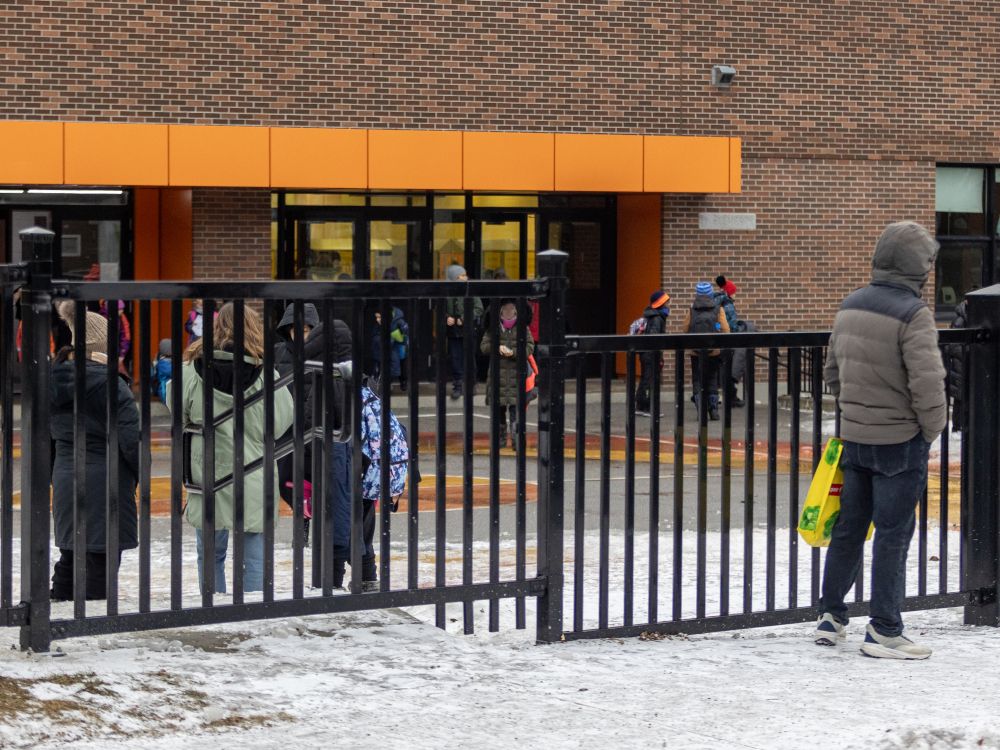
At this time last summer, Montreal’s Victor-Rousselot Park found itself at the centre of the national debate over supervised injection sites. In April 2024, three months earlier, Maison Benoît Labre, a facility that includes both drug consumption services and a drop-in centre for the homeless, had opened just metres away from the park, which doubles as a playground for the nearby elementary school, whose students use it for recess and lunch breaks.
Within weeks, the amount of new drug activity, along with assaults and public sex acts, was such that students required police escorts to and from the park at recess. Conservative Leader Pierre Poilievre, already in campaign mode, held a press conference in Victor-Rousselot Park on July 12, 2024, to announce that, if elected, his Conservatives would shut down injection sites “next to schools, playgrounds and anywhere else they endanger the public.”
Six days later, Guy Felicella, one of British Columbia’s most vocal defenders of injection sites, flew to Montreal
and recorded his own monologue in the same park.
Felicella, a harm-reduction advocate who survived three decades of addiction and six overdoses before turning his life around, is B.C.’s poster boy for injection sites.
During Felicella’s brief visit to the park, he said he saw none of the things residents had been complaining about. Felicella steadfastly denies the possibility that injection sites cause increases in crime and disorder even though he is open about his own lengthy criminal record, which includes numerous convictions for break and enter, drug trafficking and uttering threats. (He has denied a judge’s accusations of violence, and threats of violence, against women that recently surfaced
for an ex-girlfriend of Felicella’s who pleaded guilty to stealing $18,500 from the Calgary bank where she worked as a teller that have not previously been part of his inspirational life story.)
Felicella attributed the lack of open drug use in Victor-Rousselot Park to the new injection site next door. As far as he was concerned, the approach was “working as it should,” and the crime and disorder that had required police at school recess seemingly did not exist.
A year has passed: was Guy Felicella right? Did the site work as it should? Was Montreal’s St. Henri neighbourhood full of NIMBYs who fabricated a bunch of scary incidents to get it moved out?
In early May, the Quebec government
that would, among other things, prevent injection sites from operating within 150 metres of schools and daycares. While Ontario passed a similar set of laws late last year, Quebec decided to engage in a process last month that Ontario chose to bypass — public consultation with stakeholders.
One of the residents representing St. Henri in that process before Social Services Minister Lionel Carmant was no slouch. Michael Mackenzie, a professor of social work and pediatrics at McGill University, is also the Canada research chair in child well-being.
In his presentation before the committee,
MacKenzie included an academic critique of the research often used to justify injection sites in neighbourhoods such as St. Henri. He cited a 2021 systematic review of injection site literature that was able to find only 22 studies “that examined actual outcomes.”
“Within the program evaluation field,” testified MacKenzie, “it is notable that 22 studies does not represent a deep evidence base.”
Sixteen of those 22 studies are about just one site — Vancouver’s Insite — and another three are about a site in Australia. “In other words,” Mackenzie stated, “19 of the 22 studies (86 per cent) came from just two sites.”
Importantly, he noted, neither of these sites are located near schools and daycares. The one site that showed reduction in crime, Vancouver’s Insite, “was in deep and protracted community crisis before the centre was implemented.” It was no surprise then that “any intervention in a neighbourhood in the throes of real crisis was likely to show some positive short-term change.”
In MacKenzie’s view, it was severely misguided to compare a downtown area suffering from “overwhelming need” to St. Henri. The professor also referred to crime statistics compiled by Montreal police months earlier, which were in extreme contrast to the rosy picture framed by Guy Felicella.
Within 50 metres of Maison Benoit Labre, emergency calls were up 1,967 per cent (from six calls to 124) after the facility opened. Within 250 metres of the centre, “mischief calls were up 800 per cent,” and there was “a 93 per cent increase, or near doubling, in crimes against people.”
“Even overdose incidents were up 300 per cent,” testified MacKenzie, “giving lie to the claims from Maison Benoit Labre that they went to where the need was already existing and are preventing overdoses in the area.”
Similar claims made for years by Felicella and other activists that closing injection sites will inevitably lead to increased overdoses and open drug use have been called into question.
about how overdoses in Toronto dropped notably in April, after half of the city’s injection sites were ordered closed by the province at the end of March.
This trend continued in May. Overdose calls were on par with what Toronto Paramedic Services reported earlier in the year when the now-closed sites were open. Both fatal and non-fatal overdoses were about 50 per cent lower than what was reported in May 2024.
Remarkably, the fact that overdose rates in Toronto have gone down, not up, since four of the city’s injection sites closed at the end of March, was completely absent from a
in the Toronto Star about a “staggering increase” in overdoses at 10 of the city’s drop-in centres since those closures.
The story blames the loss of four injection sites for the rise in overdoses at these drop-in centres. There were eight in March, the last month the four sites were open, followed by 14 overdoses in April, 22 in May and 31 in June, an increase of 288 per cent during that time.
The Star article makes no mention of whether there was an increase during the same period last year. It’s no secret that outdoor drug use ramps up as the weather improves.
The former CEO of the now-closed South Riverdale injection site in east Toronto, which I lived across the street from for seven years, conceded that there were more people using outside of the site than inside of it, especially during the warmer months of the year.
There is also an important detail buried in the middle of the Star story — the manager of the harm-reduction site featured, Street Health, estimates it distributes about “400 to 500 sterile crack kits a day.”
This same manager also claims that “more people are choosing to use outside” because the site only has three booths for supervision, which can “sometimes lead to longer wait times.”
This theory does not jive with records from an injection site in the Kensington neighbourhood of Toronto, which were recently disclosed as part of litigation it initiated that argued prohibiting injection sites from operating near schools and daycares violated the Charter rights of drug users.
The number of visits to the Kensington site in 2024 for drug equipment to be used offsite far outnumbers the number of visits for supervised consumption. In July, only 64 of 413 total visits were for consumption. Staff noted: “Many of those visits were for supplies.” In November, 140 of 722 total visits were for consumption. Staff noted: “We are still seeing clients coming in for supplies rather than using the site.”
Arguing that consumption sites are reducing overdoses and public drug use while neglecting to mention that they are also facilitating it on a large scale is a misleading representation of the facts to those who live, work and raise children near these sites.
National Post