


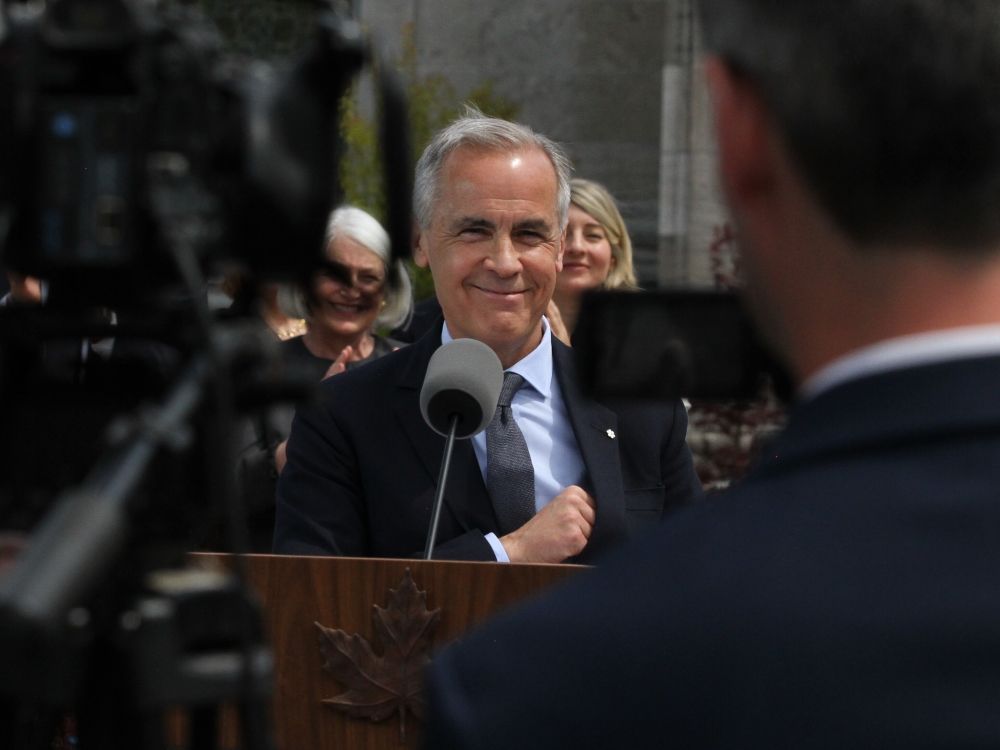
The election result was a personal triumph for Prime Minister Mark Carney with generous assistance from Donald Trump. Instead of being a verdict on the dismal Liberal decade of slow growth, low productivity and investment, and declining competitiveness, it quickly became a referendum on who would be the best leader to withstand the tariff attacks and disrespectful challenges against Canada’s independence by America’s mercurial president. During the campaign, Carney was resolute, assuring Canadians that he would not yield to bombast. In his first meeting with the president after the election, he demonstrated resolve and tact. His use of a real estate analogy, along with a smile, to dispel any notion of Canada becoming the 51st state was a master stroke of diplomacy. There is still much at risk with the U.S., but at least the mood is different.
The election was Pierre Poilievre’s to lose, and he did, including embarrassingly his own seat — a victory he clearly had taken for granted. Poilievre surrendered a 20- to 25-point lead in the polls by being tone deaf to the threat posed by Trump and the nationalist fervour it sparked in Canada. His “common sense” platform had a Trumpian flair. He unnecessarily alienated support from Premiers Doug Ford of Ontario and Tim Houston of Nova Scotia and their campaign teams, and ignored Brian Mulroney’s advice, long before the election, to adopt a “big tent” approach to building the party. Poilievre’s relentless “attack dog” demeanour did not convey an image of a prime minister in waiting. He failed to adapt to both the threat from Trump and the absence of Trudeau. At one point in the leaders’ debate, Carney
, “You spent years running against Justin Trudeau and the carbon tax. … and they’re both gone.” Carney deftly abandoned the carbon tax on consumers early in the campaign.
As a central banker, Carney has had many dealings with world leaders whereas Poilievre, as a career politician, has had much fewer. In fairness, Poilievre did make a net gain of 24 seats in the election and attracted significant support from young Canadians obviously concerned about the affordability of housing and their career prospects in a sluggish economy.
Poilievre is determined to remain as leader of the Conservatives and run in an Alberta byelection for a seat being vacated for him by the elected MP. But, before casting anything in stone, his caucus should rigorously assess what went wrong with their leader and his entire campaign team who snatched defeat from the jaws of certain victory.
NDP Leader Jagmeet Singh did much worse, reducing the party to
, five short of official recognition in Parliament. In the absence of Justin Trudeau, voters vented their wrath on his record as the leader who helped keep the Trudeau government in power. Singh ultimately paid the price for being the toady supporting Trudeau’s record, which Carney carefully side-stepped. Singh lost his seat and resigned as NDP leader.
The Bloc Québécois also suffered from the Trump threat, losing 11 of its 33 seats in Quebec, although the party is pushing for a
in one riding where the Liberals won by a single vote. The Bloc’s call for separation from Canada rang a bit hollow in the face of threatened annexation. Even though Bloc Leader Yves-François Blanchet openly described Canada as “an artificial country,” he clearly saw little value for Quebec being swallowed up by America.
With the election now behind us, the hard task of governing a nervous, divided country begins. Brian Mulroney often said that the principal challenges for any Canadian prime minister are managing relations with the U.S. and maintaining national unity — more relevant perhaps today than ever. The best answer to both would be concrete plans to stimulate economic growth and improve productivity, competitiveness and investment. Revise our tax systems to attract not dispel investment, especially for small and medium-sized businesses. Overhaul regulatory and permitting processes to encourage, not stultify, development of our extensive energy and minerals, including rare minerals resources. Promote real investment partnerships with Indigenous communities to support resource development.
Carney tempered his strong environmental track record by emphasizing both conventional and clean energy products as the path for Canada to become an energy “superpower.” His close friend, Tim Hodgson, who was appointed minister of natural resources, voiced a similar “all of the above” approach on energy. Their straddle may come back to haunt them.
There should be no rush to negotiate with the U.S. until we clarify what its objectives are regarding Canada. The trust factor remains an open question. The Canadian government should forcefully challenge the American assertion that they are being “ripped off” by Canada on trade, reminding them pointedly that excluding energy exports, 40 million Canadians buy almost as much from them as 347 million Americans buy from Canada. That is the reality. We should also litigate the gross violations to the Canada-U.S.-Mexico Agreement and the bogus national emergency excuse for U.S. tariff actions, as a
are already doing in the U.S. Court of International Trade.
U.S. Treasury Secretary Scott Bessent, United States Trade Representative (USTR) Jamieson Greer and Interior Secretary Doug Burgum should be sought out as rational members of the U.S. cabinet to dialogue with, as opposed to Commerce Secretary Howard Lutnick, whose views on Canada are off the wall.
Relations with the U.S. will never be the same but, if we bolster our economy pragmatically and rapidly revamp our shambolic military capability, we will strengthen our ability to stabilize what will continue to be our key relationship while enabling us as well to diversify with other partners using resources that Canada has in abundance.
The speech from the throne will lay out the government’s plans and priorities, but a bloated cabinet, larger than any country of Canada’s size warrants, and laced with many holdovers from the lost decade, is not a signal for real change. Besides, having
with overlapping responsibilities for trade is a recipe for confusion, not coherence.
Mark Carney deserved to win the election, but bold action requires hard choices and firm leadership. Whether he will implement changes desperately needed to restore growth and competitiveness in Canada’s economy will ultimately determine his fate as prime minister.
National Post
Derek H. Burney is a former 30-year career diplomat who served as Ambassador to the United States of America from 1989 to 1993.