


OTTAWA
— A Liberal MP and former Trudeau-era cabinet minister says the oil tanker ban the party imposed off British Columbia’s northern coast was out of “huge public demand” and predicts that the debate around the possibility of lifting it will be controversial.
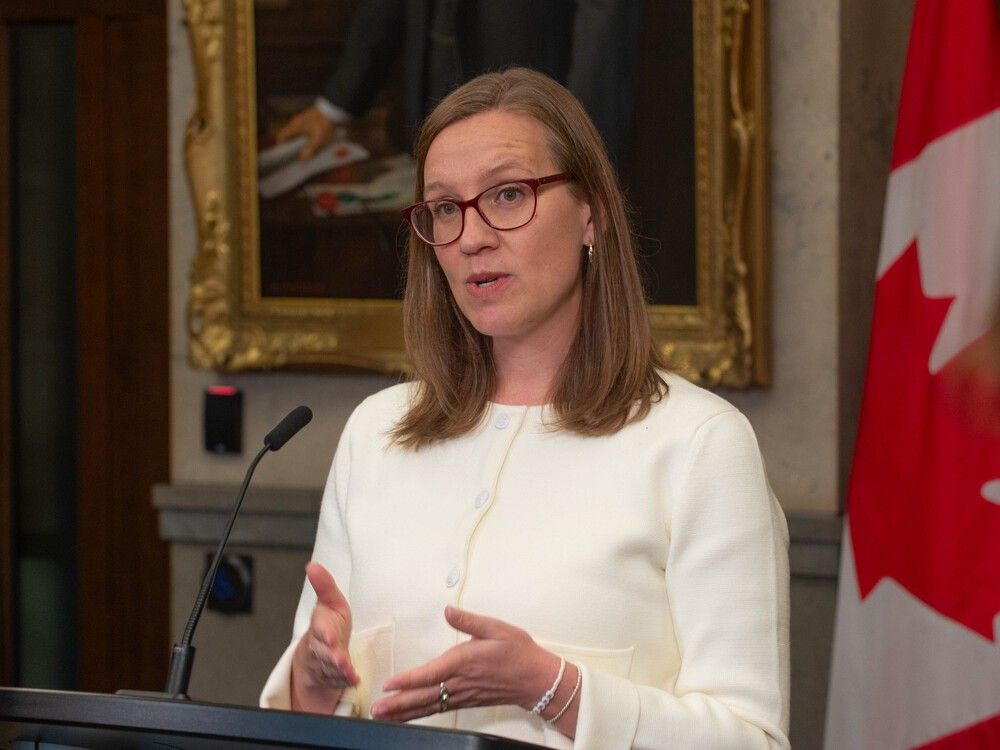
Karina Gould spoke to reporters on her way into the Liberals’ weekly caucus meeting, while Prime Minister Mark Carney and Alberta Premier Danielle Smith look to finalize the terms of a new relationship surrounding energy policy. Smith is pushing for a path for a new bitumen pipeline to run from her province to B.C.’s northwest coast, which would require an outright lifting or carve-out of the federal moratorium on tanker traffic.
“It was something we put in place because there was a huge public demand for it and it’s important for us to be able to ensure we’re protecting, you know, really delicate ecosystems, so I think this is an important conversation to be had,” Gould, who represents the more progressive wing of the party, said of the policy on Wednesday.
She said the idea of amending the ban needs to be a “national conversation,” with the most important voices being those living in the communities along B.C’s coast.
“Over the last 10 years, we’ve heard consistently from Canadians that this is something that matters and is important and is something that they want,” Gould said, adding, “I think this is a dialogue that will be a contentious one.”
Jonathan Wilkinson, a B.C. Liberal MP, who served as both environment and energy minister under Justin Trudeau, said “there’s a bunch of things” the Carney government would first have to do when it comes to the question of lifting the ban, even partially, for a new pipeline, namely, find support among coastal First Nations and B.C. Premier David Eby.
He said there would have to be “significant support” among impacted First Nations.
“At present, I don’t think there is,” Wilkinson said.
Trudeau legislated the ban on oil tanker traffic extending from Vancouver Island’s northernmost point along the B.C. mainland to the Canada-U.S. boundary with Alaska, back in 2019.
It followed a commitment Trudeau made during the 2015 election, which brought the Liberals to power. Shortly after the election, he instructed his then-transport minister to move ahead with the ban.
In 2016, Trudeau rejected Enbridge’s Northern Gateway pipeline, which would have run from Alberta to Kitimat, B.C.
After years of acrimony under Trudeau, Carney is trying to chart a new path with Smith, the roadmap of which is expected to be outlined in a memorandum of understanding being negotiated behind closed doors.
The high-level talks have involved direct conversations between both leaders, with Carney saying at an announcement in B.C. last week that discussions were
“going well,” with the expectation of reaching an agreement in the “coming weeks.”
While Smith pushes for an undoing of a suite of environmental policies that she criticizes as hampering oil and gas development, such as the oil tanker ban and proposed emissions gap, Carney’s government is looking to secure commitments from Alberta to strengthen its industrial carbon price and show a willingness to build out a proposed carbon capture and storage project.
Sam Blackett, a spokesman for Smith, said in a statement last week that Alberta wants the “
removal, carve out or overhaul of several damaging laws,” which includes “an agreement to work towards ultimate approval of a bitumen pipeline to Asian markets.”
“We are currently in the final stages of this negotiation and will have more to say soon,” Blackett said on Wednesday.
Reached for comment, a spokesman for Energy and Natural Resources Minister Tim Hodgson referred to earlier comments the minister made in an interview with National Post, where he said Alberta’s pipeline proposal was “hypothetical” and would be evaluated using the same criteria as other projects the Carney government has designated as being in the national interest. The criteria includes Indigenous participation and support from impacted jurisdictions.
Liberal MPs from B.C. pointed to those comments on Wednesday, downplaying any openness the federal government may have to outright lifting the ban.
“We’ve made it very clear what our position is going to be. There has to be Indigenous consent, there has to be consent from the provinces that are impacted. My constituents believe very, very strongly in those two principles,” said Taleeb Noormohamed, who chairs the B.C. Liberal caucus.
Eby has said he opposes Alberta’s pipeline pitch and believes the federal government should uphold the tanker ban. His NDP government also points to the ban as being essential to having the buy-in to develop its liquefied natural gas sector in the region.
A group of coastal First Nations has also called on Carney to maintain the ban.
Conservative MP Brad Vis, who represents the B.C. riding of Mission-Matsqui-Abbotsford, said on Wednesday that “Mr. Eby needs to wake up,” arguing the province has not seen the economic growth it ought to have.
The federal Conservatives have long supported more pipeline development. Carney came to power on a promise to transform Canada into an “energy superpower,” which has raised the hopes of Western premiers like Smith and Saskatchewan Premier Scott Moe.
Will Greaves, Liberal MP for Victoria, said on Wednesday that his constituents have expressed that they feel “skeptical” about Alberta’s proposal and any lifting of the tanker ban.
“People in my community are proud of the coast, proud of our coastal economy and committed to protecting it. That’s the legacy of my predecessors in the riding, that’s the legacy of many, many years of leadership in British Columbia, and that’s what the people in my community want to see the government uphold.”
Calgary Liberal MP Cory Hogan said he would need to see the “whole picture” of what Alberta and Ottawa were considering when asked whether he supports any lifting of the ban.
“We need to make sure that we are pairing any economic action with environmental action.”
Bloc Québécois MP Patrick Bonin, who serves as the party’s critic for the environment and climate change, said in a statement in French that the Liberals were foregoing environmental regulations, saying the talks with Alberta showed “their only ambition is for the development of oil and gas industries.”
Green Party Leader Elizabeth May, who voted for the Liberals’ budget this week after asking Carney to commit publicly to respecting the 2030 and 2035 Paris climate targets, told National Post that resistance to lifting the tanker ban in B.C. remains strong.
“That’s not just barking up the wrong tree, that’s barking up the wrong forest. We’re immovable.”
National Post, with a file from Catherine Levesque
Our website is the place for the latest breaking news, exclusive scoops, longreads and provocative commentary. Please bookmark nationalpost.com and sign up for our politics newsletter, First Reading, here.

