


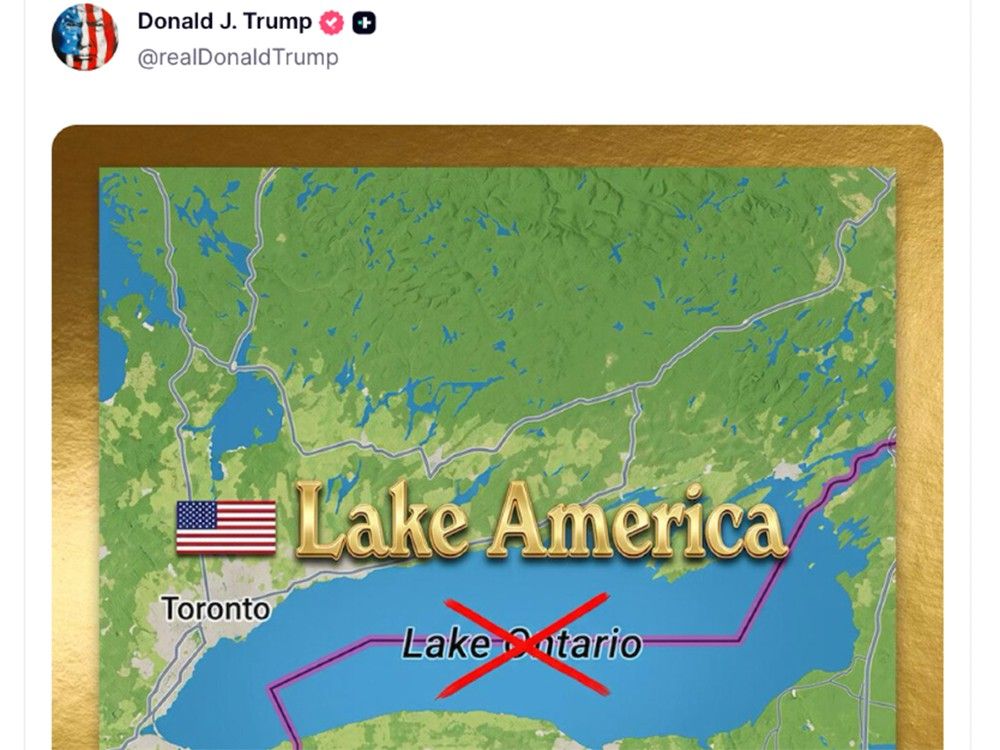
The Great Lakes mostly have anglicized Indigenous names — Ontario, Huron, Michigan and Erie — and one anglicized French name, Superior. But if U.S. President Donald Trump follows through on his latest threat amid the trade war, the smallest of those lakes could soon have an anglicized Italian name instead, “Lake America,” named directly for the United States of America, which in turn takes its name from Amerigo Vespucci, the 16th century Italian explorer. “The United States is giving serious consideration to changing the name of Lake Ontario to Lake America in that we don’t expect to doing much business with Ontario any longer,” Trump posted on Truth Social on Tuesday. The National Post explains the diplomatic and legal boundaries of Great Lakes nomenclature, and why they won’t do much to stop a determined president.
Can Trump do this?
Well, yes. He’s the president, and as such can make executive orders regarding the naming practices of federally regulated entities in the United States, such as the Coast Guard, and, more to the point, the U.S. Board on Geographic Names, and its Domestic Names Committee, which is part of the Department of the Interior. Trump has done this sort of thing before, as in Executive Order 14172, known as “Restoring Names That Honor American Greatness,” which was passed on the day of his second inauguration last year.
That’s the one that ordered the Gulf of Mexico be referred to as Gulf of America, and indeed Google Maps today lists it as “Gulf of Mexico (Gulf of America).” It also officially renamed Denali, the mountain in Alaska, as Mount McKinley. However, it is contrary to treaties and agreements the United States claims to abide by.
The United States is giving serious consideration to changing the name of Lake Ontario to Lake America in that we don’t expect to doing much business with Ontario any longer. Thank you for your attention to this matter! President DONALD J. TRUMP
( TS: Aug 25 2026, 6:58 AM ET )… pic.twitter.com/X5TxYS8TaV
— Commentary Donald J. Trump Truth Social Posts On X (@TrumpTruthOnX) August 25, 2026
Are there multilateral reasons he should not do this?
Indeed there are. At the United Nations (headquartered in New York City, the settlement originally known as New Amsterdam), the Group of Experts on Geographical Names (UNGEGN) “supports the national and international standardization of geographical names… (by) promoting the use of standardized geographical names.” So right off the bat, unilaterally changing the name of Lake Ontario to Lake America would not only put state authorities of New York in a quandary over whether to follow the federal lead, it would also raise a standardization problem between Canada and the U.S. In a conference report from 1972, this United Nations group contemplates the problem of competing names arising when countries do not share a language, and that if they “do not succeed in agreeing on a common name form, it should be a general rule of international cartography that the name forms of each of the languages in question should be accepted.” It says nothing, however, about deliberate renaming of shared lakes as an act of economic belligerence.
What about bilateral reasons he should not do this?
There are those, too. In Appendix C to the 2016 version of “principles, policies and procedures” for the U.S. Board on Geographic Names, “Treatment of Names of Geographical Features Shared by the United States and Canada,” it says “the coordination in the naming of geographic entities on or across the United States-Canada boundary is of mutual benefit to the names authorities in both countries, and to mapping and surveying agencies.” It also says retaining existing names “is highly desirable,” and that if a change is proposed for “strong specific reasons,” it should be “considered by the appropriate names authorities in both countries.”
Supposing he does it anyway. Do other countries have to use names imposed like this?
No. There are plenty of similar international examples. The French call the English Channel “La Manche.” More controversially, various countries have various names for the contested Spratly Islands in the South China Sea. Canada and the United States have more than a century of peaceful cooperation on sharing the Great Lakes under the 1909 Boundary Waters Treaty, under the terms of which the countries created the International Joint Commission to manage the Great Lakes, whatever they are called.
New media post from Donald J. Trump
( TS: Aug 25 2026, 10:04 AM ET ) pic.twitter.com/JAPoGQtDWr
— Commentary Donald J. Trump Truth Social Posts On X (@TrumpTruthOnX) August 25, 2026
Our website is the place for the latest breaking news, exclusive scoops, longreads and provocative commentary. Please bookmark nationalpost.com and sign up for our daily newsletter, Posted, here.

