



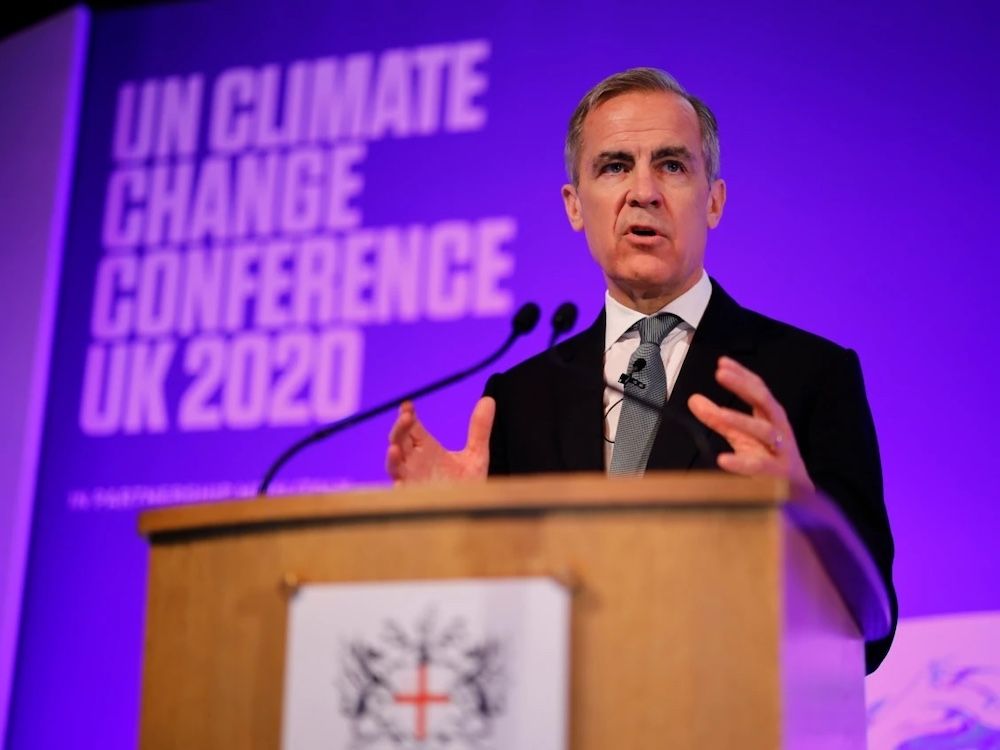
We are now close to the litmus test of the new Carney government as it approaches the bifurcation between the road to sensible fiscal and environmental policy and the road over the cliff into total war against the oil and gas industry and the piling on of taxes and higher gasoline and fuel costs in pursuit of a tokenistic reduction in Canada’s minimal contribution to world carbon use. So far, we have generally had inconclusive indications of attempts to straddle these irreconcilable options. There have been references to a ”carbon-neutral pipeline,” (a nonsensical idea), and fuzzy comments about how to pay for the prime minister’s vertiginously expensive doomsday climate wish list, including a referendum on tax increases.
Last month a meeting of the prime minister and the provincial premiers in Saskatoon surprisingly produced an agreement that the Pathways Alliance Carbon Capture and Storage Project (PCCS) could be in the national interest. This conforms to Alberta Premier Danielle Smith’s proposal for a “grand bargain.” This appears to consist of approval of a carbon capture and storage project simultaneously with a new pipeline to expedite the shipment of Canadian oil to other countries besides the United States. A number of oil and gas companies are sponsoring the PCCS, presumably because they know that they will be able to pass on their approximately one third of the $16.5 billion cost to Canadian consumers, after governments will have subsidized about two thirds of the entire cost of the project with investment tax credits.
It is not yet clear whether this is an ingenious device for pursuing two somewhat contradictory goals, or whether it is the embarrassing beginning of an unofficial stand down from the insane ambition to outlaw unnatural carbon emissions. The PCCS is supposed to gather carbon dioxide emissions from approximately 20 oil sands facilities and transport them to a permanent underground storage facility near Cold Lake, Alberta. The initial target is for less than two per cent of Canada’s annual emissions, less than three per cent of one per cent of the entire carbon emissions of the world. Obviously, this is in fact also nonsense, but it can probably be justified if it is designed to cover a massive course-correction in a way that does not shame the eco-zealots who have been inflicting the green terror on us for the last decade.
Environment and Climate Change Canada (ECCC) has assured the taxpayers of Canada that they will not be expected to fund environmental projects that cannot be justified by the social cost of greenhouse gases. The social cost of carbon (SCC) is the ECCC’s unverified “measure of the incremental additional damages that are expected from a small increase in emissions of” greenhouse gases, which is estimated to be $271. Accepting their calculations, which take no account of the cost of government debt, PCCS costs in its first five years will be $14.2 billion. The fact that the federal government is badgered into trying to justify the cost of these projects is itself a step forward, indicative of mounting public impatience and skepticism toward the eco-fanatics. But the SCC is far from an unimpeachable yardstick; the ECCC uses the estimates of the U.S. Environmental Protection Agency, which during the Obama administration was US$43 per tonne and under the Biden administration rose to US$190 per tonne. The Heritage Foundation in the United States has shown that these calculations are arbitrary and highly questionable and depend on a number of statistical variables. The eminent Canadian scholarly climate skeptic Ross McKitrick of Guelph University has challenged the assumptions used by former environment minister Steven Guilbeault, who will be best known to readers for his attempt to climb up the outside of Toronto’s CN Tower to protest the environmental policies of then U.S. President George W. Bush, in producing a highly inflated SCC. Professor McKitrick, by factoring in market discount rates, the benefits to agriculture of increased carbon dioxide, and lower public health costs from a reduction of extreme cold, believes that the benefits of increasing quantities of carbon dioxide are greater than the cost and that the entire concept of SCC is bunk. In the United States, the Trump administration, with general public approval, has dismissed the entire concept as an unrigorous attempt to justify the self-punitive aspects of the Obama-Biden Green Terror.
In the last 10 years, the federal government spent approximately $200 billion on climate change. It is impossible to justify this expenditure and someone certainly needs to explain why adding an estimated $16.5 billion in the Pathways project for minimal emission reductions and increasing oil prices will advance their declared goal of making “Canada strong.” The best that can be said is that the government is taking note of the evolving public attitude that is parallel to the general reinterpretation of these questions in the United States and other advanced Western countries, and even a relatively modest gesture in the helter-skelter scramble to throttle our greatest industry in the false pretense of protecting the planet is becoming a serious political challenge.
This would conform with other indications that we may be reaching the last stages of climate hysteria. The latest evidence of this is a United Nations call last month for the criminalization of disseminating ”disinformation and misinformation” about global warming. Elisa Morgera, the United Nations special rapporteur on climate change, has asked that what is called greenwashing be criminalized since it is deemed to be propaganda from the fossil fuel industry. There is naturally no effort to define disinformation and misinformation and no indication how the meaning of those words will be determined. But there is some evidence that even raising this absurd concept shows that the climate alarmists are becoming desperate. Given their five or more decades of wildly unfounded dire predictions of imminent disaster, that is a reassuring development but demanding that skeptics be arrested and tried as criminals has been a goal of the eco-fascists for some time. Some of the more strident and witless leftists in the U.S. Congress have called for a racketeering suit against the oil and gas industries on this account, supported by a number of “scientists” who also regard climate skepticism as “racketeering” and “corruption.” There have also been the usual noises about referring this practice to the International Criminal Court, which is just an illegitimate mudslinging and shakedown operation that the United States and a number of other important countries have officially ignored. This was the basis of Michael Mann’s attempt to muzzle the outstanding Canadian writer and commentator Mark Steyn, who had criticized Mann’s theory of the “hockey stick” acceleration of global warming.
The country is waiting to see if Carney is moving stealthily forward on his infamous climate agenda, or is in cautious retreat on this issue, upon which so much, including his government’s possibility of being successful, depends.
Note: Thanks to Canadians for Sensible Climate Policy, and the International Climate Science Coalition (Canada), for some of the information in this column.
National Post

