


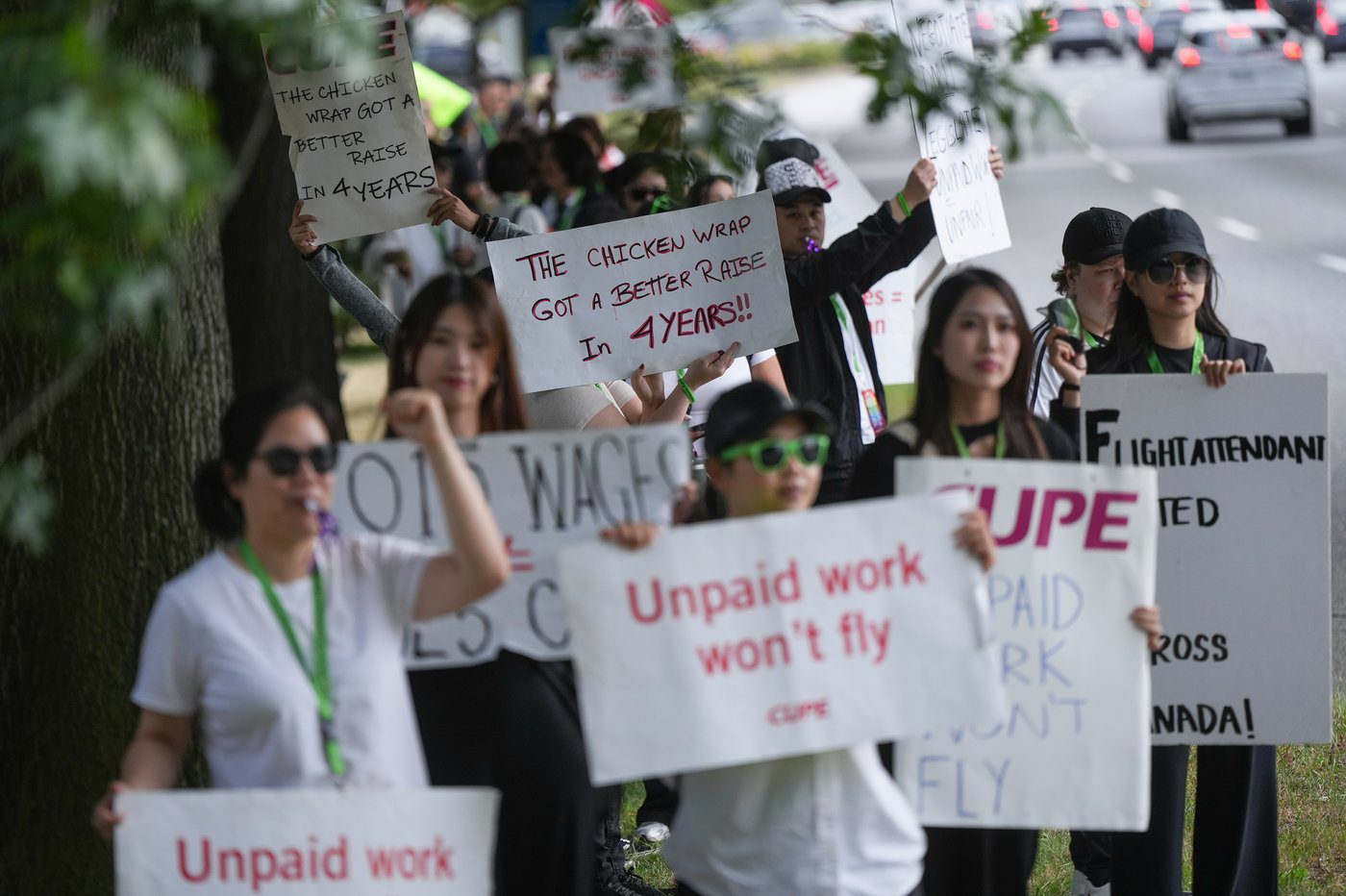
Labour unions have seized on a federal review of Canada’s labour laws to make the case for the right to strike and reaffirm their opposition to government intervention in labour relations.
Ottawa launched a review of the Canada Labour Code in mid-April, giving unions, employers and other stakeholders five weeks to offer feedback about issues including health and safety protections; collective bargaining timelines; and AI and automation for the federally regulated workforce. The government plans to publish a report on the responses.
It’s unclear when the report will be available, but several groups have seized the moment to make their own case for labour reforms.
The Canadian Labour Congress warned in a news release last week against using the review to weaken collective bargaining and strike rights as part of labour relations reform. The Canadian Union of Public Employees similarly urged regulators to protect the right to strike. At least one expert, however, says changes to the status quo may be needed to prevent larger economic damage from job action.
“Our overarching, primary concern is the issue of the right to go on strike and to be able to have your rights recognized,” said Bea Bruske, president of the Canadian Labour Congress.
The federal government’s consultation period ended on May 25. Reviewing Section 107 of the Canada Labour Code was also included as a key point of discussion.
The provision allows the labour minister to “direct the (labour) board to do such things as the minister deems necessary … to maintain or secure industrial peace,” such as ending a work stoppage.
The federal government has used Section 107 in recent years to quell strikes by ordering binding arbitration rather than passing legislation in Parliament. Notably, the measure was used in 2025 during an Air Canada flight attendants’ strike, in 2024 during a lockout of both CN and CPKC rail workers, and in a 2023 B.C. port workers strike.
In each of those strikes, the impacts were felt across large swaths of the economy, if not nationwide. Supply chains were disrupted and Canada’s reputation on the world stage as a reliable trading partner was dented as global customers couldn’t get their products to market in a timely manner.
While speaking to the media before a Liberal cabinet meeting last week, Jobs Minister Patty Hajdu said the government is looking to improve relationships between unions and employers.
“Although 97 per cent of collective agreements are arrived at in the federal space without labour disruption, there are some sectors with high-profile, challenging complications that happen on a regular basis,” she said.
Hajdu also said that there have been concerns around the use of Section 107, “yet the government does have a responsibility to foster industrial peace.”
“The question is, if not 107, then what other tools could be useful both to employers but also to unions,” she said.
Ian Lee, an associate professor at the Sprott School of Business at Carleton University, said he anticipates a “big fight” regarding the review, with pushback from unions.
He said some will argue the potential changes could amount to structural reforms.
“When you do that sort of thing, it should be done not through just a change in regulation, it should go to full-throated review and the Parliament of Canada,” Lee said.
He said he thinks there will need to be a comprehensive debate on the issue and expects “it’ll be loud, and it’s going to be long, and it’s going to be arduous.”
Lee said he recommends the government move forward with one of two policy options.
The first, he said, would be to amend the Canada Labour Code to introduce “cooling off provisions” that do not end the right to strike but “state that every time there’s any kind of a disruption in the negotiations, you break off from the negotiations (and impose an) automatic 90-day cooling off period.”
He said similar cooling-off periods were successful in reducing the number of strikes in the U.S. railroad industry after being introduced as part of New Deal legislation under the Franklin Roosevelt administration.
The second option, Lee said, is to designate workers in key areas as essential, meaning they would not have the right to strike, similar to some workers in health care and other critical sectors.
The Canadian Labour Congress said in the news release that since 2024, the federal government has used Section 107 eight times, whereas in previous decades, the section was rarely used in this manner. The group said those interventions have changed the bargaining process in the federal sector by creating a signal to employers that the government will intervene if there is enough economic pressure.
“In the past when governments have ordered people back to work, they’ve had to table legislation in the House of Commons that has had to be debated and there’s been transparency in terms of how MPs are voting on that legislation. Using Section 107 means that those things have not been debated in the House of Commons, so workers don’t actually see how their own MPs voted to actually support or not support their issues, and that’s problematic in my view,” Bruske said in a recent interview.
CUPE national president Mark Hancock said he thinks the government should stay out of the collective bargaining process unless asked by both parties to assist in finding a solution.
“When an employer goes demanding the government acts and the government acts, that definitely tilts the pendulum in favour of the employers and quite frankly takes away our fundamental constitutionally protected rights,” he said.
Lee said that Canada has a long history of government intervention in the transportation industry, with successive Parliaments legislating striking workers back to work more than 30 times between 1950 and 2015.
“Transportation has huge spillovers … You have a strike, it shuts down economies across the country, agriculture, it shuts down the ability to ship farm equipment, to ship any kind of energy equipment, so the strikes in the transportation sector are not like strikes in any other sector where if you have a strike in banking, well, you go to another bank,” Lee said.
Lee said the transport sector in particular is also vital to Prime Minister Mark Carney’s agenda to transform Canada into an energy superpower and diversify trade away from the U.S.
“To do that, that means you have to have an efficient functioning infrastructure system, a transportation system that is going to be reliable, and right now we have a system that shuts down on average every 18 months,” he said.
This report by The Canadian Press was first published June 4, 2026.
Daniel Johnson, The Canadian Press