



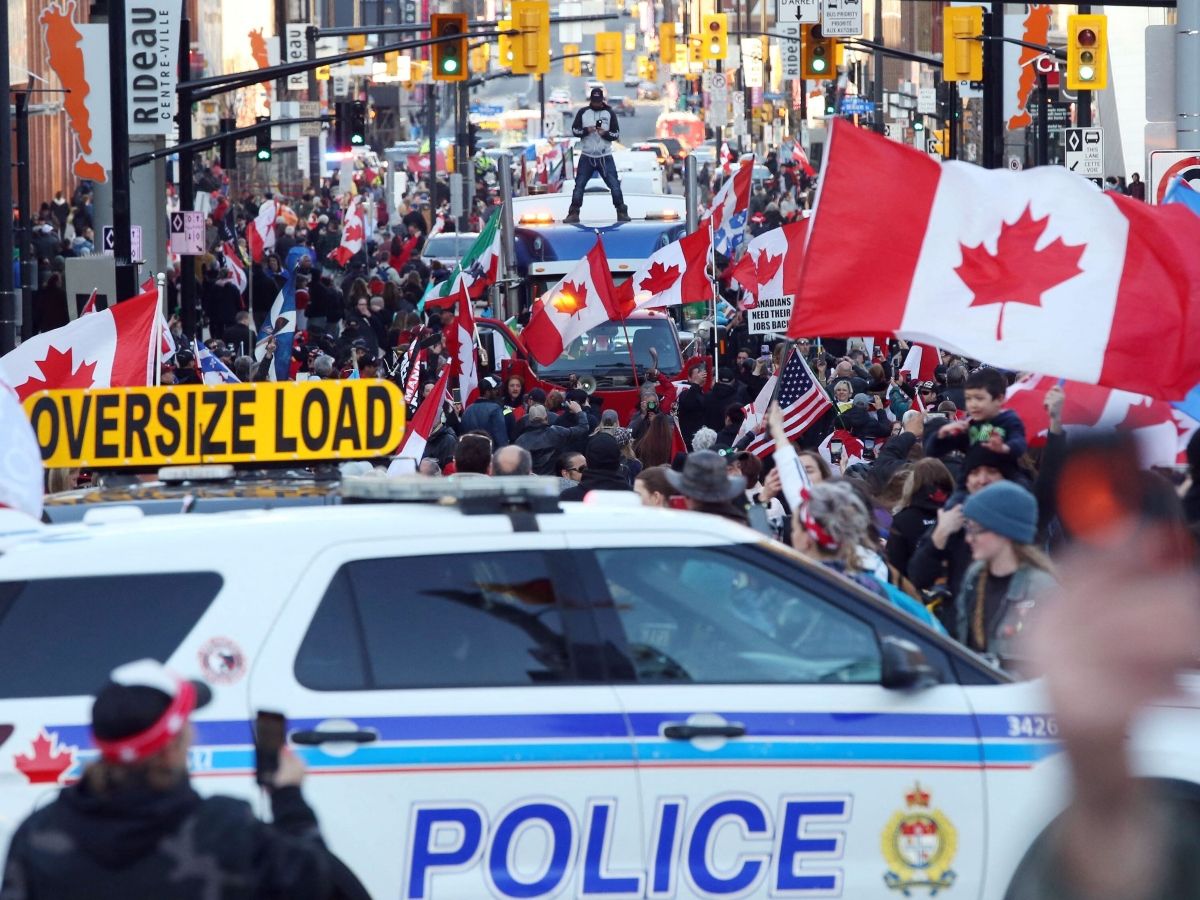
Man bites dog dep’t: Last Thursday the National Magazine of the Canadian Bar Association published an op-ed praising the Ontario Court of Appeal for an act of rock-solid common sense . A couple of weeks ago, the court overturned some Superior Court acquittals for Freedom Convoy organizer Pat King, who had been successfully convicted on mischief and other charges related to the 2022 trucker protests that besieged parts of Ottawa. But the judge trying King, the Hon. Charles Hackland, had declined to convict King on three charges related to the Criminal Code offence of “intimidation,” which can carry a sentence of up to five years’ imprisonment.
The crime of intimidation, according to the letter of the Code (Section 423.1), is anything from a list of actions that is done “wrongfully and without lawful authority” in order to compel someone else’s action or inaction. The list explicitly includes “block(ing) or obstruct(ing) a highway,” which was the very essence of the Freedom Convoy’s Ottawa protest. The record of the protest shows pretty unambiguously that one of King’s goals was to create obstructive chaos for Ottawa residents of all kinds — preventing them from getting about or even using airports — as a means of creating wider political pressure on the establishment. However sympathetic you are to the goals or ideology of the convoy, which was otherwise nonviolent and nondestructive, the legal analysis is bound to seem cut-and-dried to the layman.
But Justice Hackland, not deterred by the relative simplicity of Section 423.1, let King off the hook on the intimidation charges . The protesters did not necessarily intend to intimidate anyone, Hackland ruled; they simply hoped to “pressure, inconvenience, and annoy … downtown residents and workers, as a way of pressuring the government to alter its COVID-19 policies.” Even though blocking a road is included per se on the Criminal Code’s list of “intimidating actions,” the judge read the Criminal Code as though the offence of “intimidation” required the added use of threats or violence.
He also observed several times that “otherwise lawful protests” are deserving of special protection under the Charter of Rights, failing to explain how this could be consistent with convicting King on other charges, and expressed concerns about giving an “unduly broad” interpretation to the apparent strict meaning of the Code. (His ruling included no actual Charter analysis at all, mind you; he thought the mere mention of the Charter was enough.)
It wouldn’t do for your National Post to overlook the Court of Appeal’s firm and unanimous response , which includes dozens of quotes from past Canadian caselaw to the effect that, hey, you can’t do something illegal just because you’re a protester protesting. The appeal panel pats Hackland on the head for a “well-intentioned effort to interpret the law to accommodate political protest,” and then administers a loud caning. It is settled law, they insist, that “mass obstruction of public highways is not a form of peaceful protest.” Hackland, in practically reading “blocking highways” altogether out of the text of s. 423.1, was engaged in “impermissible legislating” (!) and in contrived invocation of the Charter. “Blockading a highway is an inherently aggressive and potentially violent form of conduct, designed to intimidate and impede the movement of third parties.” Period.
My convoy-sympathetic readers may feel ambivalent about this sudden discovery of a backbone by the Ontario Court of Appeal. They will say, with some justice, that it took a successful and clever right-wing protest for a court to suddenly find that the Criminal Code applies to protesters while in the act of protesting, and that the Charter is not a license for infinite anarchy. Readers sympathetic to King will note that the appeal court went beyond merely giving the bleeding-heart trial judge a vigorous hiding: they entered an immediate conviction against King on the intimidation charges, rather than ordering a full re-trial, and sent King back to Superior Court for re-sentencing, with a recommendation that the rule of law be properly asserted against him.
Well, the rule of law needs all the help it can get. I would (intimidatingly?) re-route the reader back to the CBA National Magazine op-ed by Jody Berkes , who is, of all things, a Toronto-area criminal defence lawyer. As Berkes observes, frontline cops are ultimately bound to enforce the law in the way that appellate courts tell them to, and their operating principles already resemble Justice Hackland’s. “Protesters intimidate, harass and exclude others, while claiming their Charter right to ‘free expression and peaceful assembly’ prevents police from laying charges. To date, various police forces have tacitly agreed, limiting charges to actual physical violence or threats. Lax enforcement has emboldened protesters, leading to groups marching in residential neighbourhoods, chanting hateful rhetoric.” I can’t find any falsehood in there — can you?
National Post

