


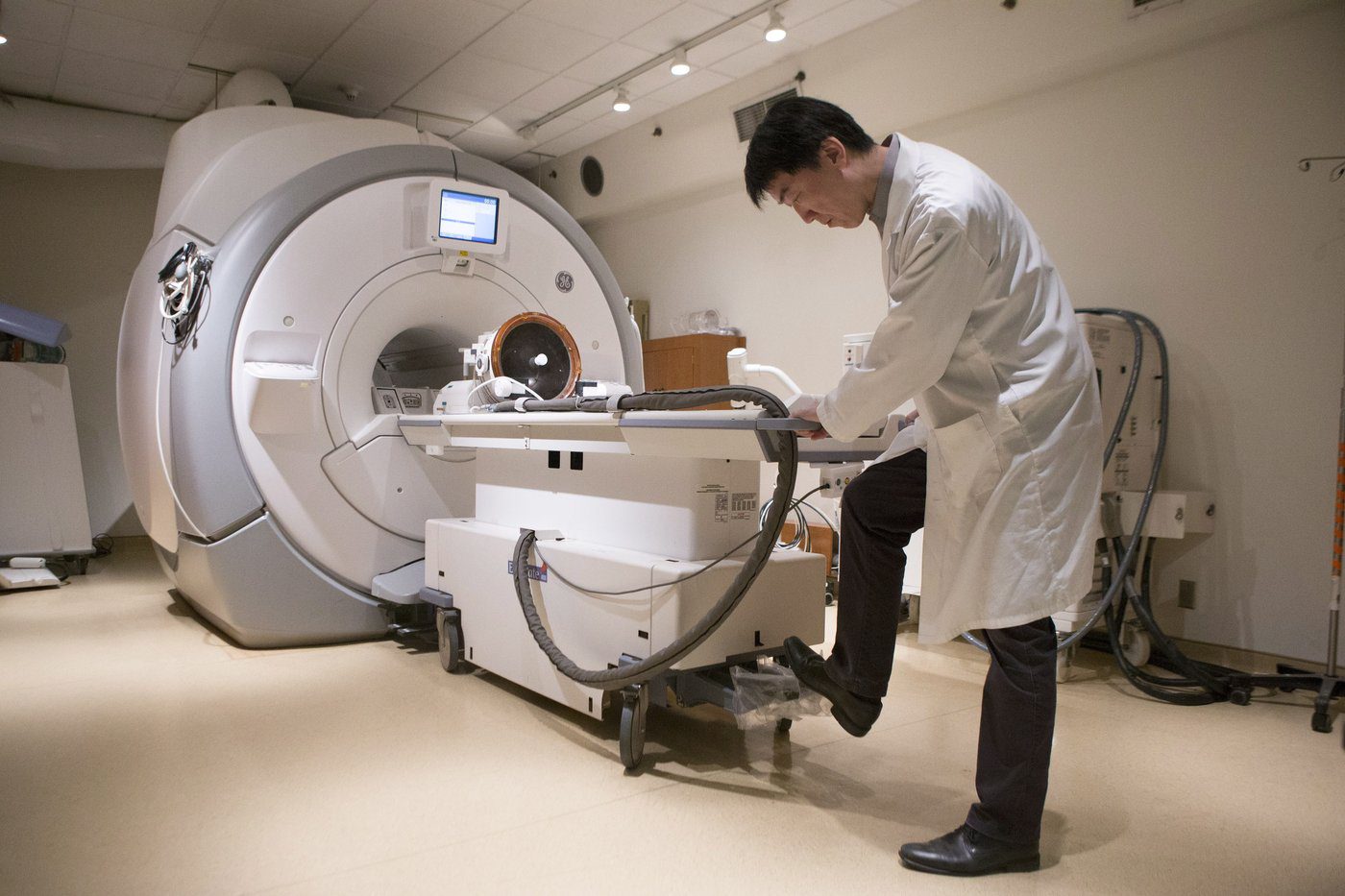
Some Alberta medical clinics are taking a wait-and-see approach to the province’s new program that lets patients bypass their doctor and privately book diagnostic imaging tests.
And those who run the machines are skeptical the province’s plan will work at all.
“The fact is we do not have enough (medical radiation technologists) in Alberta to support the number of diagnostic imaging exams that are being asked of us right now,” says Gina McRae, the Alberta provincial manager for the Canadian Association of Medical Radiation Technologists.
Premier Danielle Smith’s government has changed the rules to allow patients to book their own tests and pay up front rather than needing a doctor’s referral. The program started last Friday.
If the testing leads to a previously undiagnosed cancer finding, the patient can get reimbursed by the province. A patient wouldn’t qualify if the test is negative, finds a previously known cancer or another ailment.
The clinic can still decline a test if it finds it unnecessary or unsafe. Some clinics are turning those bookings away because they’re still working out how the new policy actually works.
The province says the program will give private operators an incentive to invest in the imaging machines and reduce testing wait times for all.
McRae says technicians in Alberta were already at their limits before the program.
“We’re very curious about how we’re going to be able to meet the new demands as more and more people are able to self-refer.”
A survey released by her organization last year suggested Alberta was short about 202 full-time equivalent jobs, and that number is expected to double by 2028.
There’s also the chance that people with no history of cancer book appointments for tests and extend the wait for those in the public health system who are at a higher risk of the disease, she said.
Data from the Canadian Institute for Health Information shows wait times for MRIs have been worsening since 2020. In the past two decades, median wait times for an MRI in Alberta were at their worst in 2017 with an average of 95 days.
That number dropped significantly in 2020, when COVID-19 appeared in Canada. Last year, it reached the longest median wait time since the pandemic of 72 days.
With the program less than a week old, some clinics have posted on their websites or have a message in their automated phone switchboard stating that they are reviewing the changes before offering the self-referral service.
Tony Alcazar, the owner of Aurora Diagnostic Imaging in Edmonton, said he first learned about the changes through one of his patients and began his own research.
His clinic opened in early July and, for now, only does X-rays and ultrasounds.
“I was surprised and I thought, ‘OK, how is this going to play out for us?'” he said.
He hasn’t heard from the province or contacted them himself, he said. For now, he’s watching how other larger clinics are taking on the new task before he makes a decision.
“If somebody comes over here (with a self-referral), I would probably politely decline,” he said.
Although the provincial government has said privately booked patients will not take priority over doctor-referred appointments, the program has raised questions about whether it violates the Canada Health Act’s promise to provide reasonable access to medically necessary care based on need.
Andrew Longhurst, a political economist at the Canadian Centre for Policy Alternatives, said there is nothing in the legislation or regulation to enforce a public health-first policy. When that claim was brought to Preventative Health Services Minister Justin Wright’s office, it did not provide a response.
“Physician-referred tests will continue to be prioritized in both public and private facilities based on need,” spokesperson Jaye Long said in a statement.
Long noted that Alberta’s Hospitals Minister Adriana LaGrange recently met with her federal counterpart Marjorie Michel to assure Ottawa of their shared commitment to the principles of the federal health act.
Longhurst said Alberta’s separate move to allow doctors to work simultaneously in both the private and public tracks has muddied the waters for the national health-care plan and moves Alberta closer to a U.S.-styled, two-tier health-care model.
The province calling it “preventative health testing,” he said, is just another way to sidestep the national health act.
“All of it points quite clearly in a direction that it is a system that is not going to be universal, it’s not going be on uniform terms and conditions which is based on the Canada Health Act, and for many reasons that’s a significant concern,” he said.
Meanwhile, one patient who has used private clinics before says she’s hesitant to support a provincewide plunge into the system.
“If you’re looking at (it) as a whole — as a community, as a province — I think it’s a terrible idea,” said Tanya Mazzer, from Airdrie, Alta.
Mazzer said she was in multiple car accidents and waited about a year-and-a-half for an MRI before learning her request was not in the system.
After the apparent error, she said she was able to have a test scheduled, but lost trust in the public health-care system. That was about two years ago.
Her following three MRIs she booked with private clinics, typically waiting a little more than a week for those.
“At least I have answers, so that part of it is nice, but not everybody’s gonna be able to afford it,” she said.
This report by The Canadian Press was first published Aug. 6, 2026.
Dayne Patterson, The Canadian Press

