


I wasn’t expecting a school class trip to invoke despair about the state of Canadian history. But it happened anyway.
It shouldn’t have been a surprise. Canada has a long history of national forgetting and cultural erasure. We know about some parts of this — about the assimilation efforts of residential schools, most notably.
But less often noticed is the weird Canadian tradition of deliberately misrepresenting and then forgetting large chunks of our national story in the interest of reaching out to cultural minorities.
We did it from the 1960s to the 1980s in a push to make French Canadians and Quebecers feel like they were part of Canada. It was well-intentioned. But it meant eradicating old symbols of Britishness from Canadian iconography — Royal Mail became Canada Post and Dominion Day became Canada Day — this last one was done almost in secret on a Friday afternoon in the summer in Parliament without telling anyone it was going to happen.
In these kinds of situations, those who challenged the shift — who argued that the cultural majority should maintain its cultural traditions — were called bigots. Why aren’t you reaching out to Quebecers? Don’t you know that we need to be welcoming and accommodating?
It’s an odd kind of Canadian tradition — and ludicrously hypocritical, as the brilliant intellectual and former Canadian senator Eugene Forsey
. The Quebec motto literally reads, “Je me souviens…” — I remember.
Forsey was completely fine with Quebecers remembering. He just wondered why English Canadians were being urged to forget.
We are doing the same thing again — this time, to accommodate Indigenous peoples.
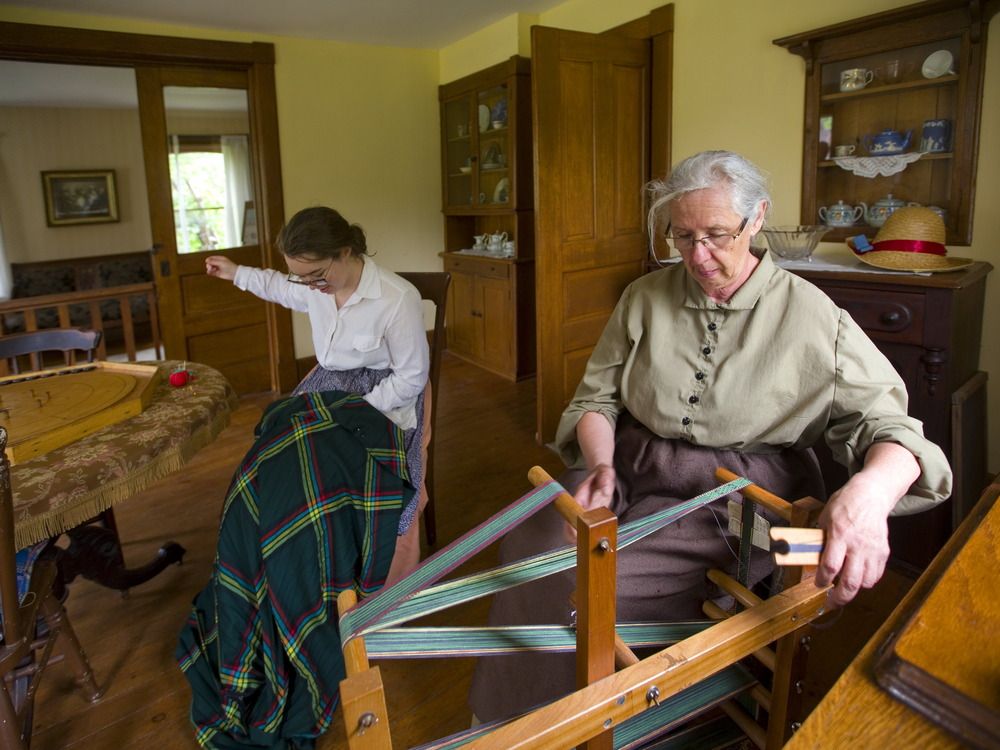
These were my thoughts as I travelled last week with a grade three class to Lang Pioneer Village near Peterborough, Ontario — one of many public history projects which demonstrate how settlers lived in the 19th century. These projects were created in the 1960s and 1970s — back when “settler” wasn’t yet a slur.
A day spent with eight and nine-year-olds brings its own kind of joy — the sheer energy, the clueless naïve curiosity, and the adorable kids, including one of my own.
But when you spend a day with dozens of children as they tour a historic site, you’re inevitably exposed to the knowledge they’ve picked up so far in their very early education — and what’s been missed.
What they know most from their post-Truth and Reconciliation Commission style education is that the main people who did things in the Canadian past were Indigenous peoples. Or, as they mostly put it, “the Indigenous.”
As we toured through buildings from this historic village, each devoted to a different artisanal skill or aspect of life, the kids seemed perplexed. There was a blacksmith, a tinsmith, a print shop, a general store, and a schoolhouse. Each interpreter walked the kids through the seemingly primitive, yet amazingly complex, sets of skills and networks of knowledge that were represented at each station.
The tinsmith used eleven different specific tools as he made a star-shaped Christmas decoration. He pointed out that the tin he used would have had to be imported from Britain. The printing press was an amazing invention that transformed 16th century Europe and the societies that emerged out of it. It needed expensive skilled labour and was constantly being updated and modified to be more efficient. Tied to the market and democracy, the printing press was part of what made this rustic little village (and the real ones it is meant to represent) part of a wider network of ideas and things. There were also weavers using complex machines that were, in some ways, the first computers.
And yet, at several points, as the interpreters turned to the kids for questions, one kept surfacing: “Did the Indigenous make this?” Because they must have, right?
To which the interpreters replied, “No,” and moved on.
So much of the social studies curriculum in Ontario tells kids to center Indigenous peoples and knowledge. How could these amazing things not come from Indigenous cultures?
It was at the replica church that things really got weird, though. There was no interpreter in this building, and so the kids were happy to run amok. One child walked up to the front and — reaching for the closest thing in his mind he could think of that might be a prayer — in mock, sonorous tones, he recited a land acknowledgment, which he knew by heart. Of course, he did.
Canadian schools got rid of the Lord’s prayer a generation ago. It didn’t fit with a modern diverse Canada. It has been replaced by land acknowledgments.
There was a time, not too long ago, when the school system didn’t operate this way — when Indigenous history and contemporary concerns were not a major focus. There has been a lot of progress to rethink how we approach the Canadian past.
But there’s also the Canadian tradition of turning a good thing into a stupid mess.
These young children know that they need to respect Indigenous cultures — and know that these cultures were sophisticated and fascinating. That’s what they’ve learned.
But what they don’t have are the lessons from an earlier time that would balance out this new appreciation. Instead, their lessons speak against an earlier way of thinking about the country. Without that earlier knowledge, what these kids are getting is the now off-balanced focus on reconciliation, relationships to the land, and inclusivity.
What they lack is the broader story of the settler societies that created Canada — about the dynamism of centuries of progress from the Scientific Revolution to the Enlightenment to the creation of modern forms of democracy, liberalism, and parliamentary institutions. Yet, this isn’t part of the elementary curriculum.
This isn’t the fault of any individual teacher (many of whom are wonderful).
It is, though, about the excesses of a cultural shift — well-intentioned — but also clueless as to its unintended consequences.
This Canada Day, perhaps it’s time to take a lot of the knowledge that’s baked into those pioneer villages dotted across the country and put it back into the curriculum.
National Post

