



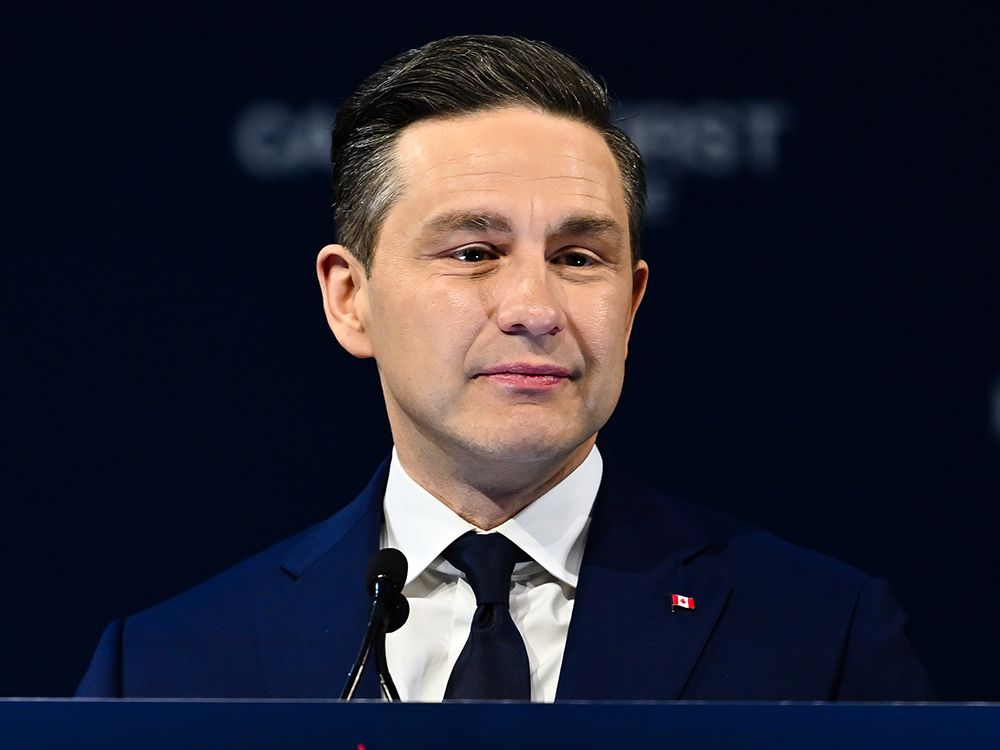
Of the many possible scenarios that could have unfolded on Monday evening, not many people seem to have anticipated the one we got: A very impressive Conservative showing, but only good enough for second place, and with party leader Pierre Poilievre
suddenly finding himself without a seat in the House of Commons
.
Considering how confident many Conservatives were, and so recently, that they would vanquish the Liberals, and considering the one-and-done trend in federal politics, one might think Poilievre’s leadership would be in serious trouble. (Stephen Harper was the last Liberal or Tory to stay on having not won an election, and he happened to be the reconstituted party’s
first
leader.)
Instead, even as they ponder campaign missteps, missed opportunities and what they see as basic strategic errors — not focusing enough on the threat of U.S. President Donald Trump, chiefly — many Conservatives seem confident that Poilievre both can and should hold on to the leadership.
“To me it’s a strong enough showing, it’s a precarious enough Parliament, that to toss the leader out … would be cutting off our nose to spite our face,” Conservative strategist Amanda Galbraith told me Monday night. “I actually think there’s a lot here to work with.”
”There’ll be a very strong argument saying we can’t give them a free ride for a year and a half just because we’re having a leadership race and going through internal navel-gazing,” echoed Yaroslav Baran, a veteran government and war-room senior staffer from the Harper era. More prominent public support came from across the Conservative spectrum, from moderates like James Moore and Rona Ambrose to bluer Tories like Jason Kenney and Andrew Scheer.
“(Poilievre’s) inspirational leadership has brought more people into the Conservative movement,”
. “His continued leadership will ensure we finish the job next time.”
Naturally, not everyone agrees. “He’s divisive. He’s polarizing. He’s so aggressive. And he drove people that would have ordinarily voted for other political parties to the Liberal party,” a Conservative source kvetched to the Toronto Star. “That’s not a winning strategy for us.”
But Poilievre has always been hugely popular among most of the party base. He brought a whole lot more people, most importantly
young
people, into the Conservative fold. Unlike O’Toole before him, who ran for the party leadership as the “true blue” option and then campaigned as a moderate, Poilievre both won the party leadership and campaigned as more or less his true self. And 41.3 per cent of those who turned out to vote — 2.3 million more than in 2021 — went Conservative.
Even without a seat, Poilievre certainly has a compelling case to make for staying. But I can see two potential problems on the horizon.
One is that Parliament might not wind up being quite as precarious as it looks. The Conservatives finished 31 seats shy of a majority in 2006, and 28 seats shy in 2008, and Harper managed to govern just fine. That was without the galvanizing effect of an annexationist madman in the White House.
The Liberals, meanwhile, are just three floor-crossing MPs away from a majority government. (Asked by CBC whether she would consider sitting as a Liberal, re-elected Vancouver New Democrat
Jenny Kwan called it “an interesting thought.”
) Failing that, the Liberals have seven New Democrats, 22 Bloquistes and the Elizabeth May Party (sometimes exaggerated as the “Green party”) to negotiate with on an issue-by-issue basis. The NDP will be preoccupied with its own leadership race for the foreseeable future and, as such, might drive an even softer bargain than Jagmeet Singh did.
The other is that Liberal Leader Mark Carney might not turn out to be a terrible or unpopular prime minister, as some Conservatives seem to be assuming he will. As impressive as those 2.3 million new Conservative votes were, the thoroughly clapped-out Liberals, running a
very
Trudeauvian campaign (minus the carbon tax) pulled in
three million
more than in 2021. The rally-‘round-the-flag effect created by Trump is powerful, in Central Canada at least, and Trump has a
lot
of time left in the White House to keep nervous Canadians rallying.
As I say, authenticity has been one of Poilievre’s strengths. But as impressive as 41.3 per cent of the popular vote is, his authentic personality also clearly turns a lot of people off. One example from the campaign just finished was particularly striking, namely, his tough-on-crime agenda.
On April 13, an Ontario tourist
was repeatedly and savagely attacked along the seawall near Vancouver’s Stanley Park
, allegedly by one Peterhans Jalo Nungu,
who was out on bail for allegedly assaulting a peace officer
. He is now out on bail
again
. It’s objectively outrageous, and it happens over and over and over — in some cases dozens of times with the same alleged offender.
The Conservatives proposed toughening bail conditions for established public menaces and making it significantly harder for them to be released from prison. Perfectly sane. But Poilievre branded it a “three strikes” rule, deliberately invoking the United States, whose penal system is a whole other kind of disaster and not something to which Canada should aspire. And he repeatedly insisted he would ensure the most violent repeat criminals only came out of prison “in a box.”
I know Central Canadian Tories, and potential Tory voters. And I can tell you that kind of rhetoric — rightly or wrongly — makes many of them squirm like beached fish. Is Poilievre capable of toning it down? Does he even want to? Conservatives need to ask themselves that question. Canadians have a remarkable ability to find a reason to vote Liberal.
National Post
cselley@postmedia.com
Get more deep-dive National Post political coverage and analysis in your inbox with the Political Hack newsletter, where Ottawa bureau chief Stuart Thomson and political analyst Tasha
Kheiriddin
get at what’s really going on behind the scenes on Parliament Hill every Wednesday and Friday, exclusively for subscribers. Sign up here.

