



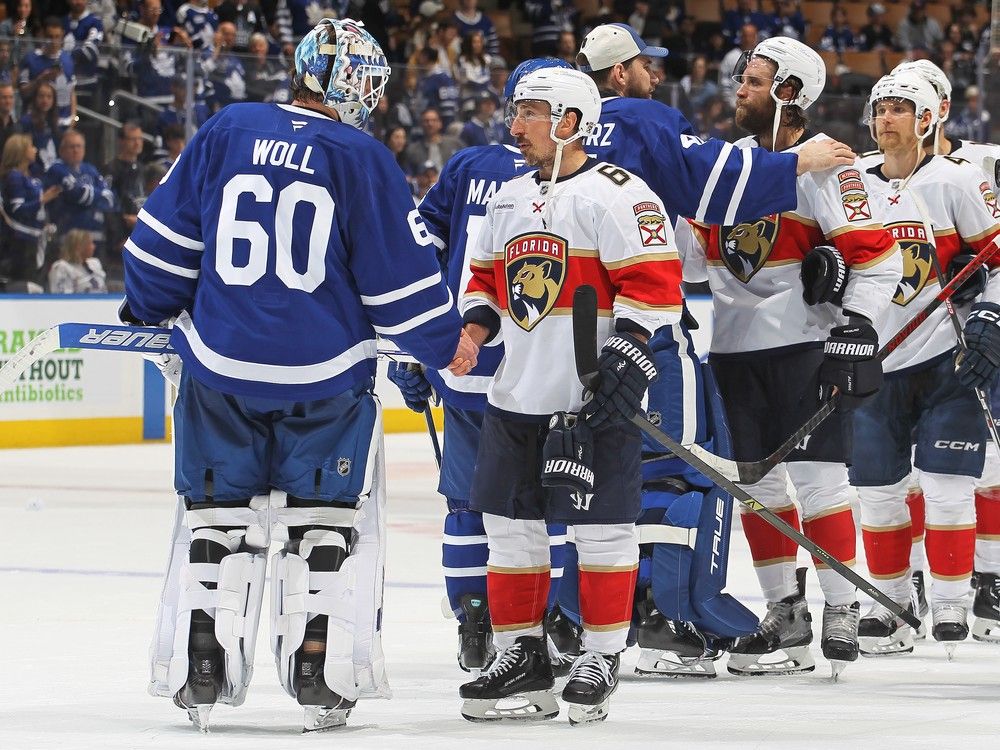
The Toronto Maple Leafs
with a trail of brown-and-yellow ice behind them, losing 6-1 in Game 7 of the second round of the playoffs to the the Florida Panthers on home ice, Sunday night. They had been up 2-0 in the series. Dismal.
The futility of this hockey club cannot be overstated. Six currently operating NHL franchises have never reached the Stanley Cup finals. The oldest is the original Winnipeg Jets-cum-Arizona Coyotes-cum-Utah Mammoth — zero sniffs at the cup over 45 years of existence. The Leafs haven’t been to the finals, let alone won, in 58 years.
I can’t quantify this, but I’m pretty sure the Leafs have severely devalued the NHL’s brand in this city and region, which is (or ought to be) the biggest pro-hockey market in the world. Head out to a pub with only one television when the Leafs and Raptors or Blue Jays are playing at the same time and you’ll see the issue right quick: You may well have to argue to get them to put on the Leafs.
In recent years, we Leafs fans have been treated to by far the most talented teams of my lifetime. But again, a decade into this new, better era, it ended in ignominy. Nine seasons with Auston Matthews, the highest-paid player in the league, and just two playoff-round wins to show for it.
“No one can defend the status quo,”
James Mirtle wrote for The Athletic
on Sunday. I’ve been watching people defend the status quo ever since. I’ve been hearing, again, about how mentally difficult it is to play in the hockey fishbowl of Toronto. As if Montrealers and their media aren’t
considerably more
obsessive about the Canadiens, who routinely find a way to make deep, unlikely playoff runs with far less talented teams than the current Leafs. As if the New York Yankees and Boston Red Sox and Los Angeles Dodgers players don’t manage to win in much more turbulent fishbowls. Ridiculous.
But look, the Leafs aren’t really the problem here. Every cartel-based sports league has basket-case franchises, though few have woven their baskets quite as intricately as Maple Leaf Sports and Entertainment. The problem, from the NHL’s capitalist perspective, ought to be that the only team in the third-largest city in Canada or the United States has been driving people away from hockey like it’s their job.
As a game for urban children — certainly at the elite level — hockey is already a sport for the relatively wealthy: people with money and cars; people with the time and inclination to fight traffic to get their kids to 6 a.m. practices, and work remotely. Basketball and soccer are, understandably, in the ascendency.
I have
long argued that the most obvious solution for the NHL and its money-hungry owners is another team
— or two, or three — in the Greater Toronto Area. Contrary to generations of Toronto barstool wisdom, the Leafs do not have any sort of “veto” over such an idea. “An expansion franchise is a three-quarters vote (of member clubs). Nobody has a veto,”
NHL Commissioner Gary Bettman said, somewhat testily, in 2014
.
And there is literally no downside to it, for anyone: The Leafs will always sell out whatever arena they inhabit, forever.
But without any business or billionaire willing to get behind a second team, there’s no point making the argument. If Toronto is really a hockey city, other solutions are available.
The major-junior Ontario Hockey League has never been a hit in Toronto. The venerable Leafs-owned Toronto Marlboros moved to Hamilton in 1989. The awkwardly named St. Michael’s Majors — St. Michael’s College being a private Catholic school/hockey factory that churned out the likes of Ted Lindsay, Tim Horton and Frank Mahovlich — decamped in 2007 for Mississauga. At the senior minor-league level, the Toronto Marlies, the Leafs’ American Hockey League farm team that wears Leafs uniforms, drew about 5,900 people a game this past season — well under their very pleasant arena’s capacity.
There are other models, though. The two-year-old Professional Women’s Hockey League (PWHL) has been selling a lot of tickets
in its six Canadian and American markets
— eight markets next year — offering its players a minimum salary of US $35,000, and an average of US$55,000, to play 30 regular-season games a season.
It’s great hockey. But as novel as it is, gender-wise, it’s hardly revolutionary business-wise. Canada and the United States have seen dozens of entrepreneurial upstart hockey leagues come and go over the years. They ranged widely in ambition and credibility. There was the World Hockey Association, which imagined itself a competitor to the NHL and put the likes of Bobby Hull and Gordie Howe on the ice to demonstrate it. And there was the America West Hockey League, an altogether ludicrous and short-lived contraption that stretched from Fairbanks, Alaska to Fernie, B.C. (where I cheered on the Ghostriders in the early 2000s) to Tupelo, Miss.
If there are no willing investors for a second GTA NHL team, why not an upstart men’s league along the lines of the PWHL —
which is incidentally owned by the Mark Walter Group
, which also owns Major League Baseball’s L.A. Dodgers.
I would propose no drafts, no age limits (within reason, I suppose), no salary caps, just capitalism. Sign whoever you can sign for whatever money you can cobble together and play hockey. How many disgruntled major-junior players are there out there, playing for no money with dodgy organizations in towns hundreds or thousands of kilometres from their families? How many older players currently plying their trades in European leagues (some of which pay
very
well, mind you) would rather be closer to home?
If there are no billionaires or telecommunications giants willing to step up and advocate for a second Toronto NHL team, let’s get some minor-league rich folks into the game. By rights you could start a six-team league just in the GTA. And if that doesn’t work, well, maybe Toronto has one true hockey team it deserves. It’s often said, ruefully, that Toronto is less a “hockey city” than a “Leafs city.” And the Leafs are a haunted mansion of wretched defeat.
National Post
cselley@postmedia.com

