



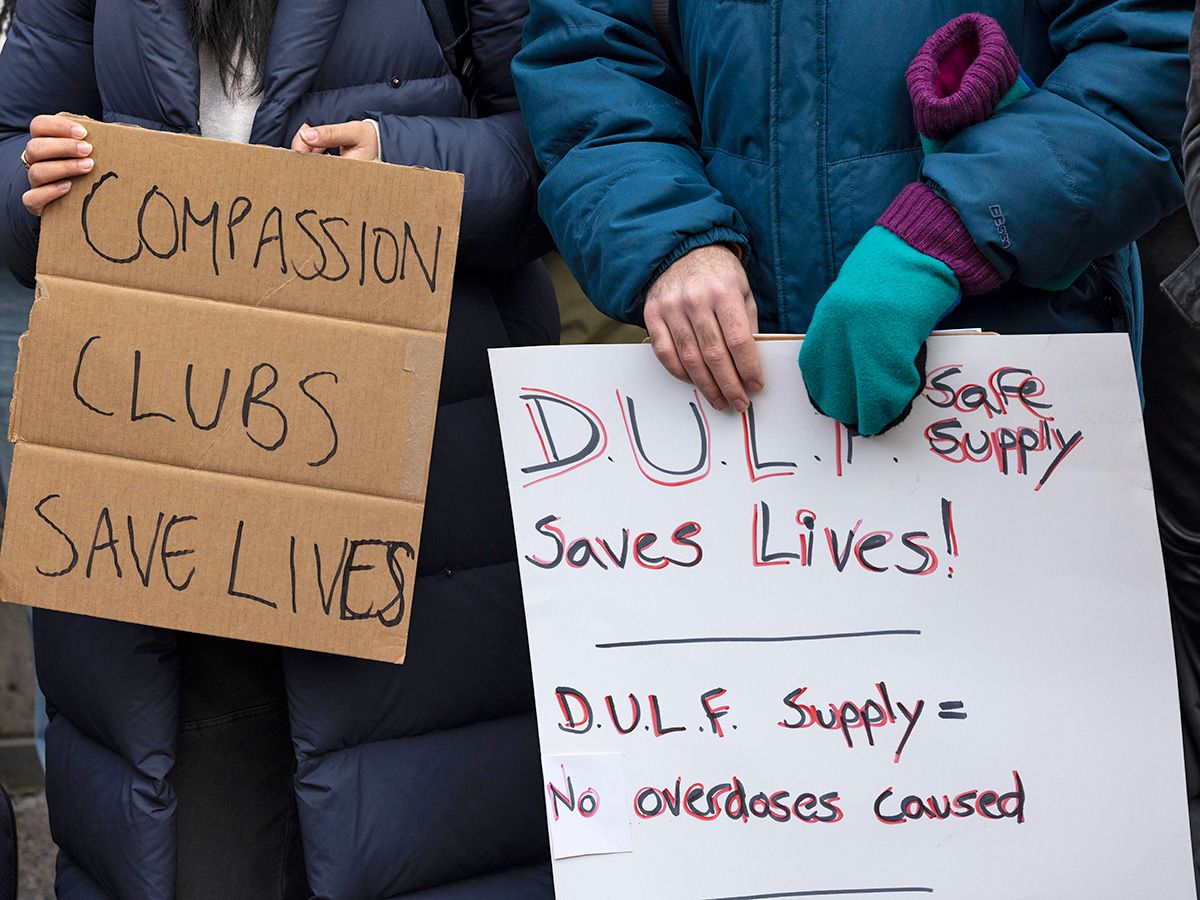
B.C. Supreme Court Justice Catherine Murray added a notable item to Canada’s rich library of addlepated court rulings this week when she ruled in favour of the proprietors of the Drug User Liberation Front (DULF), who are by any dictionary definition — and, police allege, by the criminal definition — drug dealers. They sell cocaine, meth and heroin, only the best! But they do not want to face consequences for dealing drugs, because they’re not that kind of drug dealers. They’re a “compassion club,” you understand. They screen out the riff-raff , apparently.
Murray decided that Section 5(2) of the Controlled Drugs and Substances Act — “no person shall, for the purpose of trafficking, possess (a listed prohibited) substance” — violated both “the right to life and security of the person,” i.e., Section 7 of the Charter, and also the right to equality before the law, i.e., Section 15.
Now, that’s crazy enough on its own. I’m so sympathetic to harm-reduction efforts that I’m furious how much their implementers have buggered it up. But to say the Canadian government effectively cannot ban the distribution for profit of certain substances and be in Charter compliance is … well, something I would expect a group called the Drug User Liberation Front to argue. Not a Canadian court. Murray is a former prosecutor!
It is unreasonable to ask or expect that your average Canadian would read Murray’s 22,000-word court ruling, or any other. John le Carré, they are not. It’s the media’s job to condense those rulings down to a digestible format, and we do a reasonable job, sometimes much better. (Subscribe to National Post!) But if you want to drive lunatics from the bench, which I do, and which I think most Canadians would support as a group endeavour, it’s difficult to really drive home how much truly unhinged thinking goes on in some rulings without reading at least the juiciest parts. And Murray’s ruling is juicy like a ripe pineapple plucked straight from a Polynesian shrub.
The most jaw-dropping elements, from a layman’s standpoint, are some of the things Murray considers “facts.”
“Fact: There is a need for non-medicalized safer supply,” she writes.
“Safer supply” refers to the notion of providing pharmaceutical-grade drugs to addicts as a sort of remedial maintenance procedure, ideally leading to lasting treatment — but even if not, at least they know what they’re taking and can measure the dose against their tolerance.
“Non-medicalized” means “no doctors involved.”
Safe supply went terribly wrong even with doctors involved, as Adam Zivo has compellingly reported in National Post , with opioids intended for doctors’ patients being resold on the street in exchange for precisely the junk the program is meant to get addicts off. (Most Canadians suffering from debilitating drug addictions are not addicted to hydromorphone — the most commonly prescribed “safer supply” opioid — but rather to fentanyl. I have never quite understood the point of trying to manage an addiction to one drug with a clean supply of a weaker one. The outcome that occurred seems near-inevitable.) Removing the medical profession from the equation entirely does not seem like a guaranteed victory.
And, Murray writes, “Fact: DULF’s Compassion Club reduced the risk of death and serious bodily harm associated by the toxic drug crisis and did not impact public safety.”
DULF had presented as evidence a study purporting to show it saved people’s lives.
“The Crown argues that the applicants have failed to establish that (DULF) reduced risk to … members,” Murray goes on. “The Crown says that the DULF scientific evaluation is lacking… The acknowledged shortcomings include the small study sample, the lack of a randomly selected group, the short duration of the study, the lack of a control group, and the susceptibility to response bias since DULF members self-reported their data.
“These weaknesses were unavoidable in the circumstances,” Murray wrote, correctly.
But when you haven’t even properly measured something due to unavoidable weaknesses in the data, you cannot refer to that thing as a “fact.” It’s terribly unfair that some things are hard to prove, I know, but you don’t get special fact dispensation in such affairs.
Who conducted this study, you may ask? Well, that would naturally be DULF, the proprietors of which were facing charges that led to this successful court challenge.
I have long been fascinated by judges who rule a certain phenomenally popular decision would risk bringing the Canadian justice system into “disrepute.” The ne plus ultra example of this is R v. Bissonnette, the case of the Quebec City mosque butcher who appealed his sentence of life without parole for a newly legalized life sentence without parole for 40 years. (Thanks for trying, Stephen Harper.)
“The effects of a sentence of imprisonment for life without a realistic possibility of parole support the conclusion that it is degrading in nature and thus intrinsically incompatible with human dignity,” the Supreme Court ruled on Bissonnette’s sentence. “(This) does nothing more than bring the administration of justice into disrepute and undermine public confidence in the rationality and fairness of the criminal justice system.”
Unhinged. There’s no other word.
Murray has somehow surpassed that insult with her blithe declaration of “facts” that aren’t facts. When judges start questioning objective reality, we’re really cooked. Somehow, we need to make people care. Most importantly, we need to make people care who aren’t essentially inclined to question judges — which is far too many Canadians.
National Post
cselley@postmedia.com

