



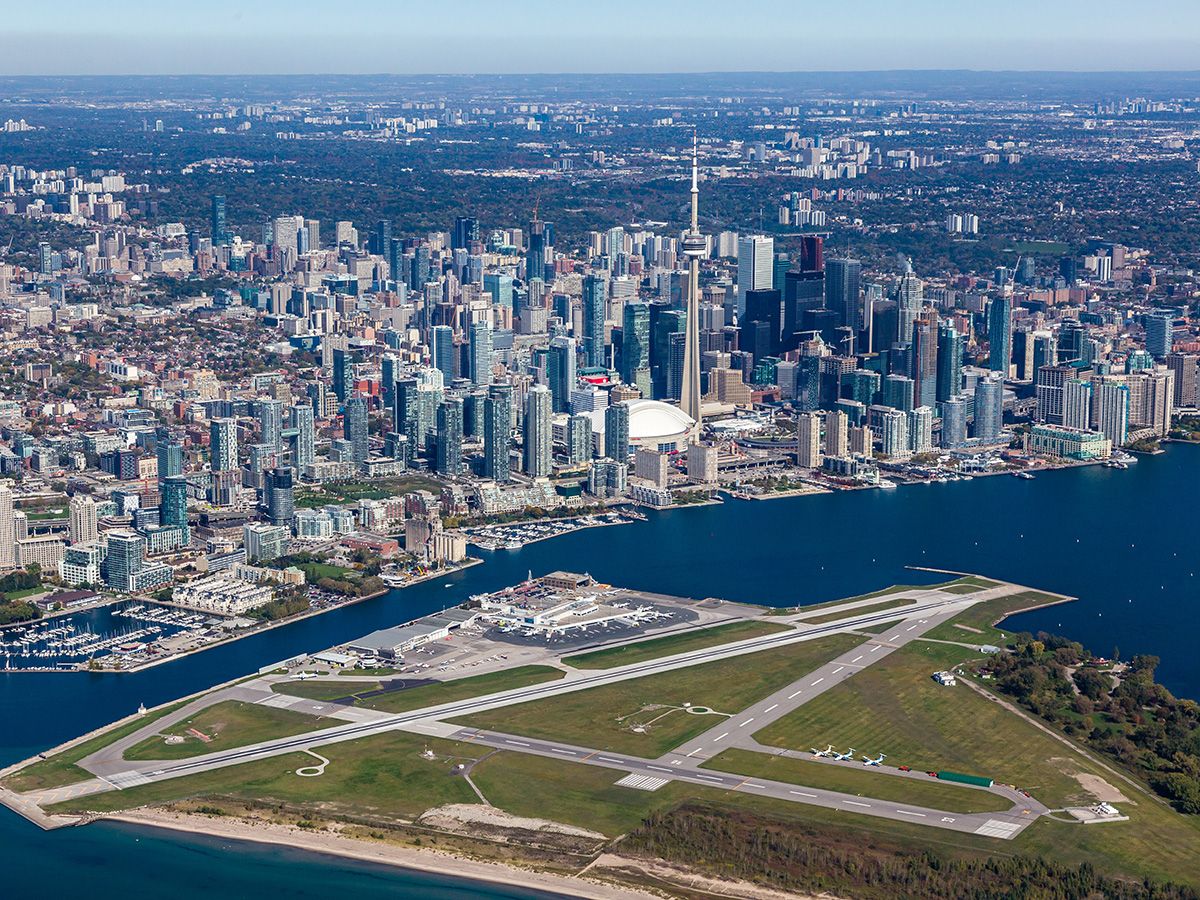
A great moment in Doug Ford-ism occurred in recent days, to much cheering from Toronto’s downtown-urbanist set. The Ontario premier had declared that the city’s little downtown airport needs major expansion, both in terms of runway length ( in order to accommodate small passenger jets versus the current turboprops) and in terms of takeoffs and landings (perhaps increasing five-fold, Ford had blithely mused ).
Last week, Prime Minister Mark Carney essentially brought the hammer down: “Nope!”
The Ford government’s case was never compelling. “By expanding capacity at Billy Bishop Airport, the province will help meet future demand in southern Ontario, reduce pressure at Toronto Pearson International Airport, increase competition in the air travel sector to support more routes and cheaper flights, and support the creation of good-paying jobs in Ontario’s aviation, tourism and construction sectors,” its press release burbled. Specifics were few and vague, allowing the idea’s opponents to flood the zone with many specific potential catastrophes: deafening noise, squinting coal-stained urchins wandering around as if in Wales in 1825, etc.
Construction jobs are a pretty lousy reason to build an airport or anything else. I’m not sure why it would have necessarily led to “more routes”: You can’t currently fly anywhere out of the Island Airport that you can’t from Pearson. And no short-haul wee-jet airport in downtown Toronto (you would never even see a Boeing 737 under this plan, never mind anything bigger) is going to remedy the fundamental factors that straitjacket competition in federally regulated industries like airlines. If politicians wanted to take on those fat-and-happy incumbents, they would. They don’t, even though many Canadians loathe those fat-and-happy incumbents . (In many countries, surely, this would be considered compelling circumstantial evidence of some sort of corruption.)
Ford’s real killer defence of the idea, as it often has been during his career, is that it’s what “the people want.” He cited an internal poll, that showed 70 per cent support, but we weren’t permitted to see it. Public polling suggested it was more like 50/50. So now Ford is somewhat diminished, at a time when he can’t really afford it: Polls suggest his Tories could be neck-and-neck with a provincial Liberal party that doesn’t even have a leader. And Carney’s federal Liberals get to act like they acted purely on principle, though it mysteriously took weeks for them to do it. Nothing has gotten better in politics or at the Island Airport. Things might have gotten worse.
As it stands, the airport is a cool little waterfront feature. But it is definitely losing some of its advantage. If you want to get from City Hall to the lounge by 5 p.m. on a weekday, which is 3.5 kilometres by road, Google Maps suggests you budget more than half an hour in a cab to lurch your way, bug-eyed, through downtown traffic.
Public transit takes longer and isn’t very good, which is one of the airport’s little ironies. Reagan National Airport is served by two lines on the Washington Metro. London’s City Airport is served by the Docklands Light Railway, the Tube, and ferries that run up and down the Thames.
Toronto’s Island Airport is served by a couple of streetcars or a shuttle bus. And there is no realistic prospect of fixing the traffic or the public transit. A critical mass of decision-makers and their unelected staff at City Hall don’t think you should be driving at all, for any reason, and also that Island Airport shouldn’t exist in any form. (I actually agree with the latter point, but only as a very long-term goal.)
Meanwhile, public-transit options to Pearson are improving. And other regional airports provide far more compelling alternatives to Pearson than the Island — Hamilton, Waterloo, London — because they have much longer runways than the Island will ever have. Ford should wish he had stumped for those instead. It’s not too late.
Chris Selley
cselley@postmedia.com