



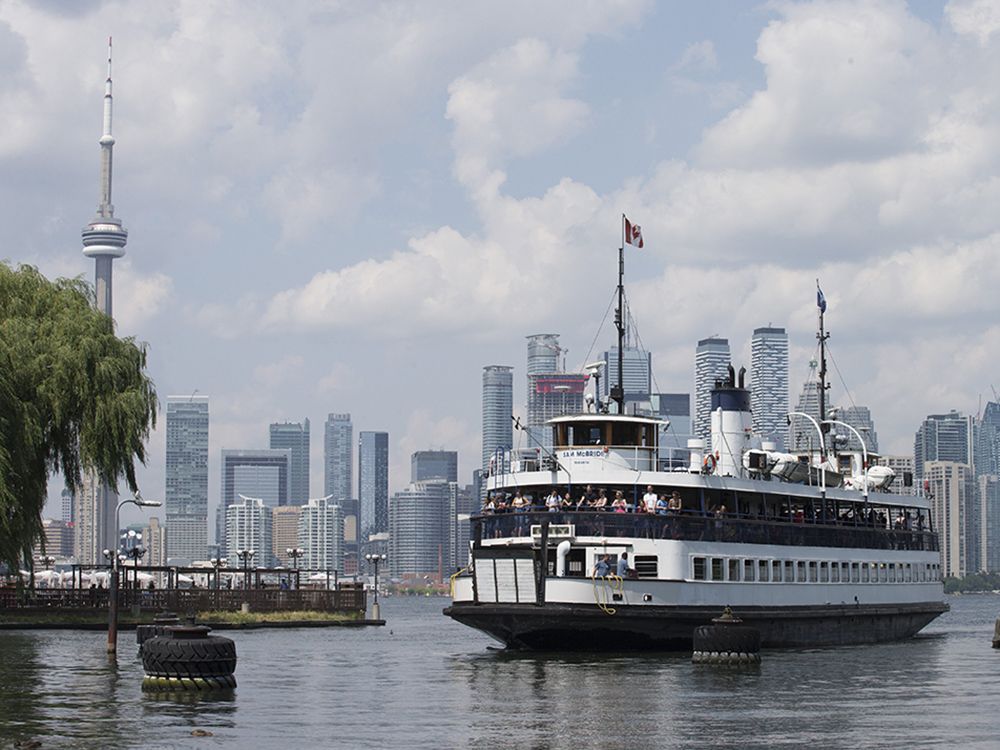
Progress has erupted in Toronto. At the request of city council, municipal staff this week delivered
a 27-page report titled “Improved Active Transportation and Water Access to Toronto Island Park,”
in which they contemplated heresy: A permanent link between the 240-hectare isle and the city’s mainland, which would involve constructing a bridge or tunnel across roughly 250 metres of water.
For the record, the Channel Tunnel between England and France is more than 50,000 metres long.
A “fixed link,” as we call the idea here in Toronto for some reason, would have many benefits. No more interminable queues at the ferry terminal on beautiful summer days. No more having to pay $28 for a family of four to visit the city’s greatest park — arguably the city’s greatest
thing
— while still having to subsidize the ferry operations. (In 2019, the ferry service’s operating expenses exceeded its operating revenues by $1.3 million.)
If this bridge-or-tunnel endeavour were taken to its natural logical conclusion, the city could get out of the ferry business altogether. (There are already many private water taxis.) Privatization would liberate the ferry service from city council’s insane decision-making.
Because the city’s current ferry fleet is ancient and decrepit,
in 2020 council approved the purchase of two new ferries
from a Romanian shipyard. Naturally they had to be electric ferries. Also, the ferries would have to be cosmetically similar to the current old-timey ferries.
“For the love of God,” you might ask, “why”?
Well, see, most Toronto city councillors, having ample backyards of their own, if not cottages as well, view the Toronto Islands less as an important civic amenity for parks-starved downtown residents than as a sort of twice-a-summer nostalgia trip — like a day out on a steam train that comes with a souvenir conductor’s cap. They
like
that it’s inaccessible.
In any event,
it recently emerged that plans for the new electric ferries
, which are already (you’ll never believe it) nearly three times over budget — $92 million for two stupid boats — had not hitherto included any provision for
charging
the ferries. D’oh! Another $50 million down the drain for that, subject to cost escalations.
Torontonians don’t get much for their 27-page “fixed link” report. Most of it just rehashes year after year of council decisions with respect to the ferries and the park, including a new recent “master plan” for the Islands that managed not to contemplate a “fixed link.” Staff do go into great detail explaining why this idea is probably doomed to fail, though.
The most convenient link to the island, the quickest and closest to downtown, would be across the western gap of the harbour — except Toronto’s Billy Bishop Airport (which has its own roughly 250-metre tunnel) lies on the other side of that gap, and you can’t have people traipsing across an active runway.
The report considers the eastern gap of the harbour, which doesn’t have that problem, but it’s also further from downtown — a 15-minute-or-so bike ride from Union Station — with no reliable current public transit links.
A bridge would either need to be high enough to allow commercial shipping underneath, but not so high as to disrupt flight paths to the airport; or, more practically, it would have to swing open or lift to allow boats through.
But, staff warn: “A lack of predictability in harbour access would potentially drive recreational and commercial users away from the harbour entirely.”
Really? Redpath is going to shut down its incongruous sugar refinery on the Toronto waterfront, after 65 years, just because boats might have to wait 20 minutes to enter the harbour? The Royal Canadian Yacht Club is going to up stakes and move to Scarborough? It reeks of quintessentially Torontonian conservatism: any change is probably bad.
As for staff’s concerns about transit links, well, if this is a “generational project,” as the report hilariously calls this endeavour, then surely said links could be improved, and future plans modified, while the world’s top engineers rack their brains in search of a feasible solution to this 250-metre conundrum. (For the record, regarding “generational projects”: digging for the Channel Tunnel began in June 1988. Passengers were whizzing through it, sipping Champagne, in November 1994.)
There are many problems with the “fixed link” discourse in Toronto: The aforementioned belief that the Islands, unlike a normal park, somehow
should
be gatekept both physically and financially; the wildly outsized political influence of the few full-time residents on Ward’s Island, who would fight any bridge or tunnel proposal tooth and nail; and, when it comes to the bridge idea specifically, the obvious enthusiasm many proponents have to build some kind of selfie-worthy landmark structure — something with “tourist appeal,” as the staff report puts it, as if a 250-metre sidewalk and bike path might someday rank with the Golden Gate or Sydney Harbour bridges.
In any event, a tunnel obviously makes much more practical sense — especially if it costs roughly the same as a bridge, which staff shruggingly suggest it probably would … while admitting they have no real expertise in the matter, and no way to judge. They suggested around $100 million, give or take … which, interestingly enough, is less than Toronto is paying for its antique electric ferries. Perhaps there’s a lesson in there somewhere.
Staff recommend further study, and quite rightly. But in Toronto, so often, the future never comes. The future means change, and we can’t have that.
National Post
cselley@postmedia.com
Get more deep-dive National Post political coverage and analysis in your inbox with the Political Hack newsletter, where Ottawa bureau chief Stuart Thomson and political analyst Tasha
Kheiriddin
get at what’s really going on behind the scenes on Parliament Hill every Wednesday and Friday, exclusively for subscribers. Sign up here.

