



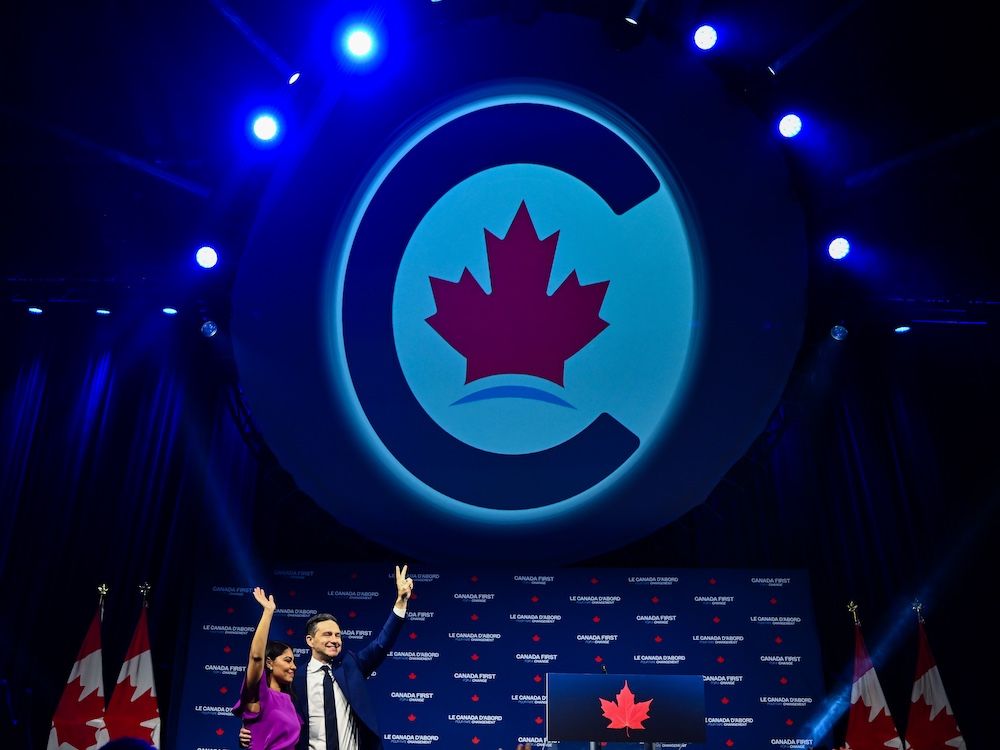
After losing to the Mark Carney Liberals, the Conservatives are going to be poring over their campaign strategy, with many blaming the outcome on leader Pierre Poilievre’s refusal to pivot his campaign more completely from issues of affordability to focusing on Donald Trump. There is some truth to that. As Poilievre’s 20-plus point lead in the polls collapsed, it is worth asking if he could have done more to keep some of those voters onside.
For instance, could he have moderated his policies, or his tone? Could he have been more congenial with the media? Or could he have worked harder to bring moderate conservatives like Ontario’s
or Nova Scotia’s
(More than anything, the internal warring in the Conservative movement resembled score settling between rival factions.)
Certainly, had Poilievre adjusted and refined his approach, he might have come a hair closer to winning the election, but gaining more than 20 seats and eight per cent in the popular vote over 2021 might have been the upper limits of what was possible.
In reality, it is not clear there is much the Conservatives could have done to win Monday night.
Poilievre was facing off against two behemoths: The first was U.S. President Donald Trump, whose threats to Canadian sovereignty and levying of tariffs created a crisis that benefitted the government. The second was the Liberal state itself, by which I mean the way the party uses the levers of government for nakedly partisan goals.
It was only four months ago that the Liberals were polling
but it might as well have been a decade ago, for all it mattered. Once Trump started threatening 25 per cent tariffs back in November, followed by constant musings about annexing Canada, the die was cast. Although what followed Trump’s economic threats was chaotic buffoonery on the part of the Liberals as the party hit its nadir, they had been gifted with the chance to campaign against Trump.
Of course, at the time, it didn’t seem to be the boon to the Liberals it would become. When then-finance minister Chrystia Freeland resigned from cabinet and failed to deliver the fall economic update, and then-prime minister Justin Trudeau went days without speaking publicly, it seemed obvious that the clown show in Ottawa was ending.
All three major opposition parties — the NDP, Bloc Québécois, as well as the Conservatives — had pledged to topple the government in a confidence motion in January.
However, just as Poilievre’s chances appeared to be at their highest, what the Liberals did next ended his hopes right then and there.
The government claimed Trump’s threats constituted a crisis, but Trudeau responded by
on Jan. 6, and proroguing Parliament, bending the apparatus of government for partisan aims to give the Liberals a chance to select a new leader ahead of an election. Given that Trudeau was certain to lose a confidence vote, it is questionable whether he had a right to make that move in the first place.
The Liberal manipulations did not end with prorogation. Once Trump’s tariffs appeared to be imminent, Trudeau avoided calm attempts at negotiation, exploited the “crisis” to insult the U.S. president, blathered on in nationalistic platitudes, and started hinting at COVID-style income supports.
While negotiations were, no doubt, going on between Canada and the U.S., rather than convene Parliament to face questions from the opposition, and to debate possible responses to the Americans,
Trudeau kicked into campaign mode
, delivering his successor a massive assist. The longer the Trump crisis persisted, the better positioned Liberals would be in any election.
Although the opposition parties had promised to bring the government down, the former prime minister should have faced Parliament to at least try and get support for his agenda.
This was to become a bit of a habit for the Liberals.
Once Carney succeeded Trudeau in March, rather than meeting the House of Commons, he made multiple policy changes and flew to Europe to meet with government leaders in the U.K. and France,
both of which he arguably had no right to do.
Because Carney swore in a new cabinet, which had never tested the confidence of the House, some constitutional experts believed the prime minister should have been following the rules of caretaker government, which are normally reserved for election periods. They limit the prime minister to duties that are urgent or absolutely necessary.
Even when the election was underway, Carney failed to respect these conventions, pausing his campaign three times to deal with Trump’s upending of free trade. By
Carney put his campaign on hold, there were no new tariffs or fresh threats from Trump. In fact, the tensions between the two countries had significantly decreased by then, but that didn’t deter Carney. He wanted to appear to be governing in a crisis, even a dissipating crisis.
To top it off, a carbon tax rebate was deposited into bank accounts less than a week before the vote. The Liberals were able to set the carbon tax to zero, and claim they were saving Canadians money, while still depositing one final rebate ahead of election day. The Liberal state always wins.
Against all this, it is a wonder the Conservatives performed as well as they did. It speaks to the relevance of the serious problems facing Canada that Poilievre was so adept at addressing. Those problems still persist, from the housing shortage, food costs and crime, to the takeover of our cities by homeless camps, the strangling of our resource sector, mismanaged immigration, and economic stagnation that is almost grotesque in its nature. None of these issues will be fixed by the Carney Liberals, who promise the same big government approach to everything that Trudeau did.
That big government approach will need to be opposed again, as fervently as it has been by the Conservatives. Now that it is clear that Poilievre
there will be those in his party out for blood. They should sheathe their knives. An extraordinary turn of events conspired against him in an unforeseeable way. If Poilievre merely had to contend with a leader less hated than Trudeau, or just Trump’s eruptions alone, he might have pulled it off. But with both together in such a short period of time, the Conservatives didn’t stand a chance.
National Post