



Mark Carney isn’t interested in being prime minister of Canada. Sure, he may like the title, the presumed prestige that comes with it, as well as meetings with Donald Trump, but when it comes down to the authority the federal government possesses, he’d rather defer to the provinces. He doesn’t want to be the leader of the sovereign nation of Canada, he wants to be a project manager for B.C., Quebec and Ontario.
At a
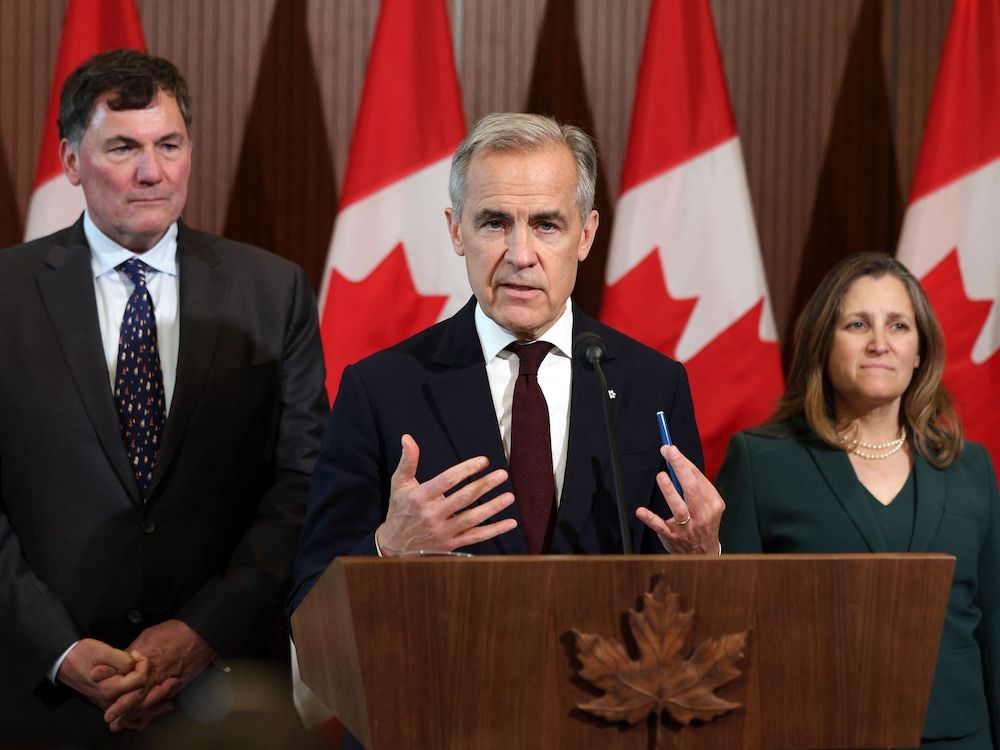
Friday to discuss his One Canadian Economy legislation, Carney claimed it would streamline the approval of projects deemed in the “national interest,” and said it was a “bill that meets this hinge moment” with “urgency” and “determination.” The prime minister spoke of how “it’s become much too difficult to build in this country” and that the “federal government” will “identify and expedite nation building projects.”
Except by “urgency” and “determination” Carney means not a streamlined process, but another regulatory regime on top of all the others. And, crucially, when Carney talks about “nation building” and the “national interest,” he doesn’t mean anything that would be in Canada’s interests but would, instead, cede power to the provinces, giving them a veto over infrastructure projects.
When asked by a reporter about whether pipelines would be approved over objections from B.C. or Quebec, Carney responded as if Ottawa didn’t have the clear authority to do so. “No. Simply no, we must have a consensus of all the provinces and the Indigenous people,” he said. If that wasn’t clear, Carney added, “if a province doesn’t want it, it’s impossible.”
To drive home an apparent ignorance of Canada’s
, Carney also said, “It is not the choice of the federal government.”
However, this is incorrect. While the Liberals may choose to not exercise their constitutional powers, it is most definitely Ottawa’s “choice.” Section 92 (10) of the Constitution explicitly grants the federal government power over “Works and Undertakings connecting” a province “with any other or others of the Provinces, or extending beyond the Limits of the Province.” Ottawa also has authority over any projects “declared by the Parliament of Canada to be for the general Advantage of Canada or for the Advantage of Two or more of the Provinces,” even if such projects exist entirely within a single province.
What this means is that if Ottawa wants a pipeline that crosses provincial borders, it is entirely within its rights to approve it, even over the objection of provincial obstructionists, be they in B.C. or Quebec. It is a power that could not be more clear and it is one that has been backed up by the courts. In 2019, for example, the B.C. Court of Appeal ruled against the provincial government, which was seeking a reference on whether it had the power to put conditions on the Trans Mountain pipeline expansion, which exports heavy oil from Alberta, through, B.C. and to the West coast. The ruling
that this was “not within the authority of the Legislature.”
In siding with Ottawa, the court noted that the pipeline didn’t just affect B.C., meaning it was not simply a local matter, but rather a project that “affects the country as a whole, and falls to be regulated taking into account the interests of the country as a whole.” If such a case, where the “basic principle,” as the court put it, of the division of powers were to be litigated now, would Carney defend Ottawa’s own authority?
For the prime minister to say there “must be a consensus,” to give the provinces a veto is clearly political, and not rooted in any legal precedent. If the prime minister was indeed concerned with projects in the “national interest” intended for “nation building,” ceding such power to Victoria, Quebec City or Queen’s Park, is entirely counterproductive. If a pipeline, or another project was truly in the national interest, then the federal government should be prepared to approve it over the objections of any of the provinces.
Alas, Ottawa constantly meddles in provincial jurisdiction, whether in health care, or in the regulation of electricity, or the taxing of natural resources, but it refuses to assert its own powers.
Prime ministers, particularly Liberal ones, have always preferred the positive feedback loop they get from social spending programs. The sometimes complicated exercise of the federal government government’s own power turns them off. But if Canada is truly to become “one economy, not 13,” then this is a fear Carney would need to get over quickly, otherwise, what is the purpose of Ottawa?
National Post