



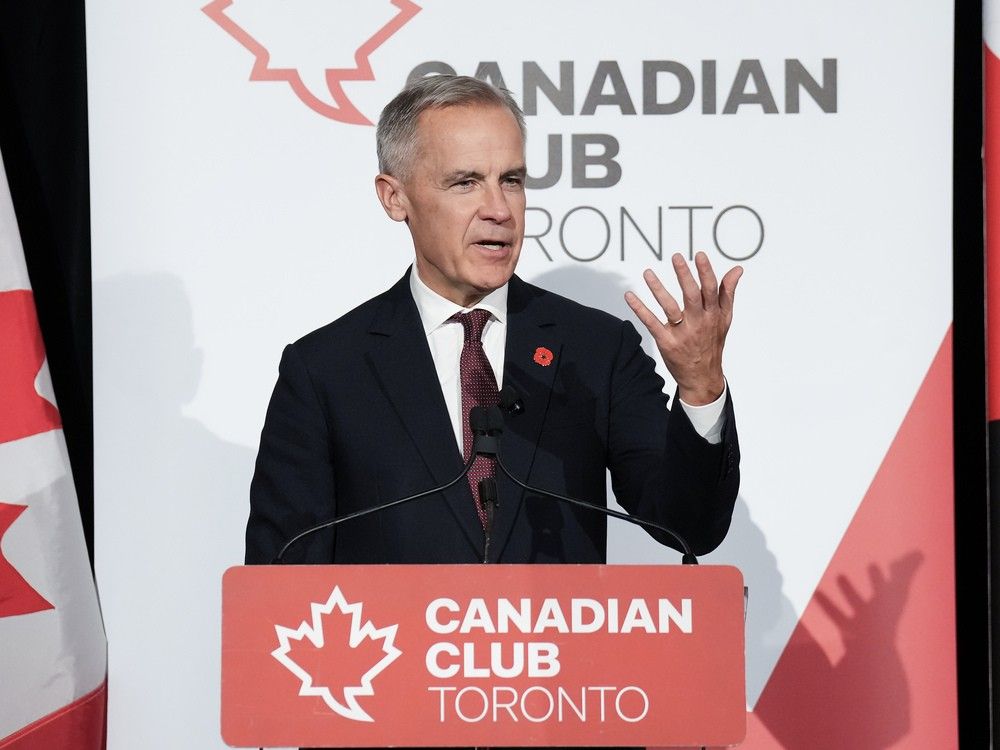
OTTAWA — Prime Minister Mark Carney announced Thursday that his government is sending more critical minerals mining, clean electricity, and a liquefied natural gas project to a new federal office designed to streamline the regulatory approvals process.
Speaking in Terrance, B.C., he announced that six more projects would be forwarded to the Major Projects Office, saying they met the government’s criteria of what constituted “nation-building” efforts to spur development and attract billions more in private investment, which the prime minister said would lead to new jobs.
Topping the new list was the North Coast Transmission Line, a project identified by British Columbia Premier David Eby’s NDP government as “essential” to expanding the province’s electricity grid, in part to support the development of other sectors, such as critical minerals and liquefied natural gas.
Carney announced on Thursday that to support its development, the Canada Infrastructure Bank had approved a nearly $140 million loan for B.C. Hydro, which seeks to twin an existing transmission line from Prince George to Terrance, B.C., to better meet growing demands for electricity. The B.C. government had been seeking financial support from the federal government, with the first stages of the project expected to cost $6 billion.
The prime minister also announced on Thursday that his government was sending the proposed Ksi Lisims liquefied natural gas project, also located in B.C., which was being partly led by the Nisga’a Nation.
“(Liquefied natural gas) is an essential fuel for the energy transition,” Carney said Thursday. “(Liquefied natural gas) can help Canada build new trading relationships, especially in fast-growing markets in Asia.”
Carney noted that Canada has the fourth-largest natural gas reserves in the world and said the country stands ready to help meet the growing demand for the fuel, predicted through to 2040.
Back in September, when Carney announced the first batch of major projects to be reviewed for fast-tracked approvals, he included on that list an LNG Canada export terminal expansion, which seeks
to double LNG Canada’s production of liquefied natural gas off B.C.’s coast.
Canada’s first major shipment of liquefied natural gas set off from the Kitimat, B.C., facility back in June.
On Thursday, Carney defended his selection of projects, such as Ksi Lisims, which seeks to build a floating natural gas facility and terminal on Pearse Island, B.C., against First Nations’ criticism by saying it was simply being sent to the federal projects office for further review.
The prime minister said that Indigenous participation in such projects was “crucial.”
As it stands, the
Lax Kw’alaams Band and the Metlakatla First Nation in northwestern B.C., separately filed judicial review applications in Federal Court last month after the federal government granted its approval under its “one project, one review” process following B.C.’s own approval.
In terms of other projects, Carney announced Thursday that his government had selected three more critical mining projects across Ontario, Quebec, and New Brunswick, as it seeks to boost Canada’s critical minerals supply.
Those projects themselves were the tungsten mine in Sisson Brook, N.B., a nickel mine Timmins, Ont., as well as a graphite mine in Quebec.
The final project selected was a hydro project in Nunavut, which Carney said would be the territory’s first fully Indigenous-owned one of its kind, and seeks to replace its long-term reliance on diesel shipments for power.
Dawn Farrell, the CEO of the Major Projects Office, appeared alongside Carney at Thursday’s announcement and told reporters that many of the projects forwarded to her office had been in development for “quite a while.”
The goal, she explained, was to bring them over the finish line by streamlining the finals approvals process to around two years, down from the current five.
“There’s a lot of work as you get to the end of the line,” Farrell said.
To do so, the Carney government ushered into law new powers under legislation, known by its legislative title of Bill C-5, which would give his cabinet the powers to fast-track project approvals by, if needed, stepping around existing environmental laws, such as the Impact Assessment Act.
The prime minister has promised Indigenous-rights holders, such as First Nations, that they would be fully consulted on projects being developed on their territories and that Indigenous participation was one of the criteria the government would use to select which projects would be eligible for its new streamlined approvals process.
One proposal absent from Thursday’s announcement was Alberta Premier Danielle Smith’s pitch to build a new bitumen pipeline from her province to B.C.’s northern coast.
Before Carney formally announced his latest batch of projects on Thursday, Smith’s office released a statement on Wednesday to say she was supportive of the choices, as her United Conservative Party government remained locked in negotiations with Ottawa on a new memorandum of understanding, which she hopes would see Carney’s government commit to repealing a suite of environmental policies, which she and other industry leaders argue hamper future pipeline construction.
“Currently, we are working on a (Memorandum of Understanding) agreement with the federal government that includes the removal, carve out or overhaul of several damaging laws chasing away private investment in our energy sector, and an agreement to work towards ultimate approval of a bitumen pipeline to Asian markets,” wrote Smith spokesman, Sam
Blackett.
Carney told reporters on Thursday that talks were “going well,” but suggested a conclusion may come in the “coming weeks.” That would be passed the Nov.16 deadline of which Smith had initially said she hoped to see a resolution.
While Alberta wants the federal government to repeal environmental laws it sees as standing in the way of a new pipeline to B.C’s coast, Carney said his government wants to see major investments in a massive carbon capture and storage proposed in Alberta, which was added to its earlier list of nation-building projects.
He also suggested the federal government wants to see Alberta look at its industrial carbon price, a policy that the prime minister committed to strengthening in the recent federal budget as a way to drive down carbon emissions.
–
With files from Christopher Nardi, Alec Lazenby of the Vancouver Sun and The Canadian Press
Our website is the place for the latest breaking news, exclusive scoops, longreads and provocative commentary. Please bookmark nationalpost.com and sign up for our politics newsletter, First Reading, here.

