



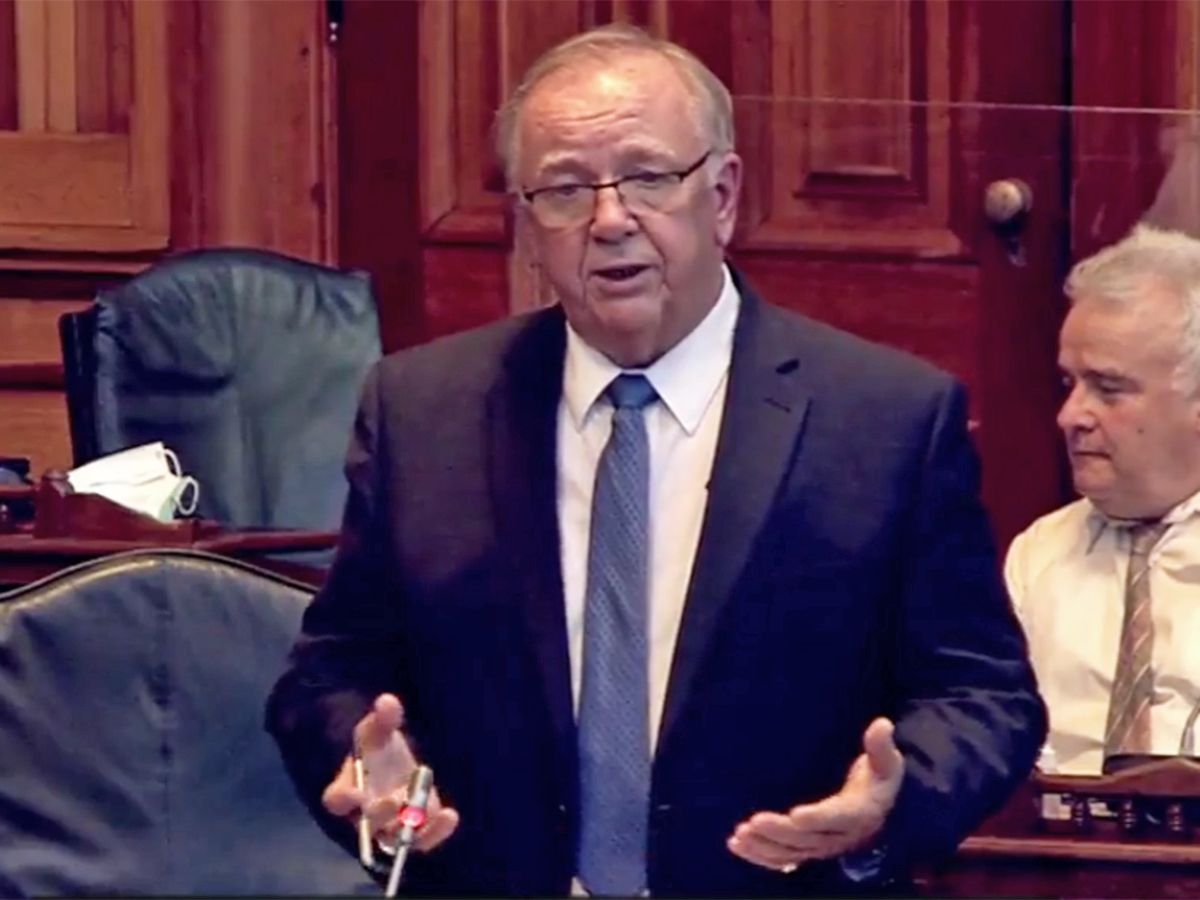
A New Brunswick politician has chalked up a dubious world’s first for Canada by apparently reading out AI prompts in an official speech.
In a June 9 speech to the legislative assembly, Progressive Conservative Bill Oliver read out the following line from a prepared text: “Here’s a more natural flowing version of that section that reads like a legislative speech rather than a series of short points.”
While it’s certainly not the first time a politician has been caught using AI to write a speech, this does appear to be the first time that the politician in question didn’t bother to remove the telltale signs of the act before reading the speech into the public record.
See the gaffe (and others like it) in the video above, or read the transcript, below.
This is Canadian politician Bill Oliver.
“Here’s a more natural flowing version of that section that reads like a legislative speech rather than a series of short points.”
This is from a June 9 speech delivered in the New Brunswick Legislative Assembly. And it seems to be Oliver reading out the prompts from an AI engine.
What’s more, he did it several times throughout the speech. Three times, to be precise. Here are the other two.
“This version should … here’s a more developed and flowing version of the section.”
“This section ends roughly …”
And, since we can now assume at least some of the speech was written by an AI engine, it does indeed carry many of the hallmarks of AI-generated copy.
One classic trait of AI-written content is that it’s repetitive, and often relies on formulaic bullet points. And there’s a lot of formulaic bullet points in this speech.
“Participation is not the same thing as decision-making. Representation is not the same thing as authority. Advocacy is not the same thing as the power to alter rates.”
“Affordability is the defining issue of our time. Seniors. Families. Small businesses. It affects farmers. It affects young people trying to purchase their first homes.”
AI engines are also notorious for writing copy that is technically correct — at least in an orthographic sense — but doesn’t actually have any real substance.
That’s true of a lot political speeches, I guess, but there’s a whole five minute section in which Oliver just outlines how governments work.
“The reality is that every decision made by government carries a cost. Every office requires resources. Every organization structure requires support. Every new administrative body regardless of how well-intentioned not only to establish itself, but to sustain itself.”
Oliver, a Progressive Conservative, sits in the opposition benches. And the whole point of this speech was to criticize a bill that would create a new government position known as the energy sector consumer advocate.
But several sections of it become extremely ironic given that we can now assume it was probably created by a computer.
At multiple points, Oliver expounds about his solemn duty to do his work as a legislator. Rather than, say, outsourcing it to an AI engine.
“Our duty is to look beyond the press release, beyond the talking points, and beyond the title of the bill itself.”
Also, this is a key point: Oliver doesn’t seem to be aware that he’s reading out AI prompts. And neither is anybody else in the Legislative Assembly.
He’s delivering a speech to whole rows of rival politicians who would benefit greatly from making him look foolish, and they’re apparently so tuned out to what he’s saying that not a single one of them caught it in the moment.
It wouldn’t be until weeks after the fact that this would be brought to public attention largely thanks to a post on the New Brunswick subreddit.
Now unfortunately, this has rapidly become one of the most widely circulated pieces of parliamentary discourse in New Brunswick history, if not Canadian history.
Clips of Bill Oliver reading the AI prompts have been viewed millions of times all over the world, and been featured in viral posts by tech websites such as Ars Technica and Futurism.
And according to ArsTechnica, this is a dubious Canadian world record of sorts. Plenty of politicians, including Canadian politicians, have been caught using AI to write speeches or campaign literature.
But this is history’s first known instance of a politician reading out the AI prompts in a public speech without even realizing they were doing it. There will probably be many more.
Stop talking and look seriously into camera.

