



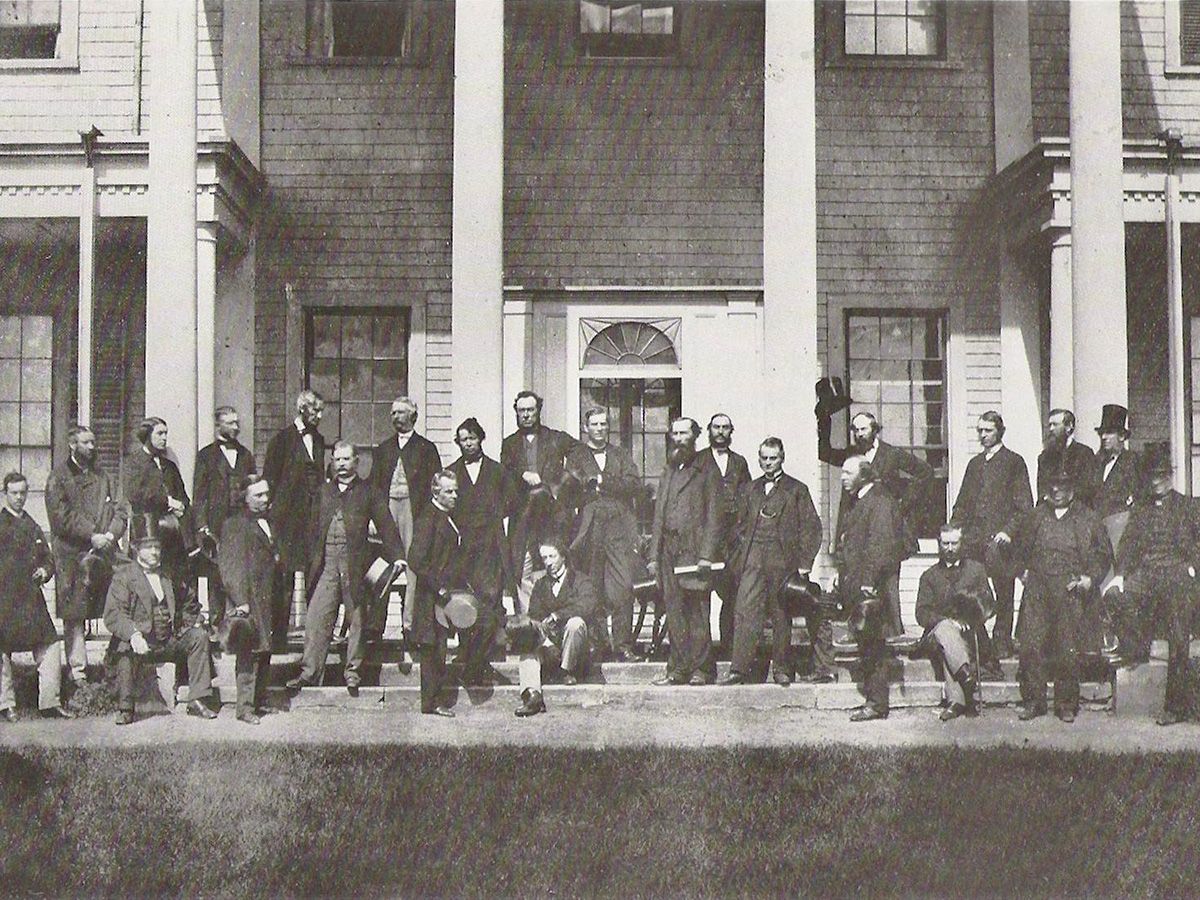
Thomas D’Arcy McGee’s 1864 pitch to Nova Scotians was simple: Joining Canada was their last shot at not becoming Americans.
McGee, the acknowledged hype man of Canadian confederation, had spent most of his life assuming that the scattered colonies of British North America would eventually be absorbed by the United States. At one time he had even favoured it.
But now, he told a skeptical Halifax audience, they had a “golden moment of opportunity” to prevent it from happening. A moment which, “if neglected, may never come again.”
“Rest assured, if we remain long as fragments, we shall be lost,” he said. Only a united Canada could head off the “Northern storm” that was sure to come.
Canada is often derided for a national identity that seems to exist only in opposition to the United States. In early 2025, then prime minister Justin Trudeau was roundly mocked for a CNN interview in which he defined Canadian identity as merely “not American.” Just this week, an editorial in the Wall Street Journal called out Canada’s “weakness for defining itself in terms of America.”
But Canada’s founders likely wouldn’t have disagreed with the characterization. Their grand project was always about roping off a corner of the continent that would be forever untouched by the American Revolution, to forge an alternative nation that would avoid both America’s sharpest edges and its worst mistakes.
And for the most part, that’s exactly what they did.
When Sir John A. Macdonald first presented the outlines of what would come to be called the “Dominion of Canada,” he made a point of stressing that it avoided all the worst mistakes of their American neighbour.
“We are happily situated in having had the opportunity of watching its operation, seeing its working from its infancy till now,” Macdonald said in 1865 .
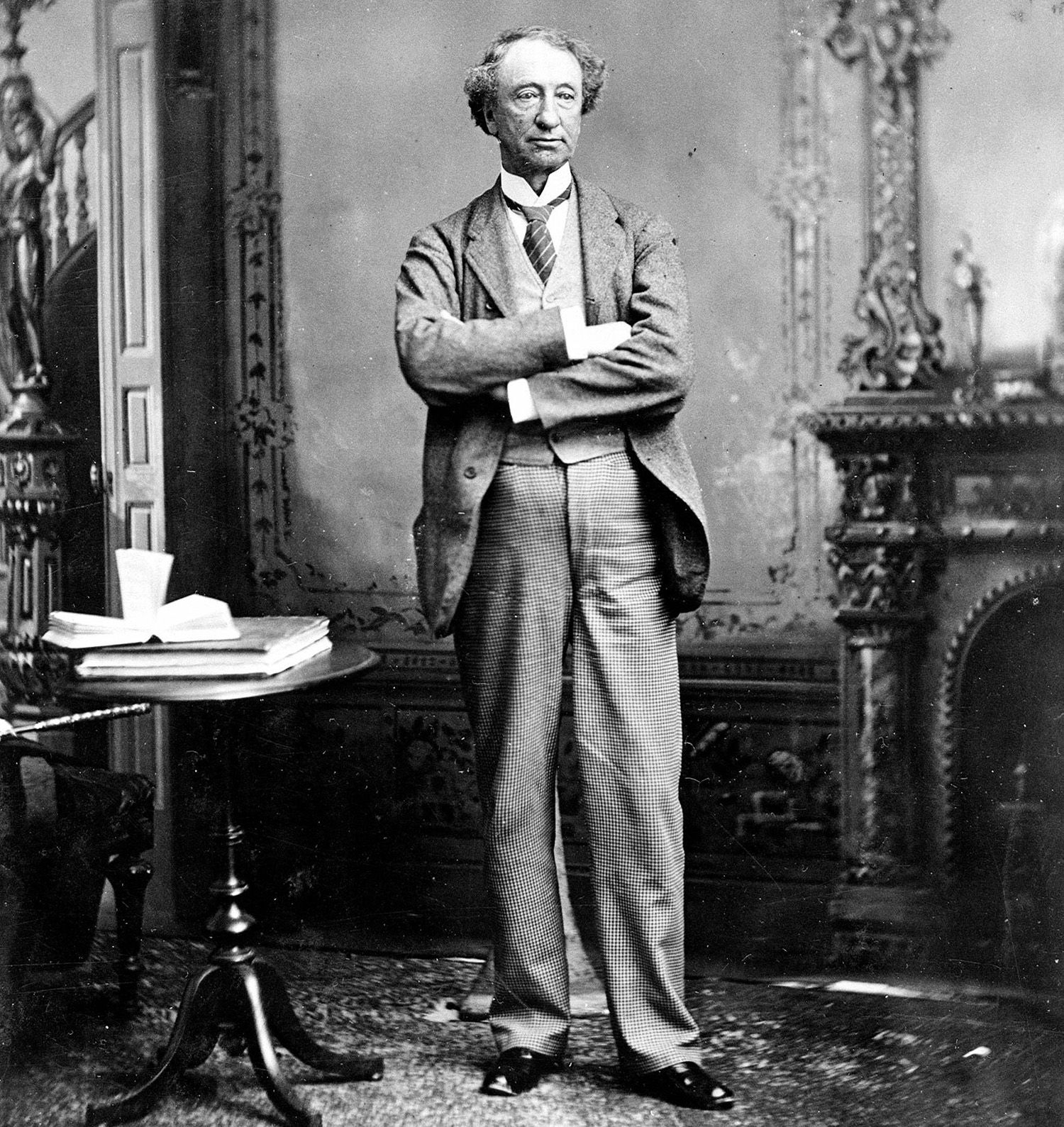
As such, they’d been able to avoid the “defects which time and events have shown to exist in the American Constitution.”
The Americans, said Macdonald, had made the mistake of declaring their constituent states to be “sovereign” entities constantly at odds with federal authority. Canada did away with this by a stronger central government.
“We have thus avoided that great source of weakness which has been the cause of the disruption of the United States,” he said.
Best of all, Canada’s head of state would be a monarch beholden at all times to elected ministers. The U.S. president, by contrast, was effectively an elected “despot.”
“A one-man power, with the command of the naval and military forces … and with the veto power as a branch of the legislature, perfectly uncontrolled by responsible advisers,” he said.
Canadians in the mid-19th century harboured no particular ill-will towards the United States. Then, as now, trade with the U.S. was a cornerstone of the Canadian economy. Several Fathers of Confederation had lived for extended periods in American cities.
Records of the Confederation debates don’t contain a single denunciation of the United States, or wish for its destruction.
“I know myself I have not a particle of prejudice against the United States; on the contrary, I am bound to declare that many things in the constitution and the people I sincerely esteem and admire,” McGee declared in 1862 .
McGee even recoiled at declarations that the United States was a failure. Such sentiments “ought to be frowned down, wherever it appears, by the Canadian public,” he said in 1861.
Macdonald said much the same. Even when he was slamming the flaws of the U.S. Constitution, Macdonald still praised it as “one of the most skillful works which human intelligence ever created … one of the most perfect organizations that ever governed a free people.”
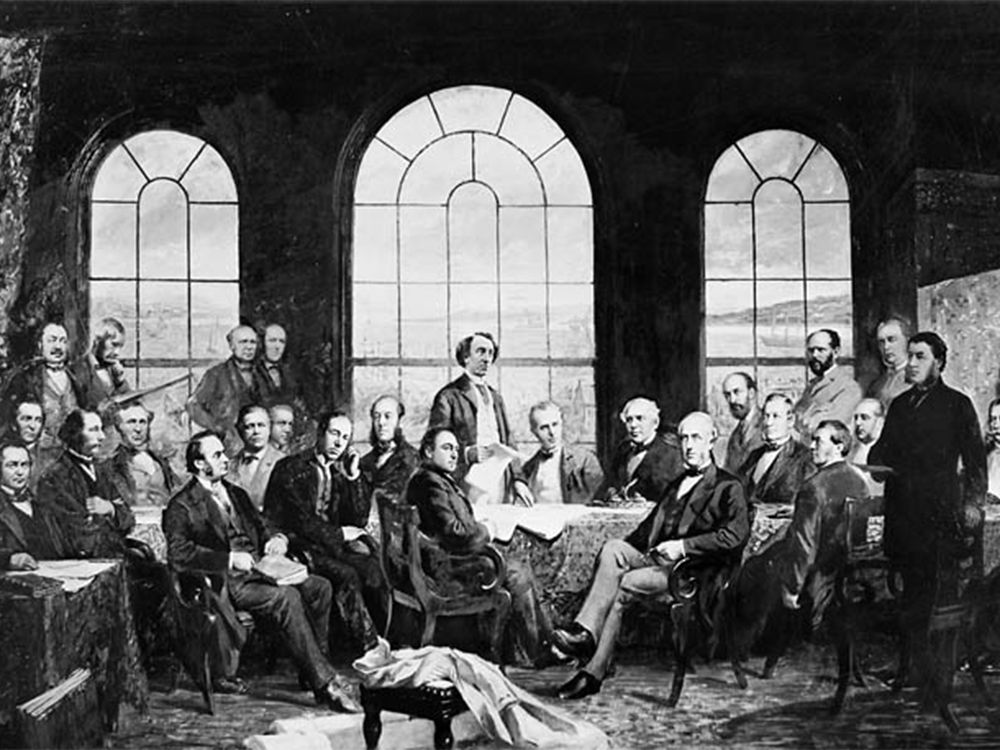
But these same Canadians also had no problem articulating why they personally didn’t want to live under the Stars and Stripes.
It’s easy for modern Americans to see themselves as the freer, more conservative alternative to Canada. But the first generation of Canadians saw it exactly the other way around.
The United States, as they saw it, was a radical experiment in mob rule plagued by political and civic corruption.
In 1849, after a small annexationist movement emerged in Montreal, the Montreal Gazette saw fit to issue a lengthy condemnation of the sicknesses of U.S. society.
“The numerous defalcations both in public and private offices in the U.S. shew something very far from perfection in the morale of Society,” it read, adding that the United States was plagued by a “dreadful catalogue of crimes of every description.”
Canada was not only safer and more virtuous, but its parliaments “shine with superior lustre and rise in proud preeminence with most of the popular legislative bodies of the separate States.”
Canadians of the era were also known to recoil at the perceived godlessness of the U.S. political class.
Also in 1849, a Toronto newspaper reacted with horror that then U.S. president James Polk had only been baptized on his deathbed. “How is it that the people of the United States suffered themselves to remain in this ignorance of the religious position of their Chief Magistrate? The anomaly must bring disgrace with it.”
Canada’s founding generation was also quick to note the American penchant to speak loudly of liberty while holding millions in bondage, slavery having been phased out by the British Empire a generation prior.
Father of Confederation George Brown had spent years as a stolid abolitionist, and he would come to believe that America’s central mistake was in becoming a republic.
“We … are forcibly led to the conclusion that Republican Institutions are not favourable to genuine liberty,” he wrote.

And the 1860s would become a particularly easy time to make the argument that the American system had failed, given that it had dissolved into full-blown civil war.
Throughout the early 19th century, British North America had experienced occasional bouts of annexationist sentiment, usually from business leaders covetous of the larger U.S. market. French-Canadian nationalists were even known to flirt with the idea that their rights would be better protected under American rule.
But these all screeched to a halt the moment American soldiers were killing each other at the rate of 500 per day.
McGee characterized the war as the “signal gun of a new epoch for North America.” A sign that British North America needed to form a common front unless they wanted to be “overtaken and subjugated.”
Macdonald took no pleasure in the conflict, calling it the “present unhappy war in the United States.” But he also called it a clear signal that the American system was broken, and that Canada could do better.
It was a belief that would continue to define Canadian political thought even after the civil war ended, and slavery was over.
U.S. expansionism would be soaked in blood by a seemingly uncountable number of American Indian Wars. But Canadians would take pride that their own Western expansion had been smoothed over with treaties. The U.S. frontier would be defined by lawlessness and vigilantism, where Canada’s would take shape under the watch of Mounties and magistrates.
In a 1905 speech, then prime minister Wilfrid Laurier would state he had the “greatest admiration” for the United States, but was constantly thankful he lived in a country where “Christian dogmas” were still strong.
“I observe in this country of ours, a total absence of lynchings and an almost total absence of divorces and murders … either the American system is wrong or the Canadian system is wrong,” he said.
As McGee once said in 1861, he hoped to see the United States emerge from its civil war and celebrate its 1876 centennial as a strong and united country. He just didn’t want to be part of it.
“We prefer our own institutions to theirs, but our preference is rational, not rancorous,” he said.

