



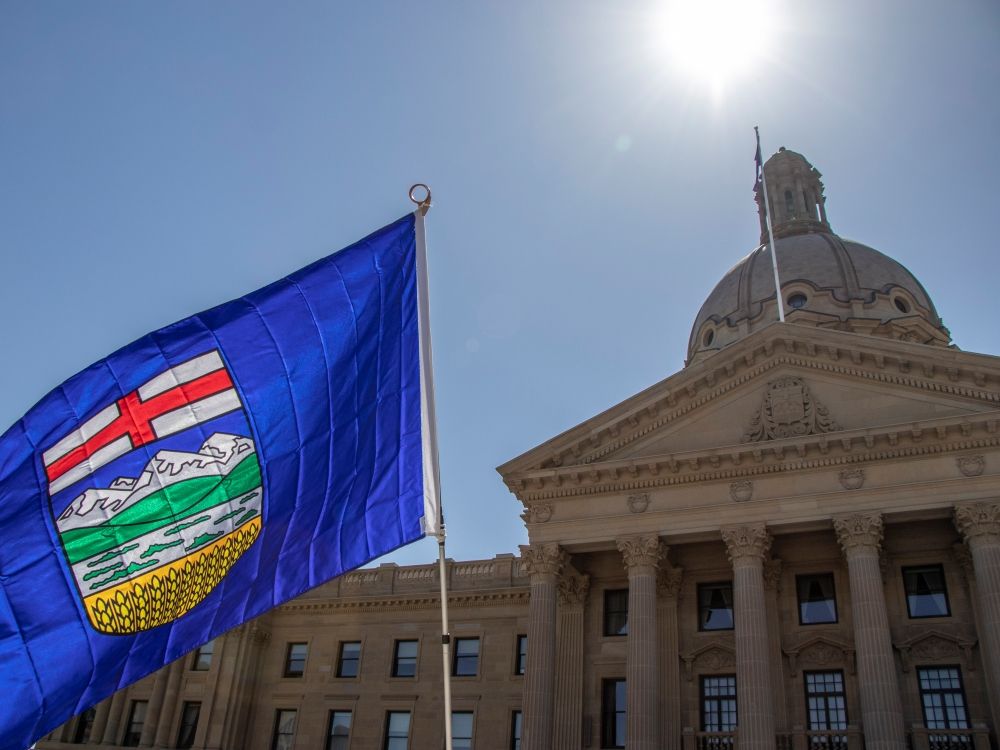
This election showed that there are still strong regional divisions in Canada, setting Alberta, in particular, apart from the rest. The newly elected federal government has the opportunity to address them while strengthening the nation as a whole.
This task should begin by understanding some basic facts about Canada’s economy and finances, and how reforming our governance to align with the Constitution is all that is needed to fix our most pressing problems.
Oil and gas make up by far the greatest share of the country’s exports — 2.5 times
than the auto sector. The fossil fuel industry supports
mostly high-paying jobs across Canada. There is a suite of policies aimed at prematurely phasing it out, but there is no replacement on the horizon that matches its productivity. The Canadian dollar and our economy will suffer greatly if these policies — particularly the impossible
of 40 per cent below 2005 levels by 2030 — are not swiftly discarded.
Canada is in a productivity crisis, and our natural resource strengths are unmatched in offering a path to remedying that. LNG exports to displace Asian coal power would reduce global carbon emissions more than anything else Canada could do.
Federal policies are not only overly aggressive in sacrificing a large economic engine for a tiny offset to the global expansion of carbon emissions, they also push right through the boundaries within our constitutional bargain. Natural resources and electricity are very clearly in the provincial domain — both before and after 1982. It will benefit all regions of the country if the feds respect this and retreat.
In addition to the economic benefits it provides Canada, Alberta’s productivity funds federal programs. Here, too, the constitutional bargain has been shredded.
When you filed your taxes last month, you may not have noticed you sent almost twice as much to Ottawa as to your province. With this imbalance of tax power, the feds have steadily made the provinces more and more dependent on them to deliver core provincial services like health, education and social supports.
Many Canadians want to see more spending in health, addictions and homelessness, education, skills training, infrastructure and many other areas that are under provincial jurisdiction. Provinces somewhat legitimately turn to the federal government for help, given that most of their residents’ tax dollars were sent to Ottawa. This not only erodes accountability, but when Ottawa does step in, it also does so with strings attached and an entire second level of bureaucracy that must be fed before any dollars get to the front lines.
In principle, if the federal government is using its dollars for legitimate federal functions, evenly spread throughout the country, there is nothing wrong with regions with higher incomes paying proportionately more taxes. Today in Canada, though, a large share of the federal budget is spent on matters of provincial jurisdiction and it is certainly not evenly spread throughout the country.
The combination of higher incomes and lower federal spending in Alberta means we subsidize federal programs outside the province. In 2023 the feds raised $78 billion in revenue from Albertans but spent only $58 billion in Alberta. The independent website
shows that from 2000 to 2023, the inflation-adjusted total subsidy from Albertans was $529 billion.
Using an average of four million Albertans over this period and assuming each was living in a family of four, Albertan households have had $544,000 in their name spent by Ottawa in other provinces. These funds often went to provincial services, spent on hiring nurses, teachers and social workers, and the facilities they work in — all while Alberta has struggled to meet growth pressures in these same areas..
For the last 10 years, while the federal government spent those dollars, layers of jurisdiction-bending economic and social policies were built to stand in the way of a prosperous future. Albertans are not asking for gratitude, handouts or special favours; we have just been asking for Ottawa to respect the Constitution.
There is an opportunity now to fix this and restore Canada’s promise for the next generation.
Economic uncertainty from the United States has unlocked a window of opportunity and we must use it. In the recent election, both major parties pledged support for expanding resource development as the surest means to boost Canada’s productivity and self-reliance. Swiftly repeal or amend the obvious barriers and, and we can continue to build.
Both parties also talked about respecting the provinces and streamlining federal regulations. Now is the time for Ottawa and the provinces to hash out their respective jurisdictions and for Ottawa to transfer equivalent tax points permanently to each province. With the proper share of your taxes, provinces will be fully accountable for their economic decisions and free to deliver efficient and responsive services.
Ottawa will then be able to focus its energies and funds on needed investments in the military, borders and interprovincial trade corridors.
The problems are clear. Our Constitution lays out the answer.
Canada’s mounting debt issues, spending pressures, and regional challenges will get much worse if Ottawa does not get back into its constitutional lane and allow Alberta — and every province — to flourish.
National Post
Bill Bewick, Ph.D., is the executive director of Fairness Alberta, a grassroots group explaining Alberta’s contributions to Canada and the barriers it faces.

