



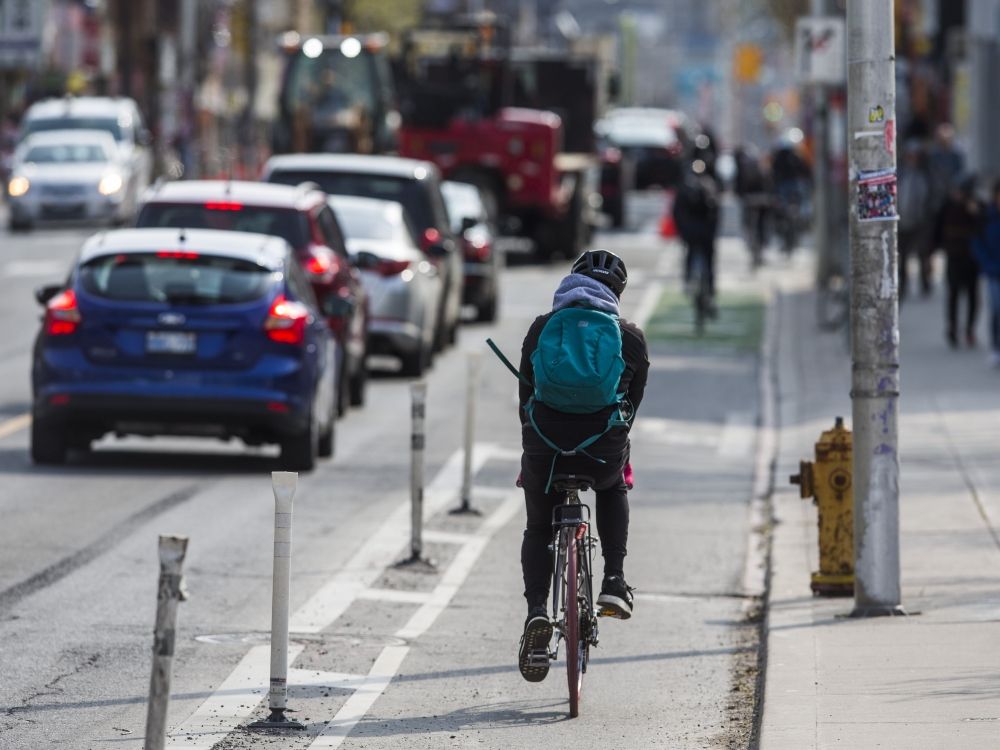
It’s absurd it even came to this, but on Friday the Court of Appeal for Ontario ruled that the Ford government was allowed to remove bike lanes in Toronto, overturning Justice Paul Schabas who ruled a year ago that removing them would violate cyclists’ rights to life and security of the person under Section 7 of the Charter.
The decision was unanimous, written by Justice Grant Huscroft, and could be described as a polite judicial smackdown. It’s a win for common sense, and the decision itself is worth reading for yourself no matter how frequently or infrequently you ride a bike. It is one of the best written and clearly and concisely argued decisions you’ll ever find. One specific passage jumps out, and should be mandated for memorization for every law student and practicing lawyer:
“Now, courts learn a great deal about a matter in the course of judicial review proceedings, and judges may be tempted to comment on matters of policy. The temptation to do so may be great; judges may suppose that they have much to offer to public policy debate. But the temptation must be resisted. It is not just that courts have no expertise in policy making — no expertise in making the sorts of polycentric decisions that legislatures make routinely. It is illegitimate for courts to involve themselves in matters of legislative policy. Policy is for politics.”
In one paragraph, Huscroft summarizes the proper role for the courts in our Westminster democracy, and where they so often seem to go wrong and engage in acts of judicial hubris that result in judges becoming legislators imposing policy preferences through the courts.
Huscroft rightly grants that a judge often has access to information and evidence that make them able to weigh in on public policy debates, but in reality judges have no expertise or legitimacy to do so. But far too often they give into the temptation. These kinds of questions must be left to politics, and public policy debates are the domain of politicans and legislators, not judges. It’s notable that Huscroft felt the need to say this in the decision.
Justice Schabas, in his now overturned Aril 2025 decision, introduced the reasons for his ruling with multiple pages of political scene-setting. He recounted remarks from the Ontario premier and the transportation minister, disputed traffic data, exchanges at committee, submissions from the mayor of Toronto and members of the public who had turned up to oppose the bill. He criticized the government’s conduct in passing the law and worried aloud that it had gone through over the objections of the government’s own internal advice. The court of appeal decision dismisses the lower court’s reasoning here in a single sentence: “None of this was relevant to the task before him.”
Schabas found the law arbitrary on the strength of Shoshanna Saxe, a transportation scholar who testified that removing the lanes would fail to ease congestion and would eventually make it worse through induced demand. Huscroft calls that a category error. Legislatures get to decide if a law actually works. A court’s only question is whether the means bear some logical connection to the end, and adding car lanes clears that bar just by being capable of easing congestion for a while. Saxe was forecasting traffic conditions years out. You can agree or disagree with Saxe on this, but it’s irrelevant for whether the law violates a section of the Charter.
At the time of the earlier decision, many of the progressive advocates for Charter protected bike lanes tried to claim, citing Schabas, that the decision did not establish a right to bike lanes. But just because the lower court stated no such right was established doesn’t make it true, and Huscroft demolishes the argument pretty effectively. He states that forbidding a legislature from removing bike lanes can only mean the lanes were constitutionally required in the first place, and he calls the conclusion “logically ineluctable.” A policy chosen by one legislature would end up frozen into the constitution and out of reach of the next one, undermining a bedrock rule of Westsminster democracy, namely that no parliament may bind its successors. The lanes exist only because democratically elected legislators passed a statute enabling them, and nothing stops a later Queen’s Park or City Hall from repealing it.
Deny it or not, the 2025 decision amounted to discovering a Charter protected right to bike lanes on the basis of academic and technical arguments about traffic, induced demand, and congestion. So how did we even get here in the first place? Justice Huscroft is candid about how this happened in the court of appeal ruling: “Something has gone wrong.” Specifically, something has gone wrong with jurisprudence of Section 7 of the Charter, which guarantees the “Life, liberty and security of the person.”
Dave Snow, a professor at the University of Guelph, published a study in May that details exactly what and how things have gone wrong. Section 7 was meant to be modest, and those who drafted it chose the phrase “principles of fundamental justice” over the American “due process” specifically to keep judges away from policy. In one 1985 reference case the Supreme Court decided the Charter’s drafters’ own statements deserved minimal weight and have taken the interpretation of Section 7 in a very different direction than initially intended.
Snow built a dataset covering every Supreme Court Charter decision since 1984. Twenty-one separate principles of fundamental justice have been invented since, roughly one new principle every seven cases, and across 61 Section 7 breaches in 40 years the Court has allowed the infringement to stand exactly once. This has of course trickled down to lower courts, who have among other things, recently used the section to block a homeless encampment clearance in Waterloo and a British Columbia ban on public drug use.
The newest member of the Supreme Court, Glenn Joyal, once called Section 7 “the single most fertile source for the discovery of new rights,” writing as chief justice of Manitoba’s Court of King’s Bench.
Cycle Toronto is considering whether to appeal the bike lanes decision to the Supreme Court, which has separately agreed to hear an Ontario case seeking to answer how far Section 7 reaches outside the criminal justice system. Almost every piece of federal and provincial legislation touches somebody’s health or safety somewhere, and a Section 7 that opens all of them turns every policy fight in the country into litigation, decided by whichever side retains the more persuasive expert. Legislatures would go on meeting and passing bills, but ultimately subject to our supreme legislators who sit on the bench.
Whatever you think about bike lanes, Justice Huscroft’s court of appeal decision is about something bigger than cycling. Those fights should happen, but judges shouldn’t be the ones deciding them. Friday’s decision is a win for democracy, but as long as Section 7 keeps getting interpreted the way it so often is, we’ll keep getting progressive policy legislated from the bench, with only a handful of judges as intellectually rigorous as Grant Huscroft standing in the way.
National Post