LP_468x60
on-the-record-468x60-white

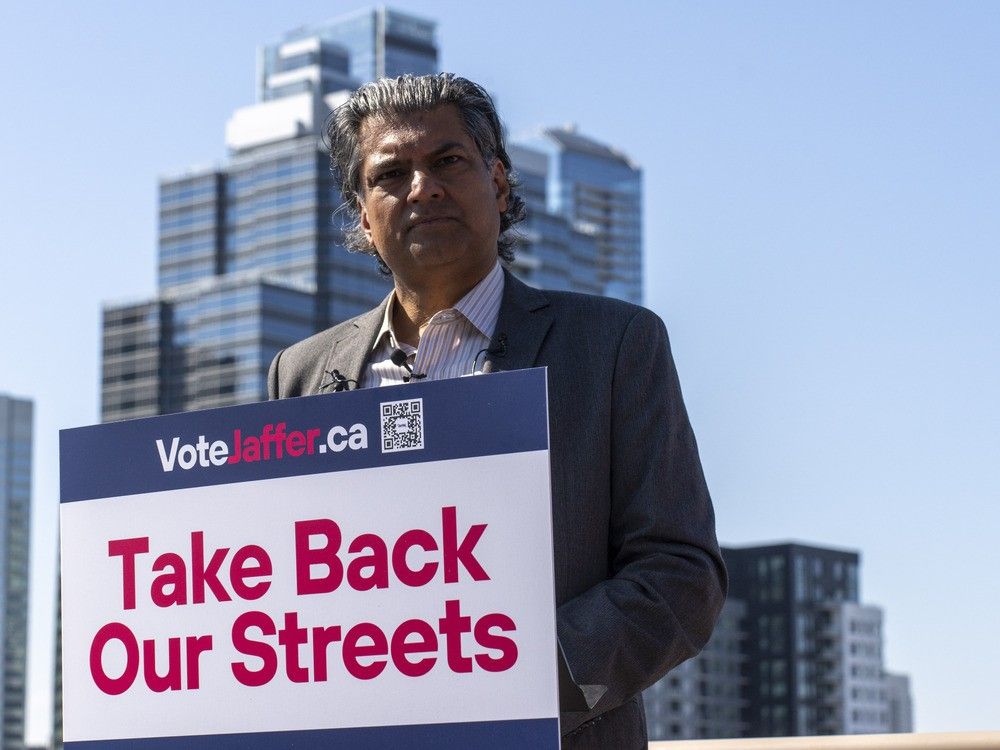
Candidate for mayor, Rahim Jaffer unveils his plan to

OTTAWA — Former four-term MP Rahim Jaffer says he’s thinking about running for the Edmonton area seat currently held by departing Conservative Matt Jeneroux.

Jaffer told National Post that he saw the stars aligning for a possible comeback when

Jeneroux announced last month

he’d be resigning from Parliament, noting the news eerily dovetailed with a development in his personal life.

“My mom lives (in Jeneroux’s riding) and … a few weeks earlier, she’d approached me and said, oh, I want to downsize, why don’t you take over this house now?” said Jaffer. “It’s kind of funny, the timing.”

Jaffer says he’s been approached by a few different people about running for the soon-to-be-vacated seat and will take some time over the holidays to mull over a return to federal politics.

He said he’ll stand as a Conservative if he chooses to run and supports party leader Pierre Poilievre.

“(Poilievre) did not bad in the last campaign. There’s more reasons to try to continue to try to build around him than throw him out and start from scratch,” said Jaffer.

Jaffer said he liked Poilievre’s focus on common sense criminal justice measures targeting property crimes like auto thefts and home break-ins, noting that crime is a top concern across Edmonton..

He said he’s not currently a member of the Conservative party and hasn’t decided if he’ll be attending the party’s national convention in Calgary next month.

“You know, I hadn’t thought about (going to the Calgary convention) but one of the local riding association vice presidents recently told me, you gotta come, you gotta go get your membership up to date. So there’s still a window, I guess to do that,” said Jaffer.

First elected as a Reform MP in 1997, Jaffer spent 11 years representing a nearby Edmonton riding before losing a tight October 2008 race to NDP candidate Linda Duncan. He was appointed chair of the Conservative caucus in early 2006, serving until his departure from Parliament.

He was back in the headlines less than a year after his defeat, when a

late-night impaired driving arrest

raised questions about his post-government lobbying activities and business ties.

The 2009 DUI wasn’t Jaffer’s first brush with controversy. In 2001, he was caught sending an aide to impersonate him during a radio interview he was unable to attend, a stunt that got him

demoted from his committee duties

.

Jaffer returned to politics earlier this year to run for mayor of Edmonton,

finishing in fifth place

with just over four per cent of the vote.

Jeneroux has not said precisely when he will be leaving office and a byelection has not yet been scheduled.

National Post

rmohamed@postmedia.com

Our website is the place for the latest breaking news, exclusive scoops, longreads and provocative commentary. Please bookmark nationalpost.com and sign up for our daily newsletter, Posted, here.



Former Canada Pension Plan Investment Board CEO Mark Wiseman speaks during an interview in Toronto, Ontario, Tuesday, January 27, 2015.

OTTAWA — The Parti Québécois is calling on the federal government to “remove” financier Mark Wiseman’s name from their list of potential Canadian ambassadors to the United States, arguing that he is “not a friend” to Quebec.

Prime Minister Mark Carney has said that he would be announcing his new pick to replace longtime ambassador Kirsten Hillman within days. For now, the person rumoured to take her place is Wiseman, a close friend of Carney’s and longtime business executive.

On Thursday, PQ member of the National Assembly Pascal Paradis said his nomination would be “unacceptable” for Quebec.

“The Parti Québécois will never accept the nomination of Mark Wiseman as Canada’s ambassador to the U.S. Why? Because Mark Wiseman is not a friend of the Quebec nation,” Paradis said in a press conference in Quebec City.

Wiseman is known as the co-founder of the Century Initiative, a controversial lobbying group which advocates for increasing Canada’s population to 100 million by 2100.

In 2023, he retweeted a Globe and Mail column calling for that dramatic increase in immigration levels to become federal policy “even if it makes Quebec howl.”

Even though those words were not his own but rather those of the title written by columnist Andrew Coyne, Paradis said Wiseman’s publication on X is reminiscent of an infamous quote from former prime minister, Sir John A. Macdonald, comparing Quebecers to dogs.

In 1885, Macdonald was purported to have said of Métis leader Louis Riel, who was seen as a folk hero and a martyr in Quebec because of his defence of the French language and his Catholic faith: “He shall hang though every dog in Quebec bark in his favour.”

Days after Riel’s execution,

as described by historian Robert N. Wilkins in the Montreal Gazette

, 50,000 people protested in the streets of Montreal and the Conservatives never fully recovered politically in Quebec until John Diefenbaker swept the province in 1958.

The PQ is adding its voice to a growing list of politicians in Ottawa who criticized Wiseman’s potential nomination this week because of his connection to the Century Initiative, but also because of past skepticism of the supply management system.

Conservative Leader Pierre Poilievre said on Wednesday that Wiseman is “someone who has shown contempt for Quebec and who cannot negotiate on behalf of Quebec.”

“Why does the Prime Minister want to appoint him as ambassador to Washington?”

Bloc Québécois House leader Christine Normandin also took issue with the use of the word “howl” which she said is something dogs do.

As for NDP Deputy Leader Alexandre Boulerice, he said to have an ambassador in the U.S. that does not believe in supply management sends a “very, very bad signal” before the start of the review of the Canada-U.S.-Mexico trade agreement next year.

National Post

calevesque@postmedia.com

Our website is the place for the latest breaking news, exclusive scoops, longreads and provocative commentary. Please bookmark nationalpost.com and sign up for our newsletters here.


Owen Sound courthouse.

An Ontario man kept his wife and four children confined in their home for years through intimidation and fear while cloaking abuse as protection that kept them healthy “in the eyes of the Lord.”

A jury in Owen Sound, Ont.,

found a father guilty

of five counts of unlawful confinement — one count each for his wife and four children — along with sexual assault, threatening death, assault, and other charges.

The man’s family escaped their home with the help of police, and he was arrested the following day.

Court heard the confinement of his wife and one child, who is now an adult, lasted 17 years, while confinement of three younger children extended for their entire lives, ranging from six to 11 years.

The man kept them mostly indoors in homes in Bruce and Huron counties, two predominantly agricultural regions dotted by villages and towns along the shore of Lake Huron, about 200 kilometres west of Toronto.

Publication bans prohibiting identification of the victims mean the man cannot be named.

“Rather than being the loving, inclusive, tolerant father and husband that he attempted to paint himself, he believes he’s smarter than most people,” Assistant Crown Attorney Meredith Gardiner told the jury.

“He knows it all. He’s done it all. He’s been through more than anyone. He has superhuman strength. He is exceptional. And he believes he should be in control of everyone and everything, all the time.”

While the couple were dating, the man told his future wife that because of “rape culture” she couldn’t go outside unless he was with her, the wife testified. While inside the home she had to close the windows and draw the curtains, but he allowed the windows to be opened briefly if the wind was coming from the north.

In her summary of evidence to the jury last week, Ontario Superior Court Judge Gisele Miller said the children were confined to certain parts of a house and couldn’t go outside unless permitted by their father, or they were with him.

The wife testified that at first her husband let her take their children to the park before restrictions tightened and “he really pulled us in … isolating the family visually from the community,” Miller said of the woman’s testimony. The increased restrictions coincided with the birth of another child.

For a few years, his wife and eldest child were permitted to attend one community event a year, “otherwise, they could not go anywhere alone,” Miller said of the wife’s testimony.

When neighbours raised concern about not seeing the family outside, the man permitted his wife to let the children out one at a time, Miller said. He asked for pictures of this, “in case CAS would call,” a reference to child welfare authorities, Miller’s summary of evidence said.

He wouldn’t let the children ride bicycles or play with toys.

“While outside, the children were not permitted to touch the ground,” Miller said. They could go outside once a week for 10 or 15 minutes, but only if the wind was coming from the north.

Two children told court they feared their father would kill them if they disobeyed. The charges include physically assaulting a son by lifting him off the floor by his face.

The wife was asked in cross-examination about opportunities to escape when her husband left them at home to go on vacations on his own, and about their shared ownership of the house and bank account.

She said she was fearful of what he would do if they left or if she used the bank card without his permission. The woman testified she and her children complied with his restrictions because they feared they would be killed if they didn’t.

The man had pleaded not guilty to all charges and denied confining his family.

He was self-represented at his trial that started Oct. 27. The court appointed lawyer Richard Stern to assist the court and the accused.

Stern said the accused characterized his actions as acts of love and protection.

Stern told the jury the father’s position was that “he went to great lengths to protect his family, keep them safe from harm, and keep them healthy and good in the eyes of the Lord.”

Stern said the defendant felt he was shielding them from what he believed were the “evils of secular society” and that videos he made of his family showed his “love and affection” for them.

The accused said the accusations were unfounded accounts by his former wife, calling it a “false, distorted story of cruelty and intimidation when the reality was love.”

The husband argued his wife could have left at any time and “all of this could have been avoided” had his family, police, and child welfare authorities told him they wanted to leave.

He told court he took the family on trips in Ontario and the United States and often reminded his wife to let the children outside. He said he made a deal with his wife and their eldest child that he would pay for everything if they stayed home and kept house, Miller said of his evidence.

The jury was shown video clips of him taking the children out in his car. One video showed one of the children, who was almost seven, seeing a community centre and a park for the first time.

Miller said the man described the videos he supplied as showing “happiness, love, frivolity and togetherness” and their “devotion to Christianity.”

Gardiner, the prosecutor, argued he was not a credible witness, that his testimony was repeatedly contradicted by his words heard on the videos. His actions were not to protect or correct the children, as parents have the right to do, but rather were a result of his “abusive personality.”

“It is the Crown position that (the defendant) ruled his family through intimidation, threats and violence. He controlled every part of their lives,” Miller told the jury. She advised that confinement can be by way of “fear, intimidation and psychological or other means.”

The jury agreed and convicted him on 13 of the 15 charges.

He was also convicted of threatening bodily harm, criminal harassment and intimidation against an Ontario Disability Support Worker who was trying to initiate an investigation that required his eldest child to sign documents.

The jury concluded he was the masked man on a Harley Davidson motorcycle who drove by the worker’s office, waited outside, and followed him to a gas station and then to a diner. The worker testified the man on the motorcycle drove up to him and said “mess with my family and you’ll pay” several times.

The man has not yet been sentenced.

Gardiner said she may make an application for an assessment of the man for a possible dangerous offender designation. That could lead to an indeterminate prison sentence and a long-term supervision order.

Postmedia

Our website is the place for the latest breaking news, exclusive scoops, longreads and provocative commentary. Please bookmark nationalpost.com and sign up for our daily newsletter, Posted, here.


HALIFAX — Premier Tim Houston is defending his government’s crackdown on cannabis dispensaries, despite widespread and escalating criticism, saying he is concerned about the illegal market.

The premier says illegal cannabis is a public health risk and may be tied to organized crime and human trafficking.

His government’s order last week to ramp up cannabis enforcement has prompted criticism that his cabinet may be interfering with law enforcement to target First Nations communities.

Sipekne’katik First Nation Chief Michelle Glasgow has called the province’s directive appalling, and says the premier, justice minister and minister of L’nu affairs are banned from band lands.

A number of critics have raised concerns about the directive including the Assembly of Nova Scotia Mi’kmaw Chiefs, the former minister of justice and attorney general, several First Nations members, two legal experts and opposition leaders.

Justice Minister Scott Armstrong triggered the widespread opposition when he unveiled the directive last week, calling on all Nova Scotia police agencies to prioritize cannabis enforcement by identifying and disrupting illegal operations and distribution networks.

That same day, he wrote to 13 Mi’kmaq chiefs requesting their co-operation as they tackle illegal cannabis sales, and rejected the requests of some chiefs to work with the province to set up their own cannabis retail systems.

Provincial law strictly controls the sale of cannabis, which is done through 51 Nova Scotia Liquor Corp. outlets across the province — one of which is on a First Nations reserve.

This report by The Canadian Press was first published Dec. 11, 2025.

The Canadian Press