



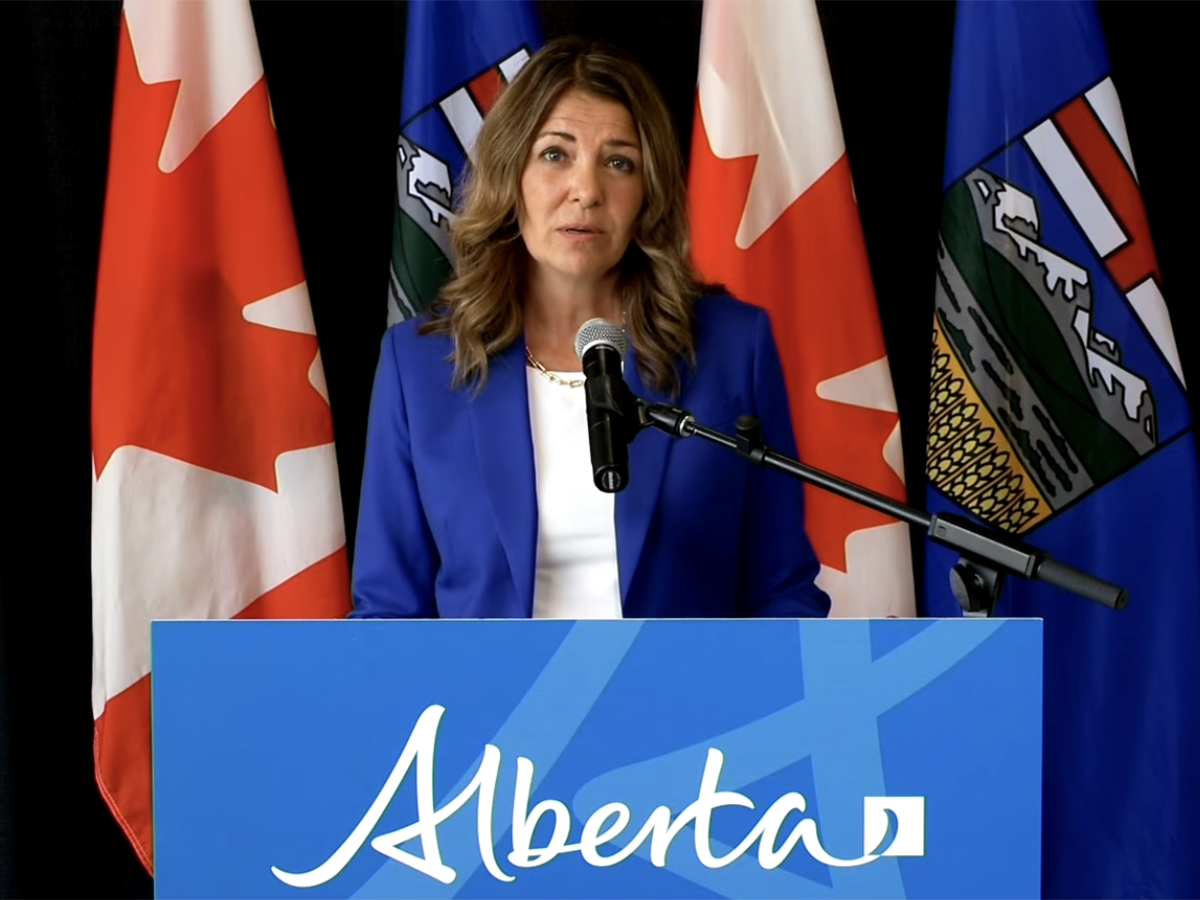
Alberta Premier Danielle Smith rejected the idea of using the province’s oil exports as leverage in the U.S. trade war, saying that such a move would “devastate the Canadian economy” and inflate energy prices for consumers across Canada.
The premier was responding to growing calls — including from Alberta NDP Leader Naheed Nenshi and former Alberta premier Jason Kenney — to consider using Canada’s energy exports to retaliate against U.S. President Donald Trump’s latest round of tariffs. But such a move, Smith said, would prompt the U.S. to slap fresh levies on everything from crude oil to natural gas to diesel, crippling eastern provinces like Ontario and Quebec that rely on the U.S. for much of their energy supply.
“I cannot think of a more disastrous policy decision than cutting off or taxing Alberta’s oil to the United States,” Smith said in prepared remarks on Wednesday.
Her warnings come as the U.S. trade spat has escalated sharply in recent days, with Prime Minister Mark Carney suggesting Canada is “at war” with its largest trading partner after the Trump administration placed punishing 50 per cent tariffs on $28 billion worth of goods. Smith, for her part, has long favoured what she calls a more measured approach to the U.S. that avoids ensnaring energy exports.
On Wednesday, Smith said she would prefer “de-escalating and doubling down on diplomacy” rather than adding new tariffs onto U.S. products.
“We need to be wise, patient, careful and deliberate to overcome the economic attacks our country is facing,” she said. “So, rather than making threats and promises we know we cannot keep, Canada should focus on what we can control and do.”
The Canadian and U.S. energy sectors are deeply integrated, with more than 80 per cent of Canada’s oil exports going to U.S. markets. Among the biggest buyers are oil refineries on the U.S. Gulf Coast, whose facilities are calibrated to accept Alberta’s heavy-grade crude, and who have for years enjoyed cheap Canadian supplies.
At the same time, a lack of east-west pipline connectivity in Canada has meant that eastern provinces are heavily reliant on the U.S. for crude and refined energy products. Energy products have thus far remained off the table in the Canada-U.S. trade tiff, largely because steep tariffs on Canadian oil would no doubt cause a politically damaging spike in U.S. gas prices for Trump.
Nenshi has not called on Alberta to curtail oil supplies to the U.S. but recently said in media interviews that Smith was “incredibly foolish” to attempt to take energy off the table in Canada’s retaliation plan. Kenney has similarly argued that Canada risked “limiting its options” by effectively eliminating a major bargaining chip.
Smith on Wednesday reiterated that Trump’s latest trade salvo against Canada has badly wounded relations between the two countries, saying there is “no excuse for their behaviour.”
“Make no mistake, the United States has betrayed a special trust between friends and allies,” Smith said. “We were there for them during 9/11, Afghanistan, and fought alongside them as we led the charge at Juno Beach on D-Day. We have fought their fires and welcomed them with open arms. We have built one of the most successful integrated economies on Earth, and defended it through NORAD and NATO together.”
While placing tariffs on oil exports would hurt the biggest producers of Alberta, Saskatchewan and Newfoundland, the move is particularly sensitive in Alberta, where voters are preparing to vote in an independence referendum this October.
Much of the resentment in the province is based on the perception among many Albertans that their oil and gas sector has been unfairly treated by Ottawa over the years, and federal negotiators’ use of their key export in the trade war would likely be seen as yet another attack.
National Post
Our website is the place for the latest breaking news, exclusive scoops, longreads and provocative commentary. Please bookmark nationalpost.com and sign up for our daily newsletter, Posted, here.

