



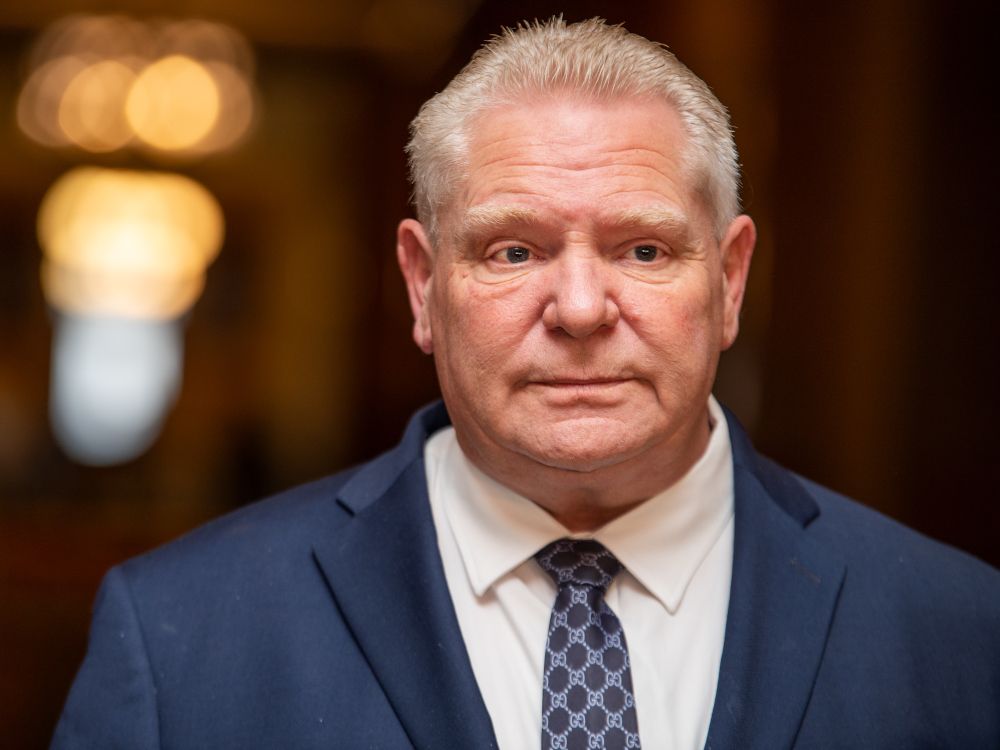
On Wednesday, Ontario Premier Doug Ford claimed that Canada’s politically appointed judiciary is
and that judges should be elected so that they are more responsive to the will of the people. His criticisms are absolutely warranted: judicial activism has run amok, causing demonstrable harms.
Ford’s comments were prompted by a recent legal battle over a law,
, that his government passed last November, to forcibly remove bike lanes on three major Toronto streets.
Biking activists
in December, arguing that the law violates cyclists’
Charter rights (“the right to life, liberty and security of the person”), and sought a preliminary injunction blocking enforcement until their case could be fully adjudicated in court.
There is a clear test for granting such injunctions: (1) the request must concern a serious issue; (2) the applicant must experience “irreparable harm” if the injunction is not granted; and (3) the benefits of the injunction must not outweigh any harm it causes to the public interest (this is known as the “balance of convenience”).
When the Supreme Court
, though, it emphasized that there is a strong public interest in respecting the authority of the legislative and executive branches of government.
Nullifying duly enacted laws erodes the separation of powers, so, ideally, this should only be done after a full hearing, especially if constitutional matters are involved. Overruling Parliament via preliminary injunctions is supposed to be reserved for “clear cases.”
Likewise, when determining a balance of convenience, judges are supposed to assume that duly enacted laws serve the public interest as intended. If this is not actually the case, that is only to be recognized in the final ruling.
With Bill 212, an Ontario Superior Court judge, Stephen E. Firestone,
that the activists had not met the “heavy burden” of demonstrating that sufficient harms or “a compelling overall public interest rationale” justified nullifying the provincial legislature’s authority.
He argued that, while removing bike lanes may irreparably harm some cyclists, “this is not a case where the applicants have no viable alternative means of transportation,” and that biking is a voluntary choice for the vast majority of people.
Regarding the public interest, he wrote that, “Toronto is a densely populated city with competing demands for road space,” and cycling represents only three to four per cent of all trips made within the city.
“The courts’ role on this interlocutory motion is not to second-guess the wisdom of the policy or to question whether it really serves the public interest. It is assumed to do so,” emphasized Firestone, correctly.
The case was then forwarded to another Superior Court judge, Paul Schabas, who, upon reviewing more evidence,
his predecessor had refused.
Deviating from
, Schabas explicitly denied that Bill 212 served the public interest and spent much of his ruling defending bike lanes and minimizing their trade-offs.
He utterly ignored Firestone’s concerns about whether the cyclists’ irreparable harms were inflated and defended the injunction due to what he claimed was a “competing public interest of encouraging cycling as a means of transportation.”
Putting things into perspective: a democratically elected provincial government was overruled by an unelected judge who seems poised to enshrine bike lanes as a Charter right.
Although voters expressed their preferences by giving a strong mandate to an anti-bike government, this judge paternalistically ignored them and decided that the more important public interest lies in encouraging more cycling.
I’m a cyclist who cherishes bike lanes and thinks that Bill 212 is asinine, but I sympathize with Ford. This issue should be resolved in democratic arenas, not through judicial activism and hastily fabricated Charter rights. Overreach is bad, even when it benefits you personally.
And this case is just the latest example of a judiciary run amok. Early last year, the B.C. Supreme Court used flimsy evidence and
to grant an injunction against a provincial law that would have outlawed public drug consumption. Apparently, smoking meth on sidewalks had, out of nowhere, become a Charter right.
Similarly, last December, Ontario Superior Court judge Michael Valente
that homeless people have a Charter right to sleep in encampments unless there is sufficient shelter space where open drug use is permitted.
The ruling seemed designed to coerce municipalities into adopting contentious homelessness and addiction policies without democratic buy-in, and was later indirectly criticized by Valente’s colleague, Judge James Ramsay, who noted, upon
on a similar case, that “micro-management by judges will not be productive.”
Amid rising judicial activism, Ford is right to call attention to the fact that all judges within Canada’s superior courts are appointed by the federal government. Although candidate lists are put together
, the feds nonetheless have the final say on who sits on the country’s most influential benches.
The impact here isn’t hard to discern:
and
, who discovered Charter rights for bike lanes and drug dens, were Liberal appointees, while
and
, who exercised judicial restraint, were Conservative picks.
Electing judges invites a different, equally serious,
and likely isn’t the answer, but something needs to be fixed.
National Post

