



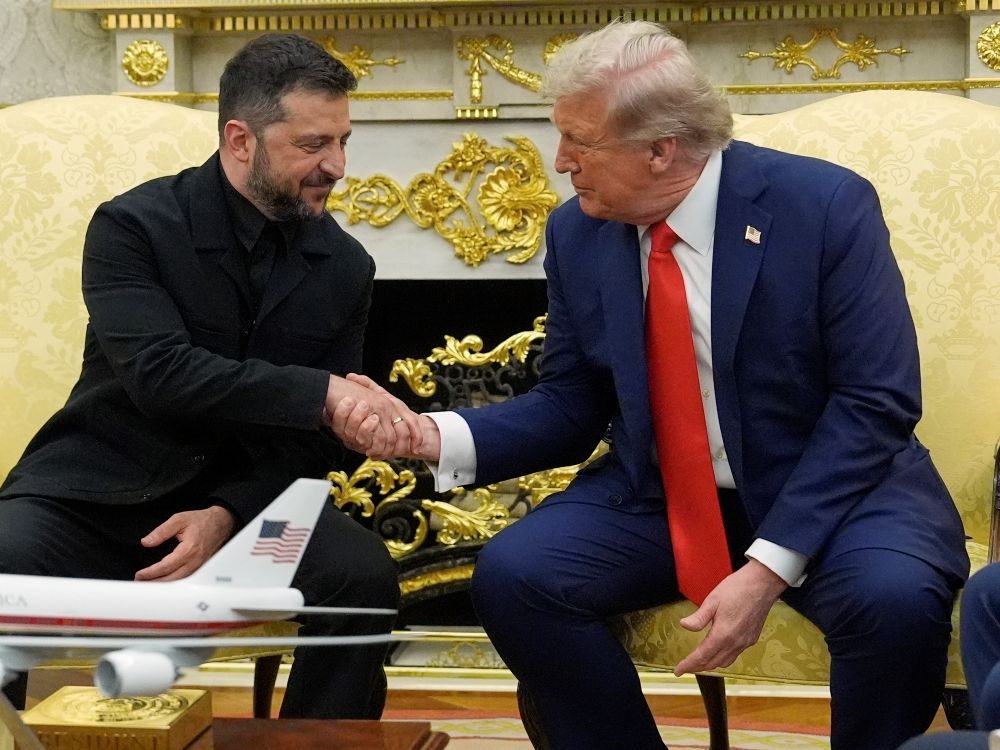
U.S. President Donald Trump is taking a
to Ukraine that emphasizes the return on investment for American taxpayers. While this has been seen by some as insensitive, it is ultimately a more durable way to safeguard Ukrainian sovereignty.
Initially, public support for Ukraine was grounded in a sense of moral obligation. The suffering inflicted by Russian forces (e.g. displaced refugees, massacred civilians, torture chambers, mass graves) was widely seen as intolerable in the West, which immediately granted allied governments the political capital they needed to send large volumes of aid to Kyiv.
But this framing faltered as the months and years grinded by. Westerners
, and desensitized to, the conflict. Some wondered: “Yes, this war is horrendous, but why is it relevant to me? I don’t live in Ukraine. There are so many other tragedies in the world, and I have my own problems here, too.”
There have always been myriad ways to
. One could point out, for example, that American aid to Kyiv never surpassed five per cent of the United States’ annual defence budget (a very modest price to pay for crippling a global adversary) and that Ukraine is an
for western military technology.
But pro-Ukrainian voices often, though not always, kept these arguments at the periphery of the debate. Many of them believed that appealing to the righteousness of their cause, and to the horrors of Ukrainian suffering, would be sufficient. Rather than persuade skeptics, they were prone to pass judgment on them instead.
These sentiments were, and remain, understandable: any normal person would want to put faith in humanity’s ethical impulses. Yet, the world is often an unjust place and getting desired results requires that we contend with people as they are, not as we would like them to be. As such, an overcommitment to moral arguments can be naive or counterproductive.
To the extent that Ukraine’s supporters make a practical case for helping Kyiv, they usually spotlight the global dangers of Russian expansionism. Yet, this risk has proven too remote, vague and speculative to resonate with many westerners, particularly North Americans. The eventual harms of Russian revanchism are difficult for many people to visualize outside of Eastern Europe. The current costs of sending billions of dollars to Ukraine are not.
As Ukraine fatigue grew, some voices pivoted to emphasizing the more immediate and country-specific benefits of helping Kyiv, which they positioned as being supplementary to the core goal of containing Russian aggression.
American civil society actors, for example, highlighted the fact that the majority of Ukrainian aid (
, according to the American Enterprise Institute) is actually spent within the United States’ borders or on U.S. forces. As Washington donates old weapons to Kyiv and then pays domestic companies for top-of-the-line replacements, this assistance could be accurately framed as a form of American
and
.
In Canada, some
,
and
have stressed that weakening Russia protects Canadian Arctic sovereignty. Both Moscow and Beijing want to dominate the Arctic to Canada’s detriment, so every dollar spent arming Kyiv today should produce defence savings in the future, all while buying Ottawa more time to rebuild its long-neglected military.
These messages seemingly have some resonance, but they have been insufficiently amplified, especially among political stakeholders. The Biden administration failed to truly foreground Ukraine’s value to American manufacturers, and Canada’s Liberals
leaned into the Arctic angle, for example.
Perhaps western governments are concerned that they will be perceived as “using” Kyiv, but there is no shame in mutually beneficial alliances.
Unlike his colleagues, Trump has few scruples about these optics. He has openly embraced transactionalism, most notably through his
and his new scheme to sell weapons to Ukraine using NATO as an intermediary (in lieu of further financial or military donations).
In doing so, he has been making the case (wittingly or not) for extending Ukrainian assistance, while addressing some of the resentments percolating in his political base. This seems to have paid off, with Republican support for arming Kyiv
over the past few months (though other factors likely contributed to this as well). While American aid to Ukraine has still decreased, that is better than no military assistance at all, which is what many Republicans seemed to want until recently.
Use of transactional narratives shouldn’t be limited to skeptical audiences, though.
Consider that, throughout the summer, Trump has bragged about an
wherein Ukraine will sell its drone technology — currently among the most advanced in the world — to the United States to modernize American capabilities. Canada is also
at joint production but, in contrast, has not really promoted the value of such a partnership and has emphasized moral commitments and
connections to the Ukrainian diaspora
, instead.
So Trump, for all his faults, turned drones into a broadly palatable selling point for Ukrainian allyship, while Canada, despite being a reliable friend of Kyiv, made no comparable pitch to its citizenry.
Given the fickle nature of public opinion and the omnipresent risk of
, it would be wise for pro-Ukraine stakeholders to copy some aspects of Trump’s approach, and to appeal to people’s self-interest rather than their unreliable moral convictions.
National Post

