



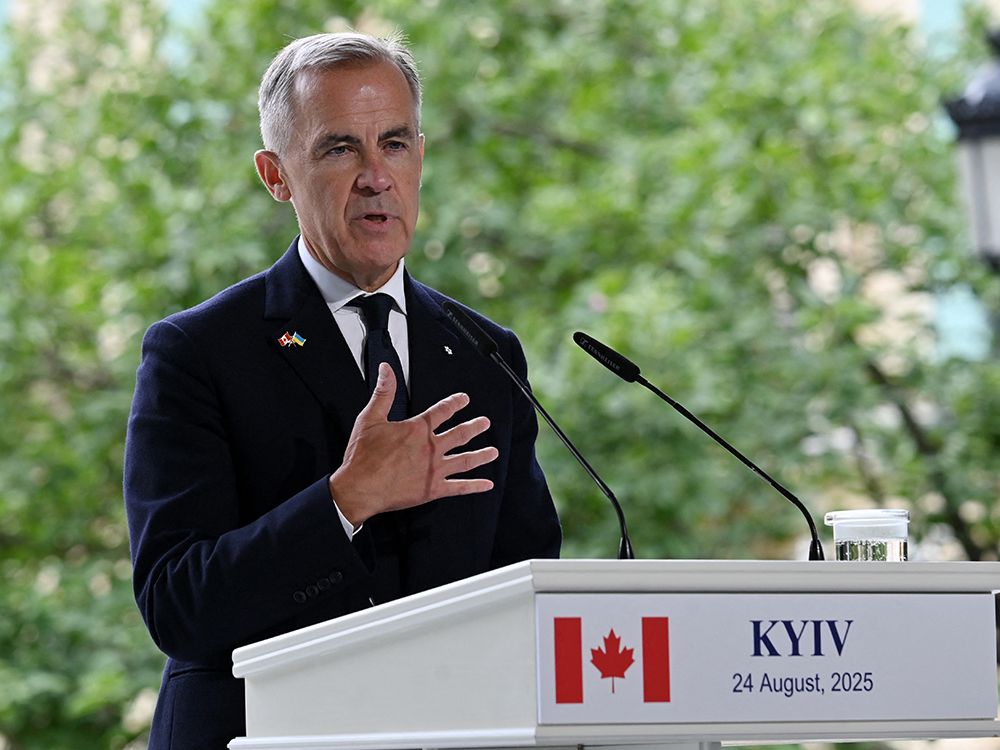
In a surprise visit to Kyiv on Sunday, Prime Minister Mark Carney gave further details of Ottawa’s latest military aid package to Ukraine and suggested that Canadian troops
to the country to enforce an eventual peace deal. Considering that Russian expansionism directly threatens Canadian interests,
, Carney’s firm support for Kyiv is both morally and strategically commendable.
Carney first announced this $2 billion aid package
at the G7 summit in Alberta but did not provide particulars at the time. However, during last weekend’s Kyiv trip, which coincided with Ukraine’s National Day of Independence, Ottawa
of how this money would be allocated.
$835 million will be spent on procuring critical equipment, such as “armoured vehicles, medical equipment, spare parts, small arms, ammunition, and explosives, as well as additional drone capabilities…” Although it is unclear to what degree this budget will go to domestic manufacturers,
that there will be
of Canadian industry.
Approximately $500 million will be spent on purchasing military equipment from the United States,
, with a focus on strengthening Ukraine’s air defences, presumably to keep Ukrainian cities safe from Russian bombing.
With respect to multilateral cooperation, $165 million will be spent on supporting Canada’s work in the
(a 57-country alliance that coordinates military aid for Kyiv) and $100 million will be spent on procuring ammunition and explosives from international partners through an initiative
organized by the Czech Republic
.
Finally, $220 million will be allocated for “drones, counter-drone and electronic warfare capacities,” which will include investment into joint ventures between Ukrainian and Canadian manufacturers. The co-production of this defence material will be governed by a new Letter of Intent,
signed by Ottawa and Kyiv on Sunday.
Collectively, these investments will increase Canadian military aid to Ukraine by roughly 50 per cent to
. This represents about a third of Ottawa’s overall Ukrainian aid — currently estimated at around $22 billion — with non-military support primarily taking the form of loans which Kyiv will have to eventually repay.
At a Sunday press conference, Carney further announced that Ottawa is working with international allies to explore how it can provide Ukraine credible security guarantees, which he
as being essential to regional stability: “We need not to trust and verify, but deter and fortify. And the fortification, the deterrence, is anchored in those security guarantees.”
The Prime Minister
that Ottawa does not believe that it is “realistic” to expect Ukraine’s military to deter future Russian aggression by itself, and that he “would not exclude the presence of troops” to “buttress” and “reinforce” Ukrainian forces in the aftermath of a peace deal.
Were such a deployment to occur, it would be done in partnership with the
, an informal alliance of Western nations. However, Carney also stated that he opposes attempts to exclude Ukraine from pathways to eventual EU or NATO membership, signalling an openness to more traditional instruments of collective defence.
Justifying his support for Kyiv, Carney referenced shared democratic values, calling attention to the
1.3 million people of Ukrainian descent
who call Canada home. But foreign policy shouldn’t be driven by diaspora politics, and shared values are insufficient grounds for expensive international entanglements. Instead, Carney should have tactfully, but explicitly, pointed out that Ukraine’s survival is also in Canada’s best interest.
For decades, Canada faced no substantial security threats, allowing its military to decay while sponging off protections provided by the United States. We became weak and complacent, and now our allies no longer consider us a credible voice on the international stage.
But the world is becoming a more dangerous place, generally speaking, and, among other things, military competition is
. Both Moscow and Beijing aspire to dominate the high north and are growing their military capacities accordingly, which may pose a threat to Canada’s sovereignty in the foreseeable future.
Ottawa has already grasped this grim reality, judging by the new
it published last year. Yet, securing the north will take incredible amounts of money and time — it will take
, and many years, to build a single icebreaker, for example. With adversaries like Russia and China, Canada will also inevitably require the support of larger allies to deter intrusions into its remote territories.
In this context, it is prudent to arm Kyiv today and, if the opportunity arises, to eventually send Canadian peacekeepers to deter further Russian revanchism in Eastern Europe. Undermining Moscow will give Ottawa more time to solve its arctic sovereignty problem, ultimately saving money (and possibly even lives) in the long run. It would also demonstrate to our allies that we are a reliable partner, making it easier for us to call for help in the future should we need it.
In the face of global instability and a looming northern threat, Canada is significantly increasing its defence spending to
(around $100-150 billion per year). Sending a few billion dollars in military supplies to Ukraine is a manageable investment when put into this perspective. Neither national defence nor international alliances are free.
By standing up for Ukraine, Carney is not only showing moral clarity, he is helping Canada become a stronger, prouder, more secure and, ultimately, more self-reliant player on the international stage.
National Post