


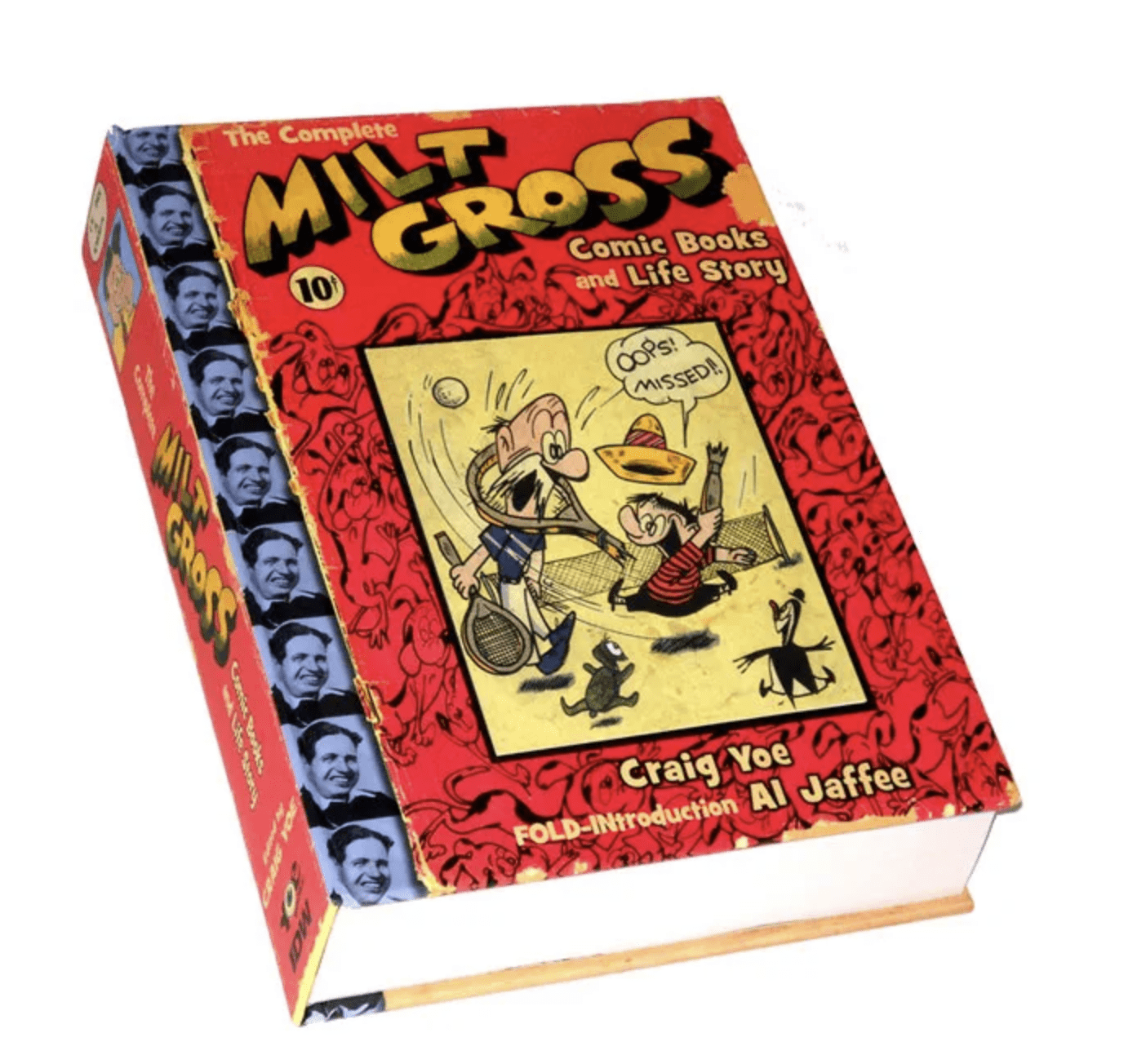

Every so often, my gaze will shift from politics to other topics. The most recent example occurred when I delved into the life and career of Milt Gross, one of America’s finest “screwball” cartoonists. While many contemporary readers may be unfamiliar with his body of work, this is a cartoonist that made us laugh and deserves to be remembered.
So, let’s step back from loonie politics and study the essence of screwball comics!
Gross and his screwball contemporaries – Rube Goldberg (Boob McNutt), George Herriman (Krazy Kat), Frederick Burr Opper (Happy Hooligan) and E.C. Segar (Thimble Theatre), among others – broke the artistic mold and tore apart the boundaries of conventional humour in the world of comic strips. His comic strip panels were creative, innovative, avant garde and a breath of fresh air.
This “subset of humour comics” was always an acquired taste, comics historian Paul C. Tumey acknowledged in his exceptional book, Screwball!: The Cartoonists Who Made the Funnies Funny (2019). At the same time, there’s “no doubt our world would be poorer without these outlandish, buoyantly funny comics.”
When it comes to Gross’s body of work, it’s still as funny as ever. The jokes and yuks du jour contained elements of creativity, simplicity and ingenuity that largely transcended time periods and societal acceptance of screwball comics.
“His trademark irreverence and his devil-may-care American absurdism may guarantee that his work—after staying fresh for decades—continues to be so for centuries, or at least as long as there are other cartoonists around to appreciate and savor it,” Françoise Mouly and Genevieve Bormes wrote in The New Yorker on Oct. 8, 2020. Gross didn’t emulate complex cartoonists like Richard F. Outcault (Hogan’s Alley), Winsor McCay (Little Nemo in Slumberland) and Johnny Gruelle (Mr. Twee Deedle). He preferred simple, straightforward gag-a-day cartoons and Sunday strips, albeit with a few lavish twists. He drew inspiration from Surrealism and Cubism. He created outlandish characters. He appreciated the use of dream sequences. He utilized bizarre geometric angles for people, places and things, too.
Gross Exaggerations: The Meshuga Comic Strips of Milt Gross, edited by Peter Maresca, is one of the more engrossing examinations of the brilliant screwball cartoonist. Not only was he a talented artist, but he also had a magnificent way with words. Memorable lines like the non-sequitur “Banana Oil!” and catchphrase “Iggy, keep an eye on me!” became part of the American lexicon. His regular use of “Yinglish,” a combination of English words with a Yiddish subtext, made him one of the world’s most important Jewish cartoonists at the time.
Author/cartoonist Ivan Brunetti summed up Gross rather succinctly in his essay in Maresca’s book, “Genius can manifest itself in two ways: the unfathomably complex, and the unfathomably simple. Milt Gross belongs to the latter category.” Gross’s main goal as a cartoonist was therefore to amuse readers in the wildest, craziest fashion imaginable.
Tumey’s newest project, the first volume of The Art of Milt Gross (2025), focused on the screwball cartoonist’s early and long forgotten work in Judge, Nize Baby, Banana Oil, Hitz and Mrs. and more. The historian discovered that some of it had been recycled. “What has not been realized – until now – is that tucked into these Judge pages are the first versions of gags Gross would later redraw in his newspaper comics.” There were other sides to this complex cartoonist, too. While Gross was “widely regarded as a pull-out-all-the-stops, widely scrawling, screwball cartoonist,” Tumey found examples of his work that displayed “a witty, perfectly executed, straight-faced poke at the business world’s absurd militaristic hierarchy and gravely serious self-regard.”
It was already known that Gross’s work in animated films, magazines (Judge, Ken, Life) and comic strips (Jack Bull, Frenchy) showed early glimpses of his genius. A significant career moment occurred in his short-lived strip, Hitz and Mrs. “Gross tacked on an extra non-sequitur standalone panel labeled ‘Applesauce,’” cartoonist Mark Newgarden wrote in Screwball!, “which was shortly upgraded to ‘Banana Oil’ (both connoting bullshit).” Banana Oil ran as a daily strip between 1923-25, and was then used as a topper on two of Gross’s Sunday strips. The plots were always crafted in the same fashion. A particular situation started out in one direction, went off into a completely different direction which was clearly a lie, and ended with the non-sequitur.
Gross developed other successful strips, including Nize Baby, Count Screwloose of Tooloose and Dave’s Delicatessen. Each of them followed the beloved screwball comics style of exaggerated characters, situations, themes and wacky humour. There were also malapropisms in either English, Yiddish or both. Gross wasn’t the first cartoonist to use Yinglish in a mainstream comic strip – Harry Hershfield’s Abie the Agent holds that distinction – but he was certainly the most successful.
Gross died in 1953 after a heart attack at age 58. He had “produced so much work,” Tumey wrote in Screwball!, that “one pictures him creating in a blurred pinwheel of hands, sweat drops, and dip pens.” The work he produced was remarkably clever and funny, had moments of corniness and pure foolishness, and was certainly a product of its time with less than salient portrayals of African Americans, attractive women and the infirmed. But it was highly original and creative, and opened the door to greater understanding of how languages like Yiddish could become a permanent fixture in the English vernacular.
Dis screwball ting was very nize, Miltie. Very nice, indeed.
Michael Taube, a longtime newspaper columnist and political commentator, was a speechwriter for former Canadian prime minister Stephen Harper.

