


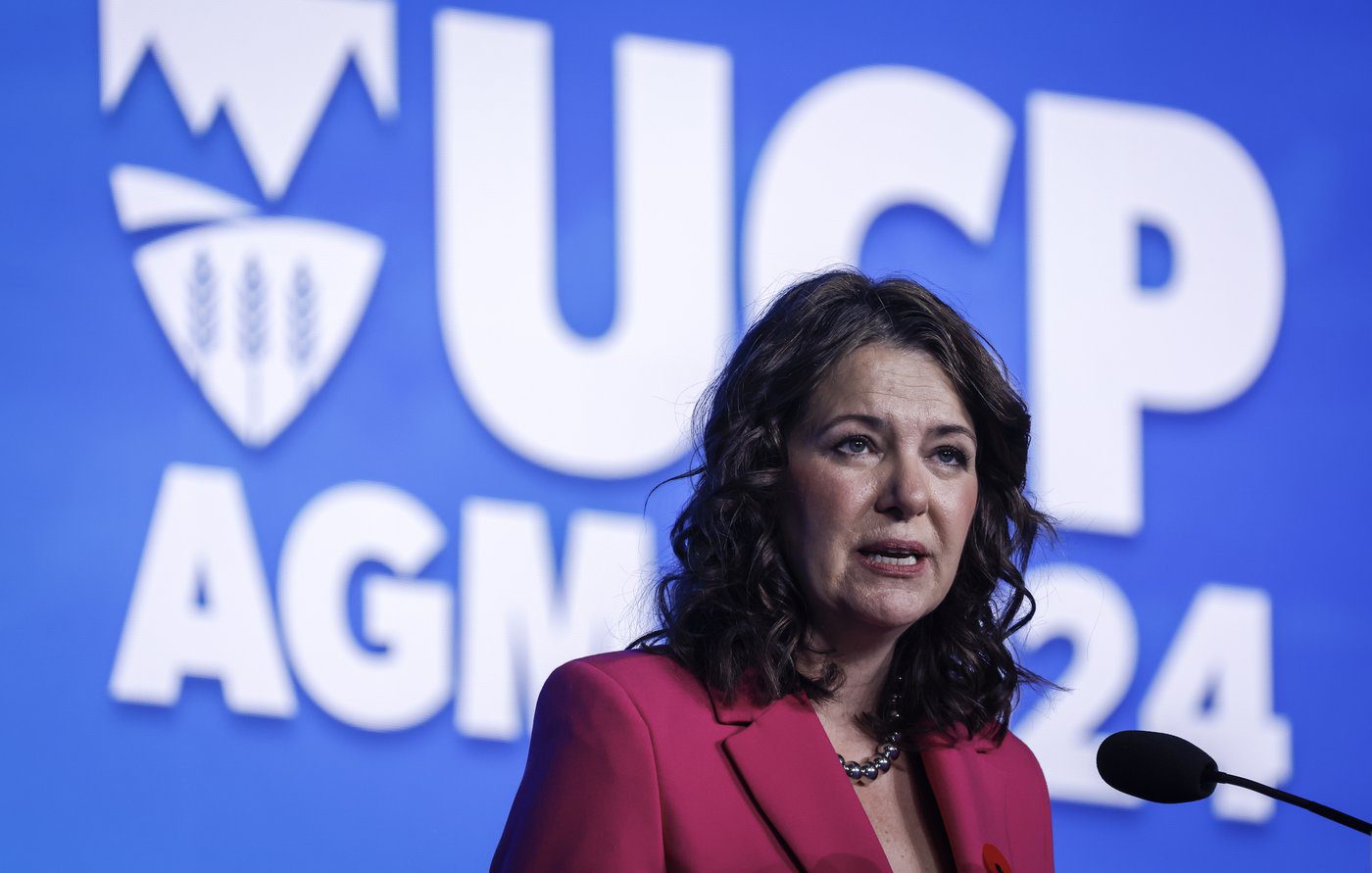
EDMONTON — Alberta’s governing United Conservative Party is gathering this weekend for the first time since an independence referendum divided the province, opened internal party cracks and led to a high-profile member’s expulsion.
Premier Danielle Smith says she hopes to leave the issue of separatism in the rear-view mirror and have her UCP regroup to win next year’s provincial election.
But prominent separatist leader Mitch Sylvestre says Smith may need to quell frustration from disappointed members of the independence movement.
More than 7,000 UCP members are registered to attend its annual general meeting Friday through Sunday in Calgary. They are set to vote on policy, a board of directors, and hear from Saskatchewan Premier Scott Moe and newly elected British Columbia Premier Lorne Doerkson.
Smith has said spokespeople for the party must accept the results of the Oct. 19 referendum. About 75 per cent of voters said they want the province to stay in Canada and not to hold a second, binding referendum on leaving the country.
“We think it’s really important from a credibility point of view,” the premier said Tuesday.
“I hope at the end of that, we emerge united. Because the whole preparation for this (annual general meeting) is prepping for the next election.”
That includes developing a party platform to put to voters for the general election, set for Oct. 18, 2027.
It has been a challenge for conservative movements to find unanimous agreement, Smith added.
“We can either focus on the things that drive us apart, or we can focus on the things that draw us together,” she said.
Party officials sent a letter last month to board candidates, and later to constituency presidents, asking them to make a pro-Canada pledge.
After at least 15 dozen refused to sign, calling it an affront to their freedom of expression, Smith said that she hoped to speak with them directly to persuade them otherwise.
Sylvestre said Wednesday he believes the number of holdouts is significantly higher. And he said he hasn’t spoken directly with the premier since constituency presidents were asked to sign the pledge.
“This weekend is going to be a very interesting weekend,” he said.
He added that it’s difficult to gauge how large a contingent of independence supporters will attend or how they might react to the premier.
“I think that people are frustrated. I don’t have any idea what’s going to happen.”
The party, long dedicated to empowering grassroots members, stripped separatist leader Jeffrey Rath of his membership last month, citing code of conduct issues — a decision Smith has said she supports.
Rath served as a lawyer for the group that collected roughly 300,000 signatures on a petition calling for a binding separation referendum.
The ouster means Rath can’t attend this weekend. At the meeting last year, when he went to the mic and asked the crowd who supported independence, he was met with roaring applause.
Sylvestre, who spearheaded the separatist petition, is the constituency association president for Bonnyville-Cold Lake-St. Paul, and he signed the letter opposing the UCP’s code of conduct.
He said Rath was ejected to prevent a repeat of that public show of support.
“They want the independence movement out of the party, and that’s what they’re trying to do.”
He said much of the battle ahead will be pushing for Smith’s government to make good on other promises she has made to her supporters.
Sylvester said he believes one example is taking steps to pull out of the Canada Pension Plan in favour of a provincial fund in order to unite the party.
Smith previously shut the idea down, saying it doesn’t have popular support in Alberta.
Members of the separatist movement have also criticized Smith for publicly endorsing to remain in Confederation and not offering a binding referendum on the issue.
“If they’d done what they said they were going to do, then we wouldn’t even be having this conversation,” Sylvestre said.
On Saturday, members are to vote for the party’s board of directors, a ballot Sylvestre said is “massively important.”
“The party board actually is supposed to represent the membership. That’s its job,” he said. “We’re seeing that the government is not representing its members very well right now.”
When candidates spoke to members at a virtual town hall last weekend, the issue of party unity dominated and many anchored their pitches to the goal of defeating the Opposition NDP.
Vince Byfield, a candidate a board vice-president position, said the referendum “cost us members on both sides.”
He’s challenging incumbent Patrick Malkin, the deputy chief of staff in Smith’s office. Malkin is part of a slate of candidates dubbed “Team Unity,” believed by some to be Smith’s set of preferred candidates.
While several candidates emphasized bridging divides, candidate Rob Anders, a former Conservative member of Parliament, said the board ought to push back on governments that go “offside” of the membership.
Members are also to debate resolutions that could affect a wide range of government policy, from land acknowledgments to laws impacting transgender people’s access to washrooms and change rooms.
Adopting separatism as party policy isn’t on the floor for debate.
Policy resolutions approved at these meetings are not binding on the government, but many have been adopted by Smith and passed into law.
This report by The Canadian Press was first published Nov. 26, 2026.
Lisa Johnson, The Canadian Press