


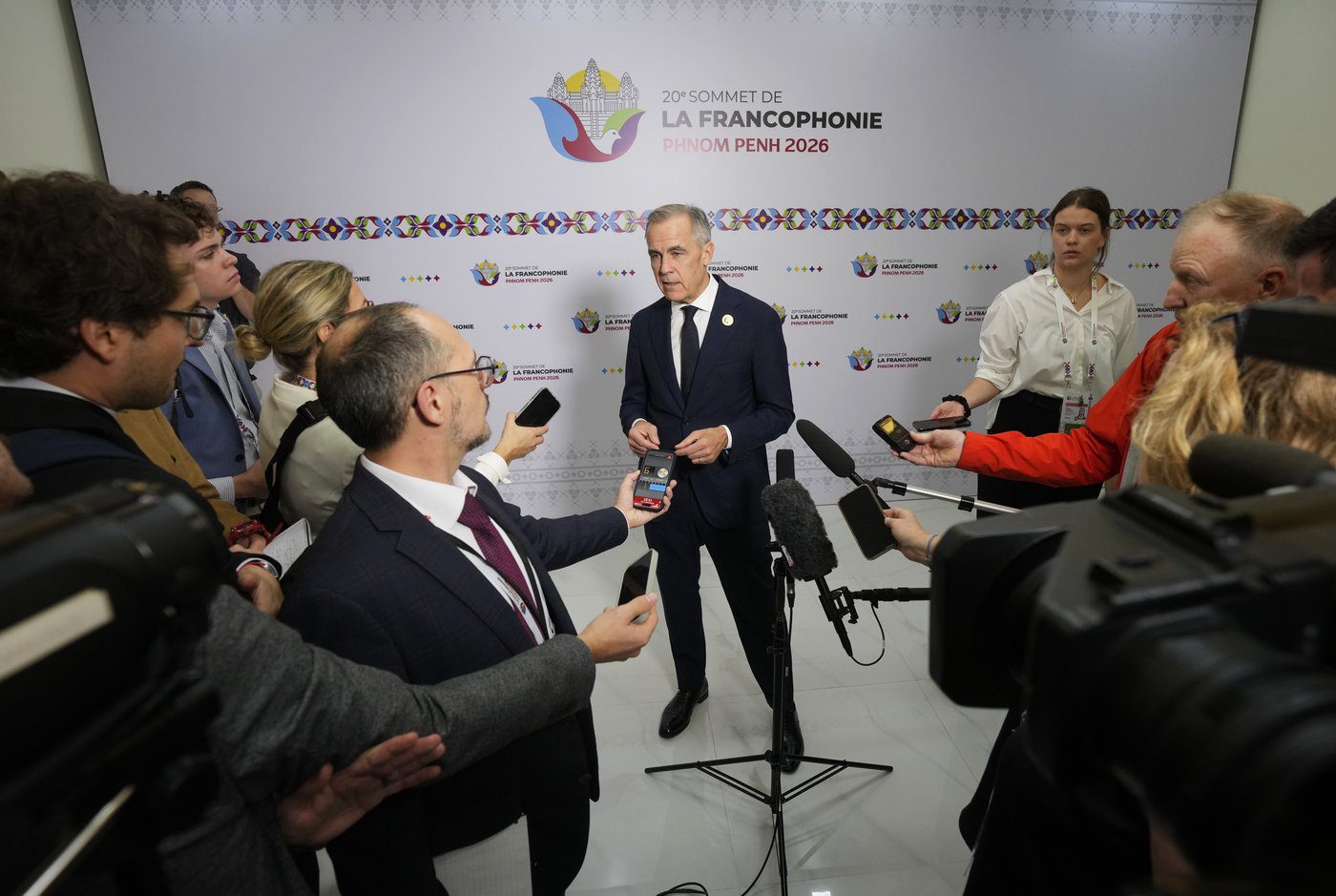
PHNOM PENH — Prime Minister Mark Carney is travelling to China today, where he is set to meet with Chinese President Xi Jinping and leaders from across the Pacific Rim.
Carney is leaving the Francophonie summit in Cambodia and travelling to Shenzhen, China’s tech hub, for the Asia-Pacific Economic Co-operation summit.
He is scheduled to meet with Xi at a time that will be Tuesday morning in China but late Monday evening in Ottawa. Carney said Canada could do more with China in terms of agriculture, clean and conventional energy, and financial services.
“We’ve established pretty clear guardrails on the areas that we’re going to focus on … I’m using our words, not theirs,” he told reporters in Phnom Penh.
Carney also expects to speak with Xi about “the evolution of the international system, China’s role in that and Canadian priorities.”
An overarching topic will be Chinese investments into Canada’s auto sector. Both countries agreed earlier this year to allow a limited amount of Chinese electric vehicles into Canada.
Carney has said he wants Chinese carmakers to set up shop, but only if they provide decent jobs, saying he is wary of plants where workers assemble cars using components mostly made in China.
He said trade talks with Washington will shape how Canada approaches Chinese investment.
“It’s part of the trade negotiations,” he said. “Depending (on) where that settles, there’ll be other options — European options, Asian options.”
“This is not leverage, but you know, action-reaction. It depends.”
Carney will also meet with various leaders from the APEC forum, a group of 21 economies on both sides of the Pacific that work together to break down trade barriers. The grouping includes members as varied as Taiwan, Australia and Peru.
Carney’s office says he will stick with his focus of drumming up more investment and diversifying Canadian trade.
Vina Nadjibulla, co-founder of the Centre for Strategic Statecraft, said she’ll be watching to see whether Carney allows more Chinese investments into Canada “in critical sectors, in energy and technology, particularly related to renewables and batteries” in addition to auto manufacturing.
“We have to constantly triangulate our relationship with China with our discussions with the U.S. — and also watch then what happens between the U.S. and China bilaterally,” she said.
Nadjibulla also said the summit should help craft the foreign policy review that Carney aims to table in the House of Commons in the coming weeks, as well as next year’s planned renewal of the 2022 Indo-Pacific strategy launched by his predecessor Justin Trudeau.
“We now have a really solid foundation,” Nadjibulla said, noting that leaders from Asia have visited Canada or are planning to, notably Vietnam and India.
“Canada is finally on their radar and has relevance to their own diversification agendas and their own economic security and resilience agendas.”
She said any update to Ottawa’s regional strategy must include a look at relations with Taiwan, a self-governing island which China claims. The federal cabinet has left a trade arrangement sitting unsigned for more than a year, despite the House foreign-affairs committee urging that government proceed with more economic relations.
During the APEC summit, U.S. President Donald Trump is set to meet President Xi and Russian President Vladimir Putin.
That has raised alarm among European officials, as some suggest U.S.-brokered peace talks between Russia and Ukraine have included proposals they say would leave both Ukraine and Europe vulnerable.
Carney said Brazilian President Luiz Inacio Lula da Silva recently told him that he encouraged the talks in order to end the war. Carney said Canada wants a just peace for Ukraine and a ceasefire is needed.
Nadjibulla said it’s incredible the trilateral meeting might happen, adding that it reinforces Carney’s warnings about “unconstrained great-power politics” in his January speech at the World Economic Forum in Davos.
“It’s a reminder that other countries need to double down on their efforts to build resilience and agency, so that they don’t become collateral — so they don’t end up on the menu of great-power competition, but rather have a seat at the table,” she said.
China has indicated great enthusiasm for Carney’s visit. The state-controlled English-language newspaper Global Times has framed it as a mutually beneficial partnership in a turbulent world.
“The ability of China and Canada to address previous trade frictions through calm and equal-footed dialogue not only helps strengthen bilateral strategic mutual trust, but also injects confidence into global economic and trade co-operation,” said Zhao Xingshu of the Chinese Academy of Social Sciences, according to the newspaper.
“Nearly eight years of limited high-level exchanges mean rebuilding mutual understanding between officials and institutions will require time. At this stage, maintaining the momentum of stabilization in bilateral relations is itself an important and realistic objective.”
The APEC summit takes place in Shenzhen, which borders Hong Kong, where Canada has repeatedly expressed concern about growing repression as the territory transitions from semi-autonomy to full Chinese rule.
Earlier this month, Canada joined western peers in condemning 10-year sentences for politicians and democracy activists under national-security laws, particularly Joshua Wong.
“We call for an immediate end to all unjust prosecutions of individuals charged under the (national security law),” the joint statement says.
It urges Chinese leaders to “uphold their international commitments and honour the rights and freedoms guaranteed to the people of Hong Kong” when the British government ceded sovereignty.
Carney has said he raises human rights issues privately with China but avoids public criticism.
This report by The Canadian Press was first published Nov. 16, 2026.
Dylan Robertson, The Canadian Press